
Best Cam Sites Right Now — Our Picks





DxLive has been running since 2002, which its copyright line states plainly, and it publishes the most complete per-mode rate card of any platform covered on this site. Every connection option is priced in points, on a public FAQ, with no account required.
It is a Japanese cam site serving an English-language front end, and that combination produces both its main strength and its main weakness. This DxLive review covers what the site publishes openly, and where the transparency stops short.
Short version: DxLive prices every connection mode openly, then never says what a point is worth in real money.
- What it is: a Japanese live cam site, online since 2002, with an English front end.
- Pricing: eleven modes priced individually, starting at 1.2 points per minute.
- The catch: the point price itself is not published in any currency.
- Best for: visitors who read Japanese.
- Weakest point: profile text and performer status lines stay in Japanese.
How much does DxLive cost?
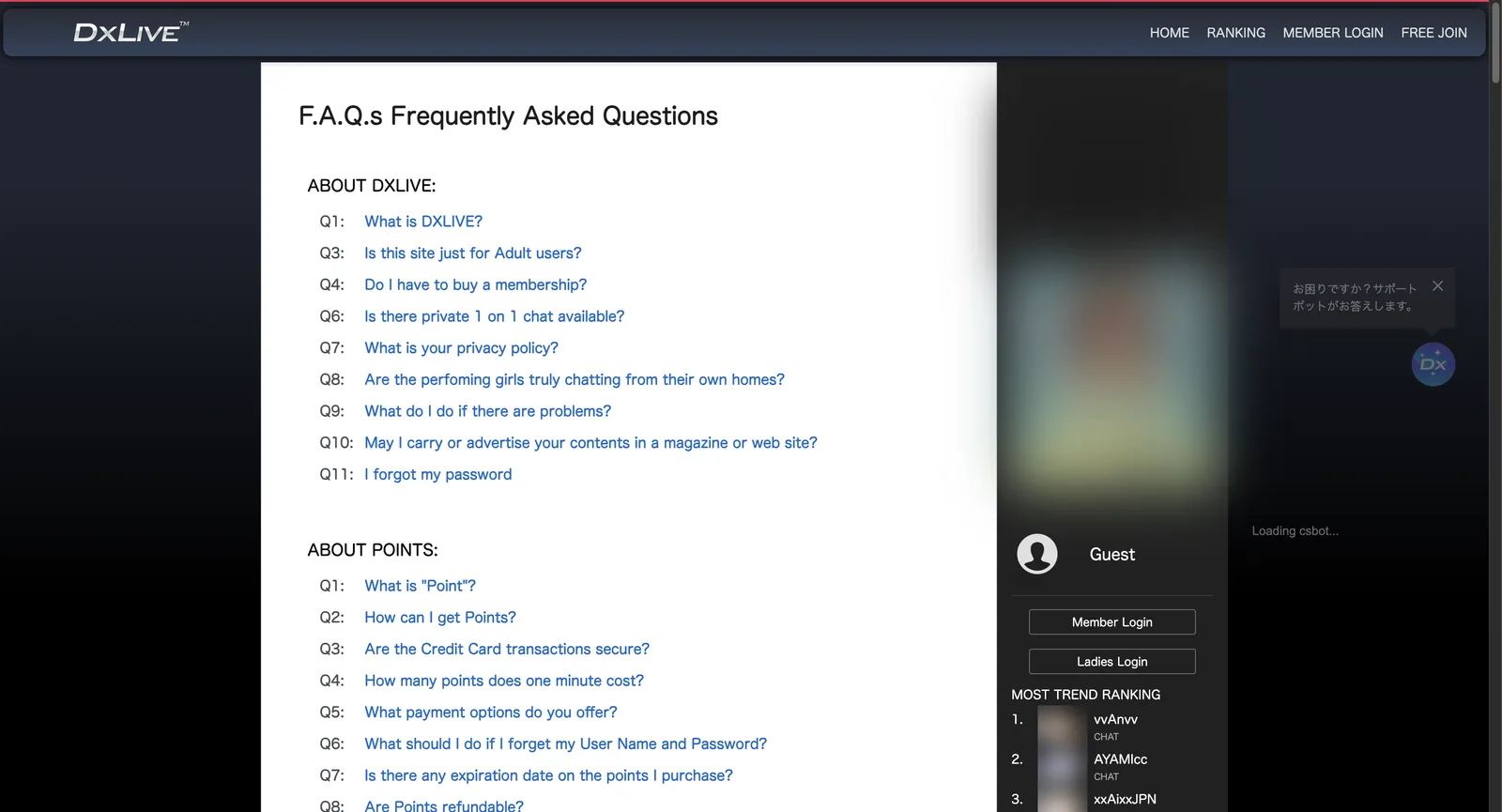
The FAQ answers the cost question with a full tariff rather than a single number. The basic charge is 1.2 points per minute for both peeping mode and chat mode. From there the options are priced individually:
- 2SHOT private chat at 1 point per minute, for exclusive one-to-one access.
- 2WAY chat at 1 point per minute, which turns on your own camera.
- 2SHOT private plus 2WAY combined at 2 points per minute.
- Remote toy usage at 1 point per minute, or 2 points for controlling two toys at once.
- Secret messages at 1 point per message.
- Gifts in four fixed denominations: a teddy bear at 3 points, a flower at 5, a gift at 10 and a heart at 15.
That is eleven separately priced things published on a page anyone can read. For comparison, Visit-X publishes none of its prices at all, and most platforms in this reference publish one rate if they publish anything.
How DxLive’s rates add up
The options stack on top of the base rate rather than replacing it. Basic chat costs 1.2 points per minute, while adding exclusive private access costs 1 point per minute, so a private two-way session runs the base 1.2 plus the 2-point combined option.
Publishing the components separately lets a buyer work that out. It also means the cheapest way to watch and the most expensive way to interact differ by roughly a factor of three, which a visitor can establish before spending anything.
What is a DxLive point worth?
DxLive never states what a point costs in yen, dollars or any other currency. The FAQ describes point packages with volume bonuses, says the more you buy the more bonus you receive, and never gives a figure. The familiar gap applies here, though less severely than usual.
So the tariff is internally complete and externally unconvertible. A visitor knows a private two-way minute costs roughly three times a plain chat minute, and cannot turn any of it into money without registering.
What the FAQ does publish about points is unusually candid in two respects:
- Non-refundable. Points cannot be returned once purchased.
- Expiry after 24 months. Points lapse if you do not spend at least 0.1 point within that window.
Both are terms most platforms bury. Stating an expiry rule with a precise threshold and window, on a public FAQ, is the opposite of burying it.
DxLive payment methods and processors
The FAQ names everyone involved in taking your money:
- Cards accepted: Visa, Mastercard, JCB and Diners Club.
- Transactions: handled by DTI Services.
- Customer support: operated by Allbright Information Services, Inc.
- Security: payments run over SSL.
Naming a payment processor and a support operator is rare. It gives a customer somewhere to escalate that is not the platform itself, which is exactly what you want when a payment goes wrong.
DxLive performer profiles and session history
Each profile publishes a seven-day session history rendered as a grid, with the days down one side and the hours from 1 to 23 across the top. It shows when that performer actually streamed over the past week rather than when she says she will.
That distinction matters. A stated schedule is an intention; a session history is a record. Thuis.nl publishes a comparable hour-by-hour grid and StudioHotline publishes fifteen-day histograms, and DxLive belongs in that small group of platforms willing to show a visitor what actually happened.
Profiles also publish a precise last-login timestamp to the minute, a favourites count, languages spoken, age, bust size, hometown prefecture and a free-text line about what the model usually does. There is an HD indicator on some tiles and a mobile-broadcast icon on others.
Live online count and site controls
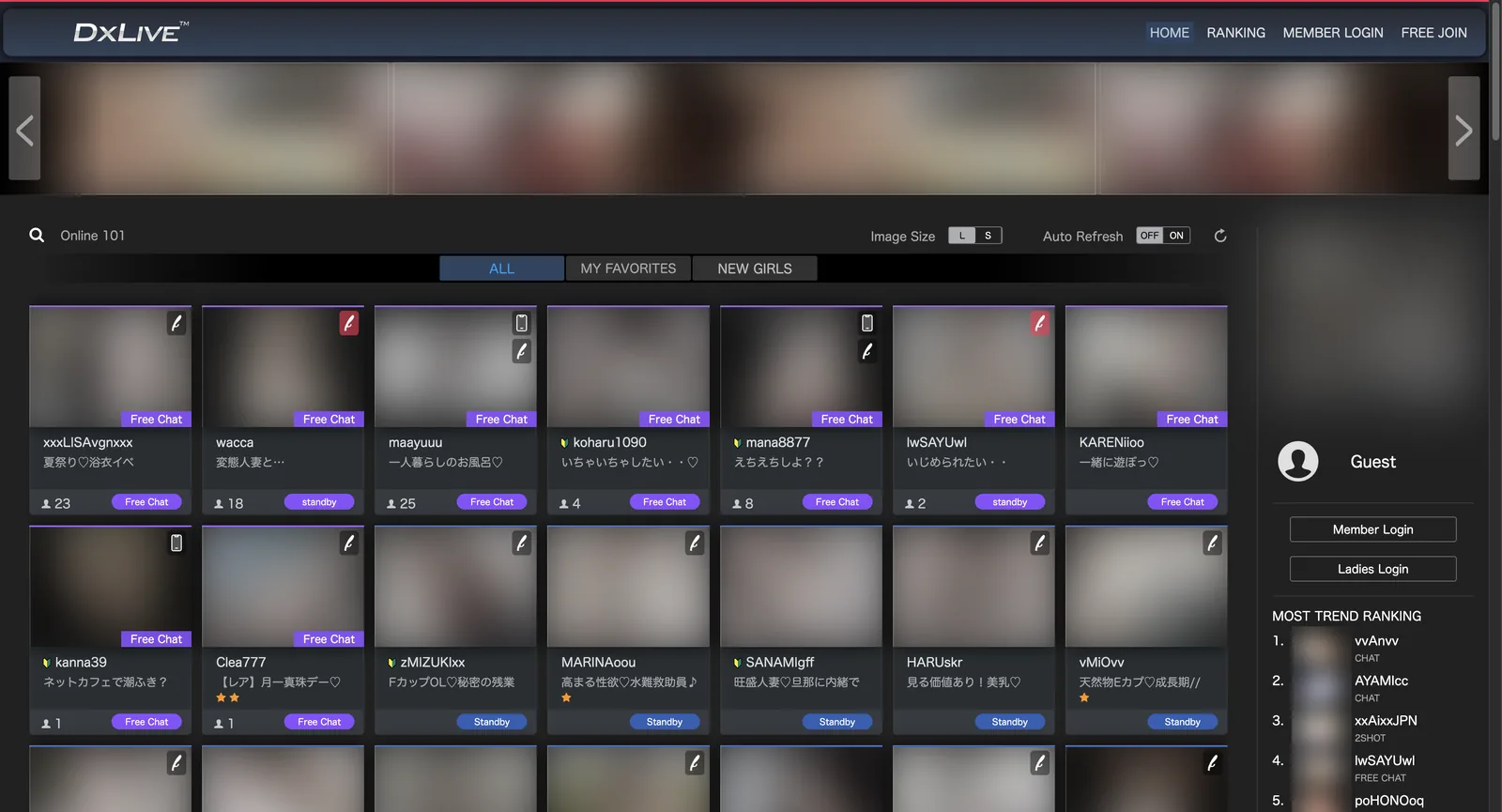
The grid header publishes a live online count, showing 101 at capture, and offers an auto-refresh toggle plus an image-size control. Per-tile viewer counts run from 1 to 25, which is a plausible spread for a platform of this size and considerably more active than several larger-claiming cam sites in this reference.
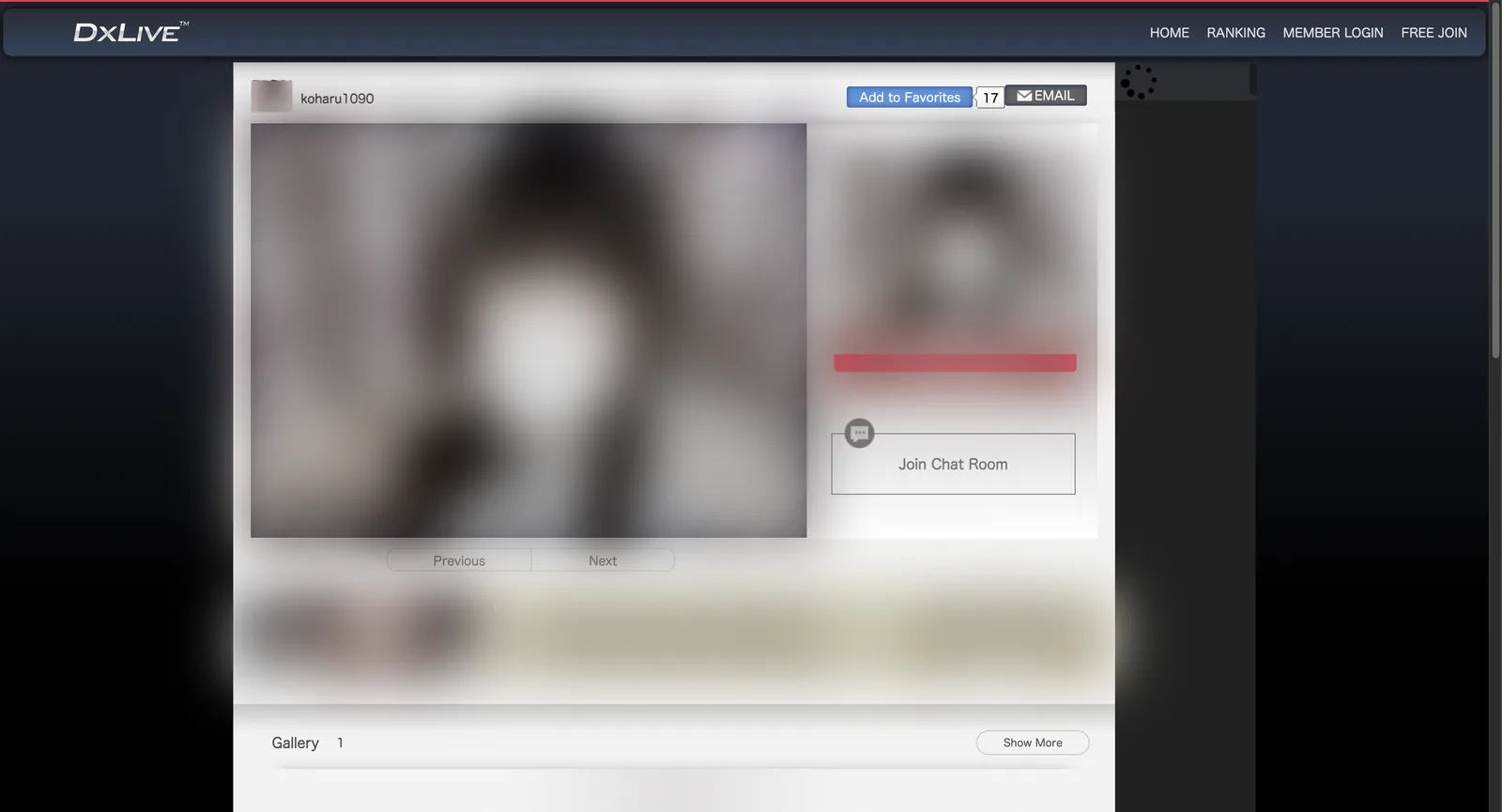
Tiles carry status badges distinguishing free chat from standby, plus icons marking mobile broadcasting and other capabilities, and the roster of cam girls splits into all, favourites and new girls.
Is DxLive safe and legally compliant?
The policy set is unusually complete for this category. The footer carries a 2257 Record-Keeping Requirements Compliance Statement, a Privacy Policy, Terms and Conditions, a Human Rights Policies link, a California Privacy Notice and a Content Removal route, alongside FAQ, Contact us and an affiliate program.
Two of those stand out. A human rights policy as a named document is uncommon in this category. A content removal route as a first-class footer link matters more, because it is the mechanism a person uses when material involving them needs to come down.
The footer also discloses sibling properties under a Discover heading, naming three other adult brands. Publishing network relationships rather than hiding them is the right behaviour, and it is the opposite of the undisclosed white-label arrangements found elsewhere in this reference.
What DxLive does not disclose
No operating company appears for DxLive itself. Allbright Information Services is named as running customer support, and DTI Services as handling transactions, but the entity behind the platform is not stated, nor is any address or jurisdiction.
Is DxLive usable in English?
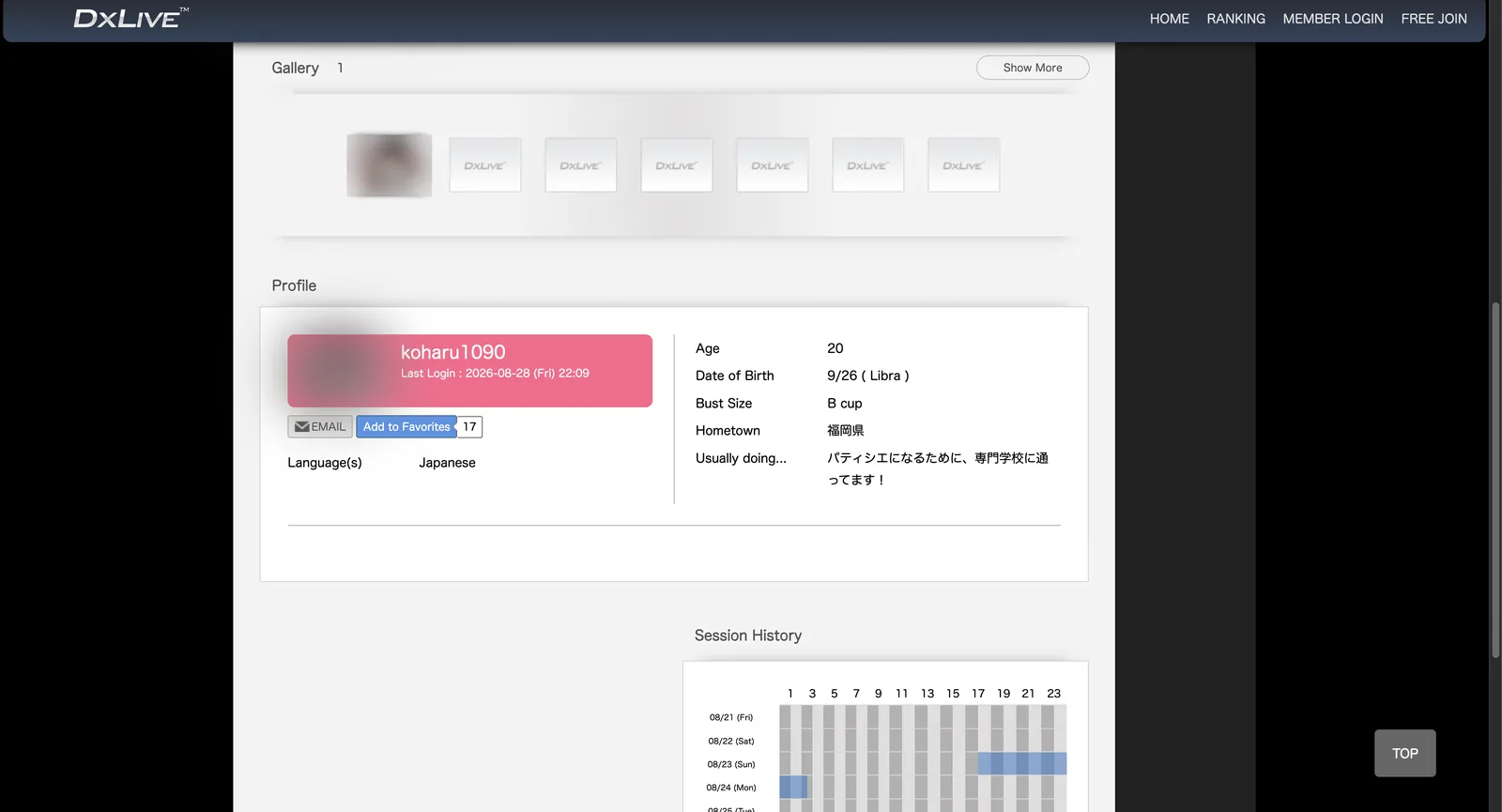
Partly. The English front end is real but thin. Profile fields render in English while their values often do not: the hometown field returns a Japanese prefecture in Japanese characters, and the free-text description is Japanese only. Every performer status line on the grid is in Japanese.
The FAQ itself is fluent but slightly dated in phrasing, and the profile examined listed Japanese as the only language spoken. An English-speaking visitor can find their way around the site, understand the pricing and read the policies, but cannot read what most performers have written about themselves and may not share a language with them once connected.
DxLive pros
- Eleven separately priced options published on a public FAQ with no account.
- A stated basic rate of 1.2 points per minute for chat and peeping.
- A published point expiry rule with a precise threshold and window.
- An explicit non-refundable statement rather than a buried clause.
- Named card networks, plus a named transaction processor and a named support operator.
- A seven-day session history grid showing when performers actually streamed.
- Last-login timestamps published to the minute.
- A live online count with per-tile viewer numbers in a plausible range.
- A full policy set: 2257 statement, human rights policy, California privacy notice and content removal route.
- Disclosed sibling properties rather than hidden network relationships.
- Operating since 2002, stated in the copyright line.
DxLive cons
- No point price in any currency, so the entire tariff is unconvertible.
- No operating company, address or jurisdiction named for the platform itself.
- Profile values remain in Japanese even on the English front end.
- Performer descriptions are Japanese only.
- Language barriers are likely for English-speaking users.
- No ratings or reviews of performers.
- No revenue share or payout terms published.
Verdict: is DxLive worth it?
DxLive publishes a better rate card than almost anything in this reference. Eleven priced options, a stated basic rate, an expiry rule with a real threshold, a non-refundable warning, and three named third parties handling money and support. That is a platform behaving as though customers are entitled to read the terms before agreeing to them.
It then withholds the one number that makes the rest usable. Without a point price, a complete eleven-line tariff tells you the shape of the pricing and nothing about its size. The gap is smaller than Visit-X, which publishes nothing, and larger than it needs to be for a site that clearly does not mind explaining itself.
For an English-speaking visitor there is a second consideration. The interface translates; the content largely does not. Someone who reads Japanese gets a well-documented live cam platform with twenty-four years of history, honest session data on every model, and a strong policy set. Someone who does not gets a clear tariff attached to profiles they cannot read.