
Most of the AI companion and erotica tools I test are built for people who want something quick and easy. DreamGen is not that. It is a serious creative-writing platform aimed at people who want to build worlds, run long roleplays, and shape stories with real control, and it runs on models the team trains itself specifically for fiction. Spend five minutes in it and you can tell it was made by people who care about the craft of a scene, not just about getting to the spicy part.
Top AI Girlfriend Platforms — Our Picks

Hyper-realistic AI companions with adaptive memory that recall your past conversations.


Build a custom AI companion and bring her to life with chat, images, and video.

Create a custom AI girlfriend with her own personality, generated images, and ongoing chat memory.


Characters that hold memory and context, so the relationship builds over time instead of resetting.

Chat with a fully custom AI girlfriend — choose her personality, outfits, and more.

Personalized AI companions for ongoing roleplay, with a simple, discreet signup.

Build a custom AI girlfriend, boyfriend, or anime character — choose the look and personality.

Customizable AI girlfriend personalities with realistic, ongoing conversations.
I spent an afternoon with it, ran a roleplay, dug through the scenario editor, and poked at the image generator and the plans. The short version is that the writing quality is excellent, the depth is genuinely impressive, and the learning curve is real. This is the most powerful tool in this batch of reviews, and also the one most likely to overwhelm someone who just wants to type a prompt and read a story. If you are a writer or a roleplayer who wants an engine rather than a toy, it is worth your time.
What DreamGen actually is
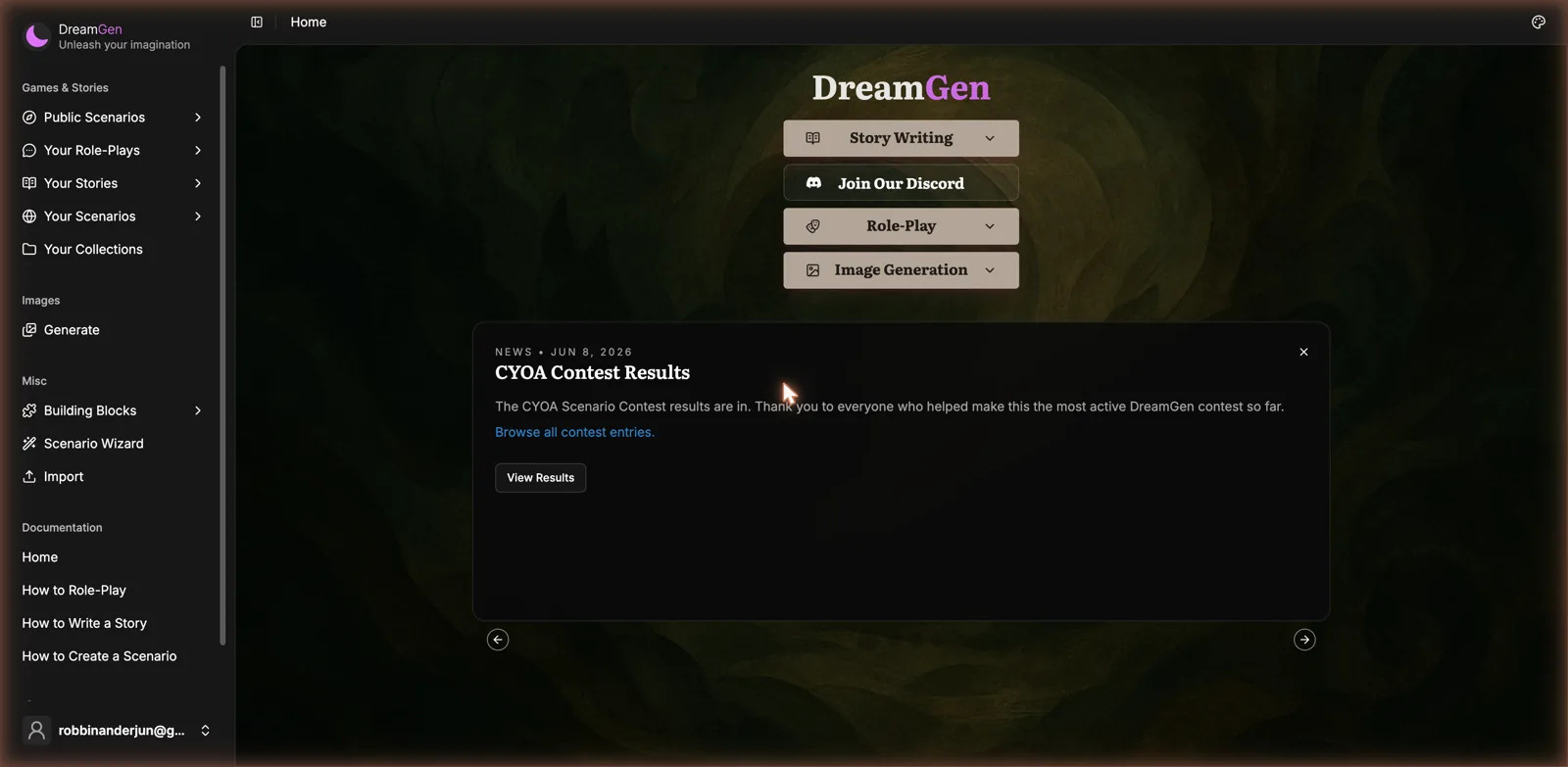
DreamGen is a browser-based platform with three things under one roof: interactive role-play, long-form story writing, and image generation. The home screen lays those out plainly, and the left sidebar shows how much sits underneath: public scenarios to play, your own role-plays, stories, scenarios, and collections, an image generator, and a set of authoring tools like Building Blocks and a Scenario Wizard. There is also a proper documentation section with guides on how to role-play, write a story, and create a scenario, which tells you right away that this is a tool people are expected to learn.
The thing that sets DreamGen apart from most of the field is that it runs on its own fine-tuned models built for creative writing, rather than wrapping a generic chatbot. That focus shows up in the output, which I will get to. It is uncensored, but it is not an adult-first product in the way a lot of these sites are. It is a writing tool that happens to let you go wherever you want. If you want a companion instead, see the AI chat partners we tested head to head.
Running a roleplay
I started with the role-play side, since that is what most people come for. You can build your own scenario from scratch or jump into one from the large public library, which is stuffed with community creations. There are choose-your-own-adventure takes on popular anime and comics, original open-world RPGs, and one-on-one character sims, most with their own cover art.
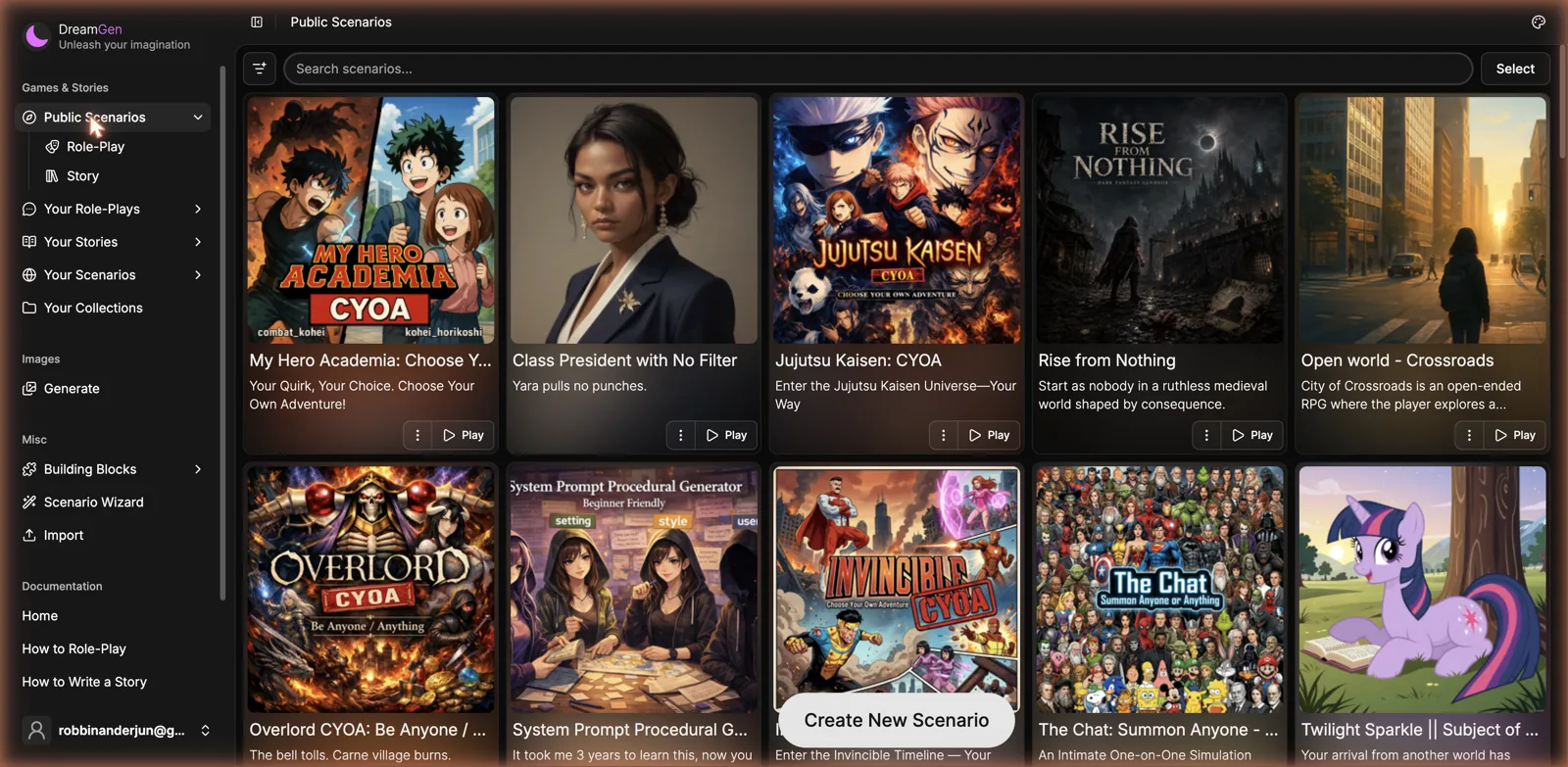
I picked a dark-fantasy sandbox called Rise from Nothing. Before the story began, it asked me to define my persona, and it offered pre-made ones I could use as a starting point. These were not simple name-and-bio fields either. Each suggested persona came as a detailed character sheet with traits, abilities, and little RPG-style mechanics, and the custom template made a point of enforcing adult-only characters. It is a level of structure I have not seen in the easier apps.
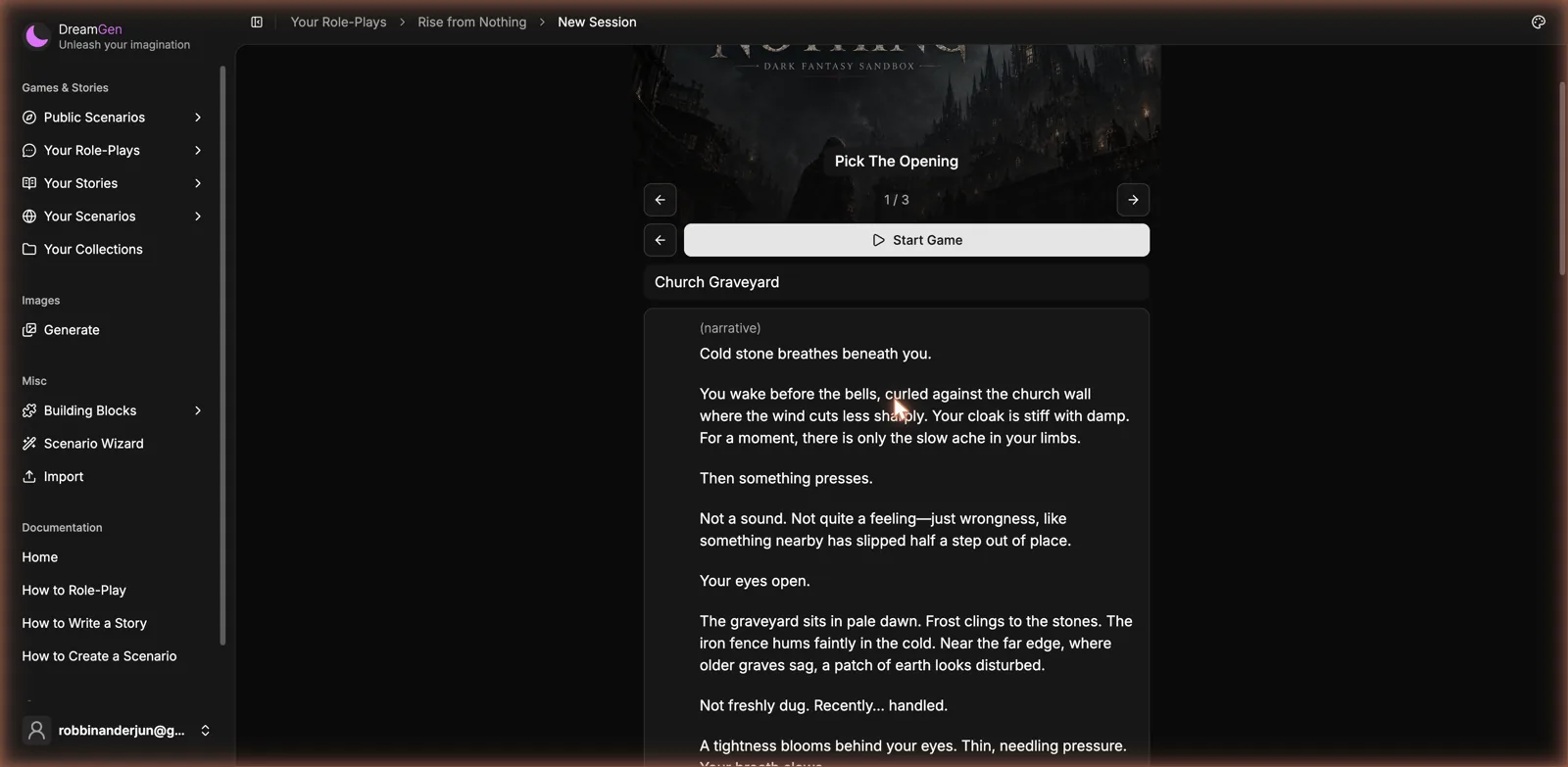
Then the writing started, and it was genuinely good. The opening put me in second person waking against a church wall at dawn, with lines like cold stone breathing beneath me and a wrongness in the air like something nearby had slipped half a step out of place. A watchful priest appeared and started probing at my character with the kind of loaded, unhurried attention that builds real tension. This is a clear step above the competent-but-flat prose a lot of these engines produce. It reads like fiction, not like autocomplete.
The interaction model is flexible too. You can write your own actions freely, or lean on suggested next steps that the scenario offers in a choose-your-own-adventure style, with options like giving a practical answer, deflecting with quiet defiance, or staying silent and watching. Underneath the surface, the more elaborate scenarios inject a hidden block of structured game-state instructions that steer the AI, tracking things like tension, reputation, and escalation. You can toggle that visibility on and off. It is the kind of machinery that makes a scenario feel like a game with rules rather than a freeform chat, and it is completely optional to engage with.
The scenario editor is the real power
If you want to build your own world, the scenario editor is where DreamGen shows its hand. It is deep. You define a plot with optional modifiers for setting, style, and history, then add as many characters as you want, each with a description and its own building blocks for persona, location, objects, and a narrator voice.
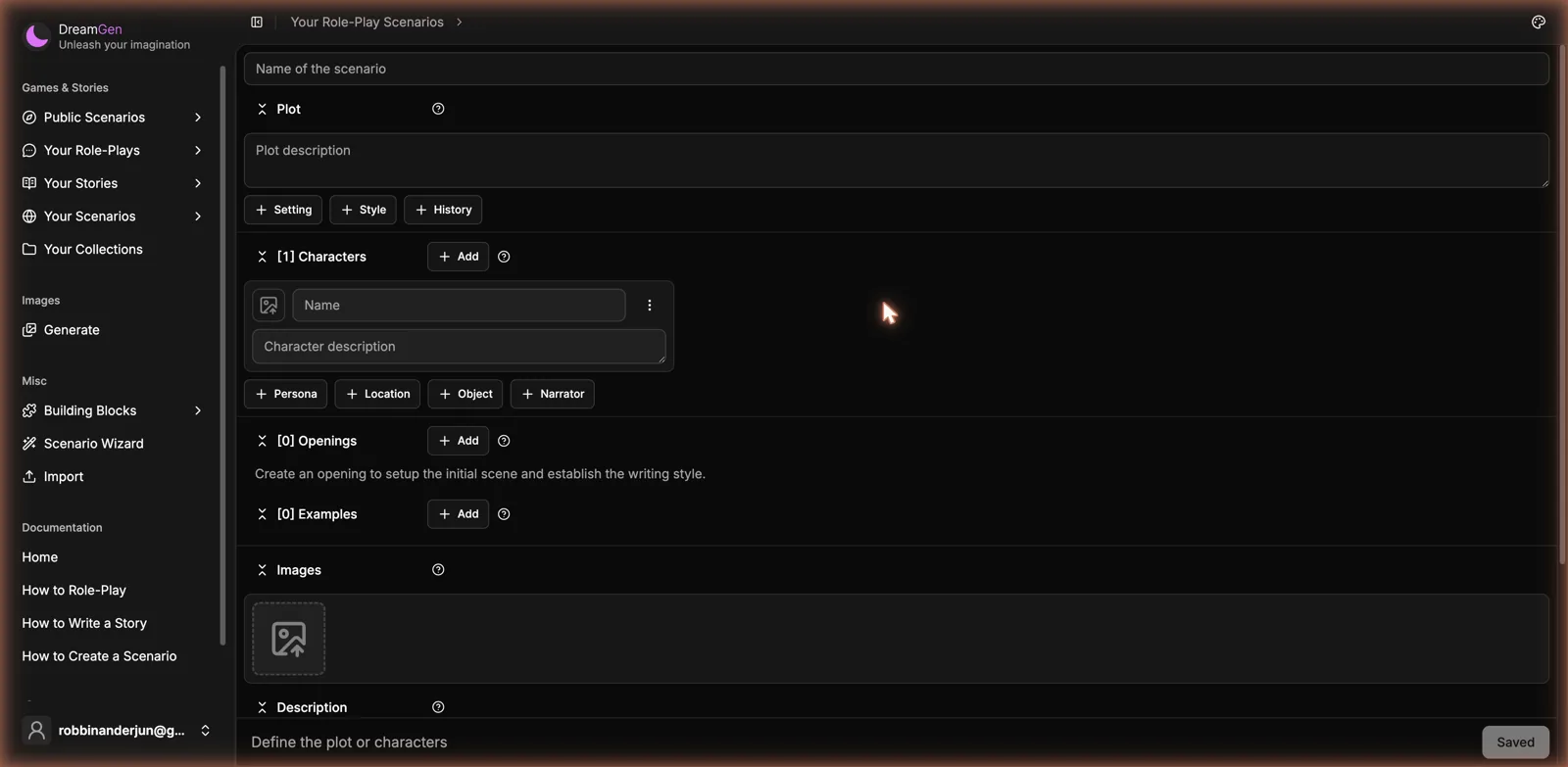
Below that you create openings to establish the initial scene and writing style, add example exchanges to teach the AI the tone you want, and attach images. There is a Scenario Wizard that will help you generate one with AI assistance if starting from a blank page feels daunting, and an Import tool for bringing in character cards from elsewhere. The Building Blocks system lets you make reusable characters, personas, and locations once and drop them into any scenario, so a serious user can build a whole recurring cast and setting over time. This is closer to a tabletop game master’s toolkit than a chat app, and it is the reason DreamGen has a dedicated community running scenario contests.
Story writing and image generation
The story-writing mode is the other half of the text side. Where role-play is turn-based and interactive, story writing is about co-authoring longer prose, with the AI continuing and expanding what you write. It draws on the same strong models, so if your interest is drafting fiction rather than playing a character, you are well served. The public library has a Story tab alongside the Role-Play one for exactly this.
What makes both modes work is that DreamGen gives you the controls to steer rather than just regenerate. You can edit any part of the output directly, branch the story in a different direction, adjust the style, and feed the AI examples of the voice you want. Combined with the scenario system, it means a story you build here can hold a consistent tone and cast across a long session in a way the one-shot generators struggle with. The trade-off is that you have to put in the setup work to get there, but the ceiling is much higher.
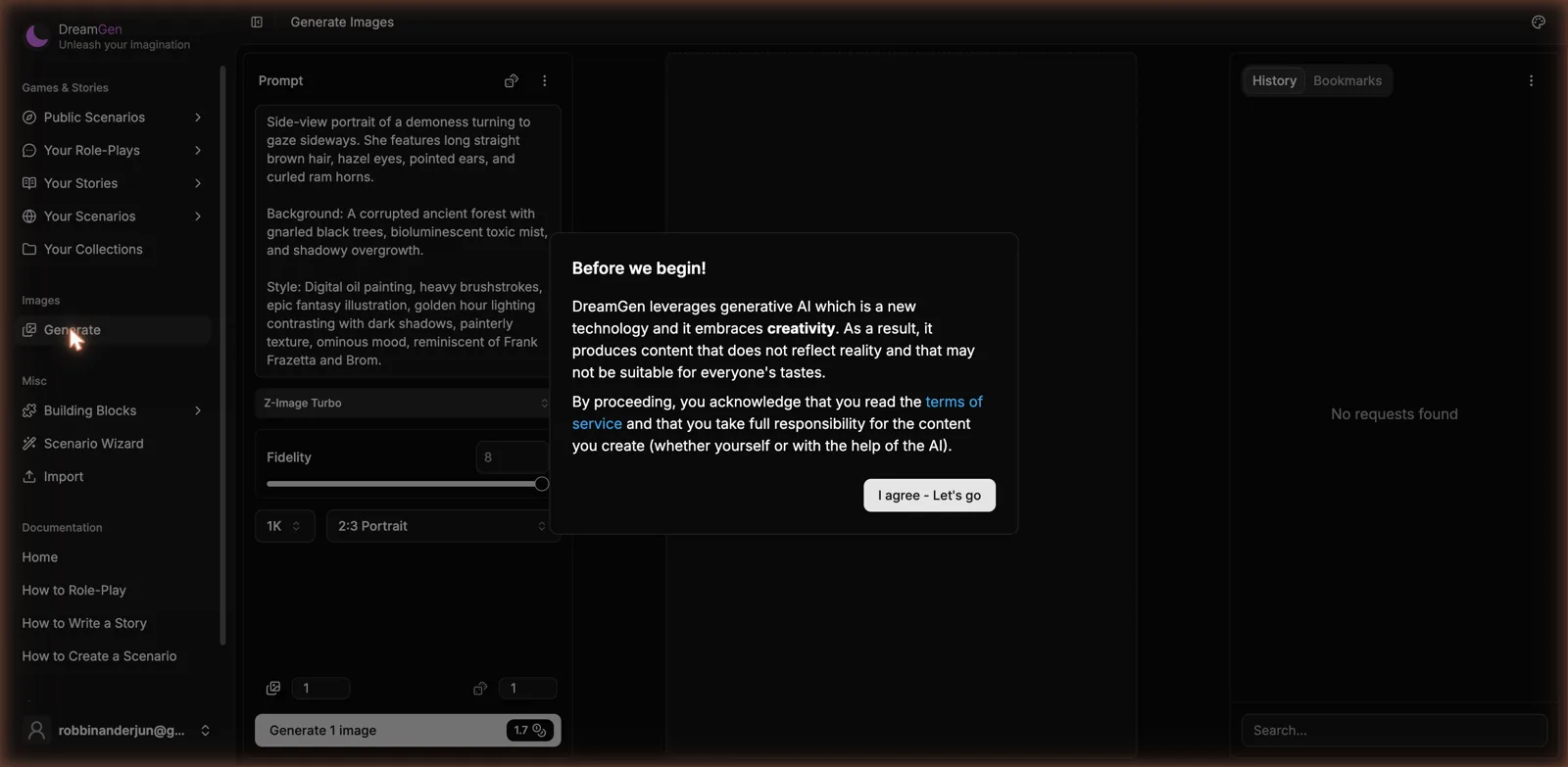
Image generation is bundled in as well, though it feels more like a companion feature than the main event. You get a prompt box, a model such as Z-Image Turbo, and controls for fidelity, resolution, and aspect ratio, with each image costing a small number of credits and a history panel to keep your results. Before it let me generate, it showed a responsible-use notice reminding me that the output is AI and that I take responsibility for what I make, which is a reasonable bit of framing. If images are your main goal, a dedicated generator will go deeper, but having it attached to your stories and characters is a nice touch.
The content and copyright side
DreamGen is uncensored, and it handles that with a matter-of-fact, grown-up tone rather than the wall-to-wall explicit imagery some sites open with. The persona templates enforce adult-only characters, and the image generator gates itself behind a content acknowledgment. Because the heat and direction of any scene come from you and the scenario you choose, you can run it as a clean adventure engine or take it somewhere adult, and nothing pushes you either way.
The one thing worth flagging is the same copyright gray area that follows every community-driven platform. A large share of the public scenarios are built around copyrighted characters from anime, comics, and games, which the platform hosts without resolving the rights question. That is standard for user-generated libraries, but it is worth knowing that a chunk of the ready-made content leans on other people’s intellectual property.
Credits, plans, and the money math
DreamGen has a real free tier you can use to get a feel for the models, which is the right way in given how much there is to learn. The paid plans are built around a few levers: a context window that sets how much your models can remember, a pool of monthly and daily credits, and discounts on extras.
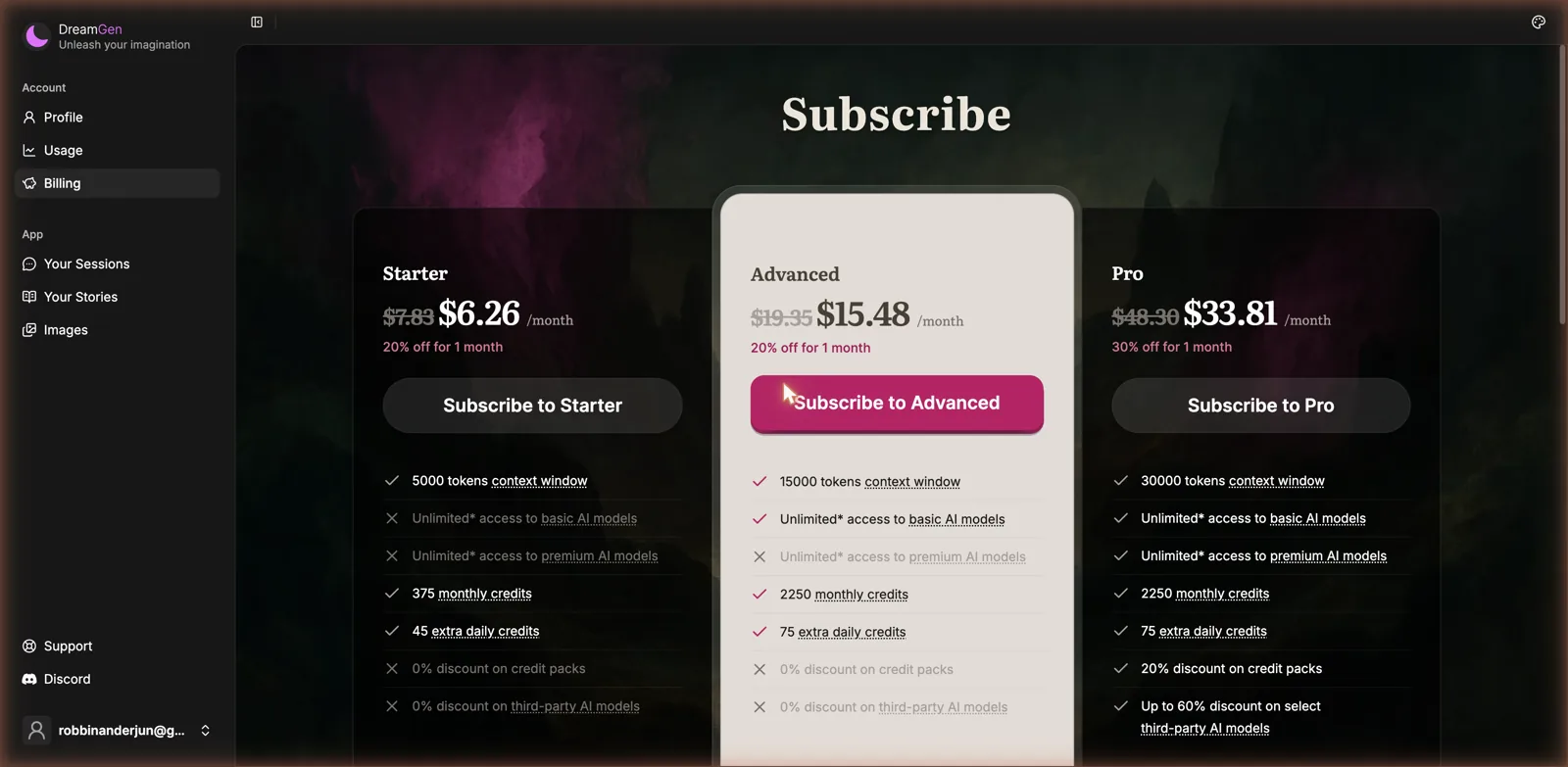
Starter runs about $7.83 a month and gives you a 5,000-token context window, 375 monthly credits, and 45 extra daily credits. Advanced at around $19.35 a month widens the context window to 15,000 tokens and bumps you to 2,250 monthly credits and 75 daily. Pro at roughly $48.30 a month pushes the context window to 30,000 tokens and adds meaningful discounts on credit packs and on select third-party models. Each tier runs a first-month discount. The important nuance is that text generation on DreamGen’s own models is effectively unlimited, while credits are what you spend on images and on routing to premium outside models like the big commercial LLMs. So the question is less about running out of story and more about how much memory you want and whether you plan to use the fancier external models.
That memory ladder is the thing to weigh. A bigger context window genuinely changes how coherent a long roleplay stays, so if you write marathon sessions, the jump from Starter to Advanced matters more than the credit count. For casual use, the free tier and Starter are plenty.
How it compares
The closest comparison I have written up is Chub AI, the other big power-user sandbox, with its lorebooks, presets, and deep parameter tuning. If you are the kind of person who wants to tune the engine, those two are the natural rivals, and DreamGen is the more polished and guided of the pair while Chub is the more wide-open. PepHop AI is another to weigh if the power-user angle appeals, since it leans into roleplay with a bring-your-own-API-key approach for people who want that flexibility.
On the model-choice front, Yodayo is a good reference point, since it also pairs transparent model selection with a full creative suite including image generation. And if your real interest is written stories rather than interactive play, RedQuill and My Spicy Vanilla are the focused erotica story generators to read next, both simpler and more approachable than DreamGen’s scenario machinery, and both a better fit if you just want to describe a story and read it back.
What I liked and what I did not
On the plus side, the writing quality is the headline, easily among the best in the category thanks to those purpose-trained models. The scenario editor and Building Blocks give you authorship most tools do not come close to, the persona and choice systems make roleplay feel like a real game, and the documentation and active community mean help is there when the depth gets overwhelming. It stays uncensored without being sleazy, enforces adult-only characters, and the free tier plus a reasonable Starter plan make it easy to try.
The downsides are mostly the flip side of the strengths. The learning curve is steep, and someone who just wants a quick story will find all the scenario scaffolding intimidating. The two-currency setup of unlimited text but credit-metered images and third-party models takes a minute to understand. The best memory sits behind the pricier tiers, and the public library leans heavily on copyrighted characters. Image generation, while welcome, is not as deep as a dedicated tool.
Who it is for
DreamGen is for writers and roleplayers who want depth and are willing to learn a real tool to get it. If you want to build a persistent world, run long and coherent roleplays, or draft fiction with a model that actually writes well, it is one of the best options I have used, and the free tier lets you confirm that for yourself before paying.
If you want something you can pick up and enjoy in two minutes, this is not it, and a simpler story generator or companion app will make you happier. But if you have ever wished these tools took the writing as seriously as you do, DreamGen is the one that does. Start free, work through a public scenario or two before building your own, and let the context-window question rather than the credit count guide which plan you land on.