Playbun is an NSFW AI generator that leans hard on video. Where a lot of these sites treat clips as an afterthought to still images, Playbun puts video front and center, right down to a pricing page that grades its tiers on frame rate and render quality. On top of the generator it adds a train-your-own-template system with a creator payout angle, plus a small games section. I went hands-on with the generator, the training feature, and the pricing to see how it holds up. It is an adults-only tool, so treat this as your 18-plus warning up front, and I will flag a couple of things worth your caution as we go.
Top AI Girlfriend Platforms — Our Picks

Hyper-realistic AI companions with adaptive memory that recall your past conversations.
Build a custom AI companion and bring her to life with chat, images, and video.

Create a custom AI girlfriend with her own personality, generated images, and ongoing chat memory.

Characters that hold memory and context, so the relationship builds over time instead of resetting.

Chat with a fully custom AI girlfriend — choose her personality, outfits, and more.

Personalized AI companions for ongoing roleplay, with a simple, discreet signup.

Build a custom AI girlfriend, boyfriend, or anime character — choose the look and personality.

Customizable AI girlfriend personalities with realistic, ongoing conversations.
Playbun at a glance
- What it is: a browser-based NSFW AI image and video generator, prompt-based rather than tag-based.
- Standout feature: train your own template and publish it to earn money, with the first training flagged at 300 credits.
- Price: free tier with a small starting balance of 30 credits, then $4.99, $14.99, or $24.99 a month, with up to 50 percent off annually.
- Best for: people whose main interest is AI video and who are comfortable writing their own prompts.
- Watch out for: prominent Undress Photo and photo-to-video ad slots on the home page, which I would avoid entirely.
Here is my take on what Playbun does, how it makes money, and who it suits.
What Playbun actually is
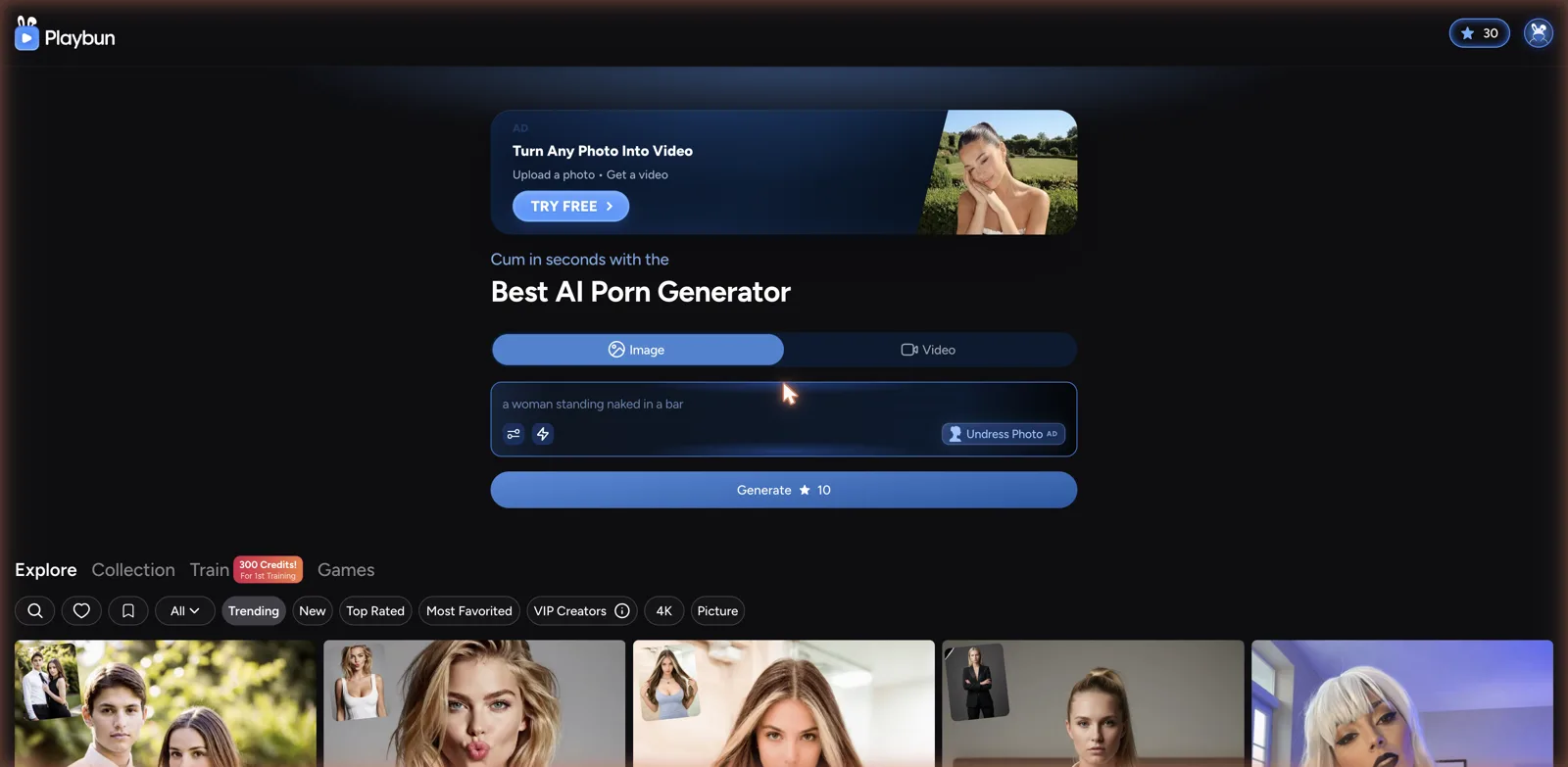
Playbun is a browser-based NSFW AI image and video generator. The home page puts the generator right at the top: you toggle between Image and Video, type a prompt, and hit generate, with a credit cost shown on the button. Below that is an Explore feed of community creations you can filter by Trending, New, Top Rated, Most Favorited, VIP Creators, 4K, and more, and the top nav adds Collection, Train, and Games.
So the core is a straightforward prompt-to-media generator, with the twist that video is treated as a first-class output rather than a bolt-on. The interface is clean and the free account I used started with a small credit balance, so you can poke around before paying. There is also a content-removal link in the footer, which is the kind of takedown process a responsible platform should have. If you want AI girlfriend chat alongside video, my main ranking covers apps that do both.
The Explore feed is more than window dressing, since its filters, including a VIP Creators tag and a 4K option, hint at the platform’s ambitions. VIP Creators ties into the train-and-earn system I will come to, marking out the people producing the popular templates, while the 4K filter signals that Playbun cares about output resolution, not just quantity.
The Games tab in the nav is a lighter, more playful mode sitting alongside the serious generation tools, the kind of extra that rounds out an app without being its main draw. Taken together, the navigation paints Playbun as trying to be a small ecosystem, generation plus a creator economy plus a bit of play, rather than a single-function tool.
The PornHaven games tab takes that same small-ecosystem idea further, sitting next to an image generator, a video generator, a hentai section and both AI girlfriends and boyfriends.
A word of caution on the ads
Before I get to the good parts, one honest flag. On the home page, Playbun surfaces promotional slots for an Undress Photo tool and a Turn Any Photo Into Video feature, both labeled as ads. Undress or deepnude tools, which take a real photo and generate nudity from it, are non-consensual imagery tools, and photo-to-video swaps carry the same deepfake risk. Whether these are Playbun’s own features or third-party ads, their prominence is something I want you to see clearly.
The generator itself, as I used it, is prompt-based, meaning you describe a fictional scene and it renders one, which is the standard and defensible form of AI adult content. But I would steer entirely clear of any undress-a-photo or photo-to-video function, on Playbun or anywhere else, since the only acceptable use of a real person’s image is with their explicit consent, and tools built around undressing photos are designed for exactly the opposite. Keep to prompt-based, fictional generation and give the photo-upload features a wide berth.
The generator and the video focus
How generating actually works
The generation flow is simple by design. You pick Image or Video, write a prompt, optionally adjust settings through the small controls by the prompt box, and generate for a credit cost, which showed as 10 for an image in my session. There is no sprawling tag system like the CreatePorn-network sites use, just a prompt box, so it is closer to a classic text-to-image tool than a menu-driven builder.
CreatePorn offers a comparable menu-driven builder for anyone who wants deep tag-based customization instead of a freeform prompt box.
Why video is the selling point
The video emphasis is where Playbun tries to stand out, and the pricing makes the priority obvious, grading plans by video quality and frame rate rather than just credit count. If moving content is your main interest, that focus is a point in its favor, since many generators treat video as a lower priority. It is worth comparing against a dedicated video tool like DeepSwap AI for how they approach motion, though Playbun’s is prompt-driven generation rather than face-swapping. For plain prompt-to-image work, PornX and MakePorn are the closer comparisons.
The trade-off of a prompt-only interface
The trade-off of a prompt-only interface is worth being clear about. Without a tag system, you get freedom and simplicity but less guided precision, so how good your results are leans heavily on how well you write a prompt. Newcomers who do not know how to phrase what they want may find a menu-driven builder easier to get a usable result from, while people comfortable describing a scene will appreciate not being boxed into preset tags. It is the classic freeform-versus-guided divide, and Playbun sits firmly on the freeform side. The small settings controls by the prompt box give you some adjustment, but the heavy lifting is on you and the prompt.
Train your own template, and earn
The Train tab is Playbun’s most distinctive feature. It lets you train your own template and, notably, publish it to earn money, turning the platform into a small creator marketplace rather than just a generator. The first training is discounted, flagged at 300 credits, and once published your template can presumably earn from others using it.
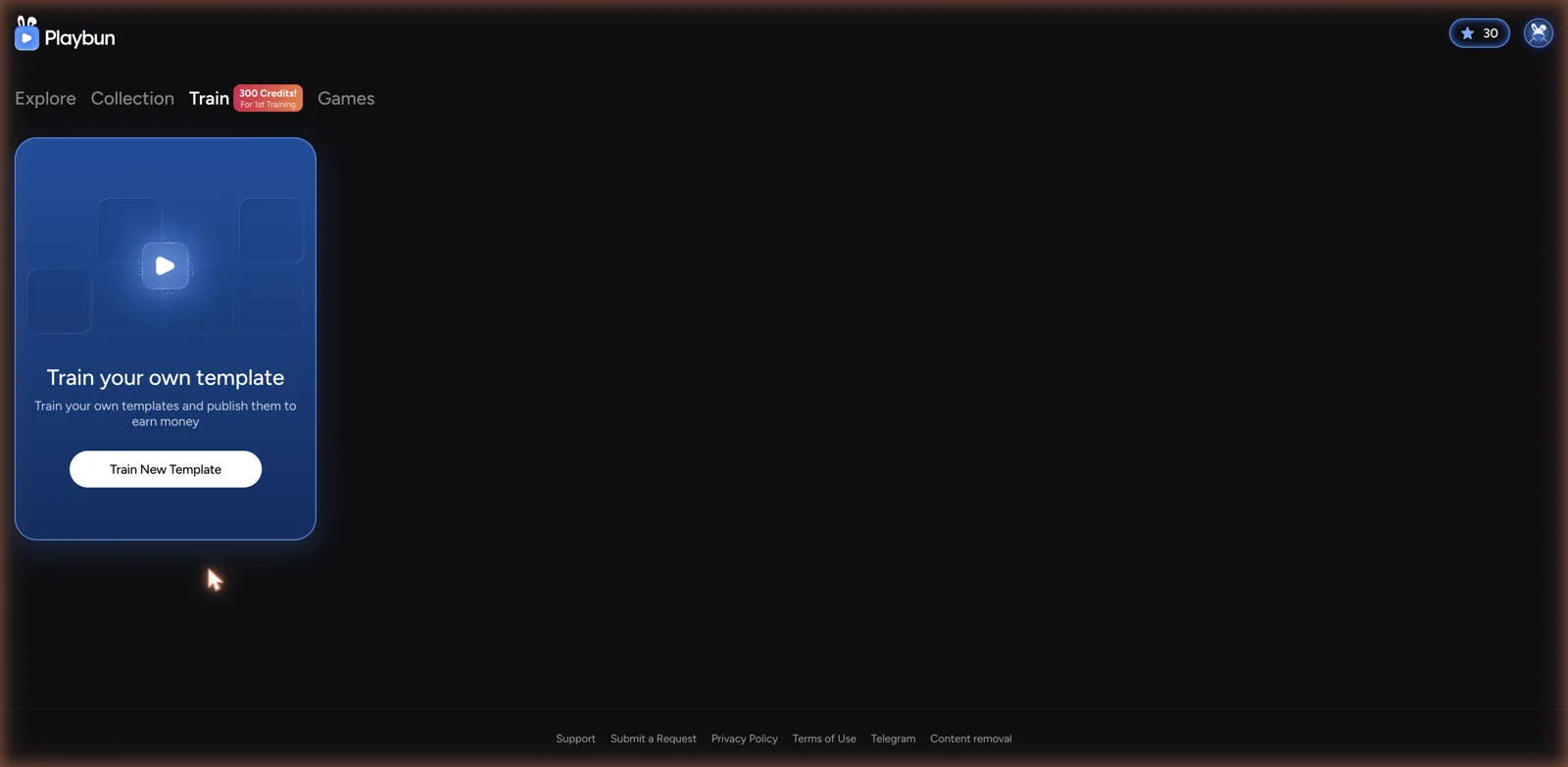
That creator-payout angle is genuinely interesting and sets Playbun apart from the pure generators, giving power users a reason to invest effort rather than just consume. The obvious caveat is the same consent principle: a template should only ever be built from content you have the right to use, and publishing raises the stakes on that, since you are putting a model out for others to generate with. Used responsibly with your own or fully synthetic material, it is a clever way to reward the people who make the good templates everyone else enjoys.
The economics of it are the interesting part. By letting creators earn from published templates, Playbun turns some of its users into unpaid content suppliers who keep the Explore feed fresh, which is a smart flywheel: creators make templates to earn, those templates draw in generators who spend credits, and the spending funds the payouts.
Whether the earnings are actually meaningful is something only a creator who committed to it could tell you, and it will depend entirely on how many people use your template and what the platform pays out. But the structure is a real differentiator from the many generators that give you nothing back for your effort, and it explains the VIP Creators tag on the Explore feed as a way to surface the people driving that engine.
What Playbun costs
Playbun runs a credit-based subscription with a free tier and three paid plans, plus an annual toggle that saves up to 50 percent. The free plan comes with a small starting credit balance, enough to test the waters.
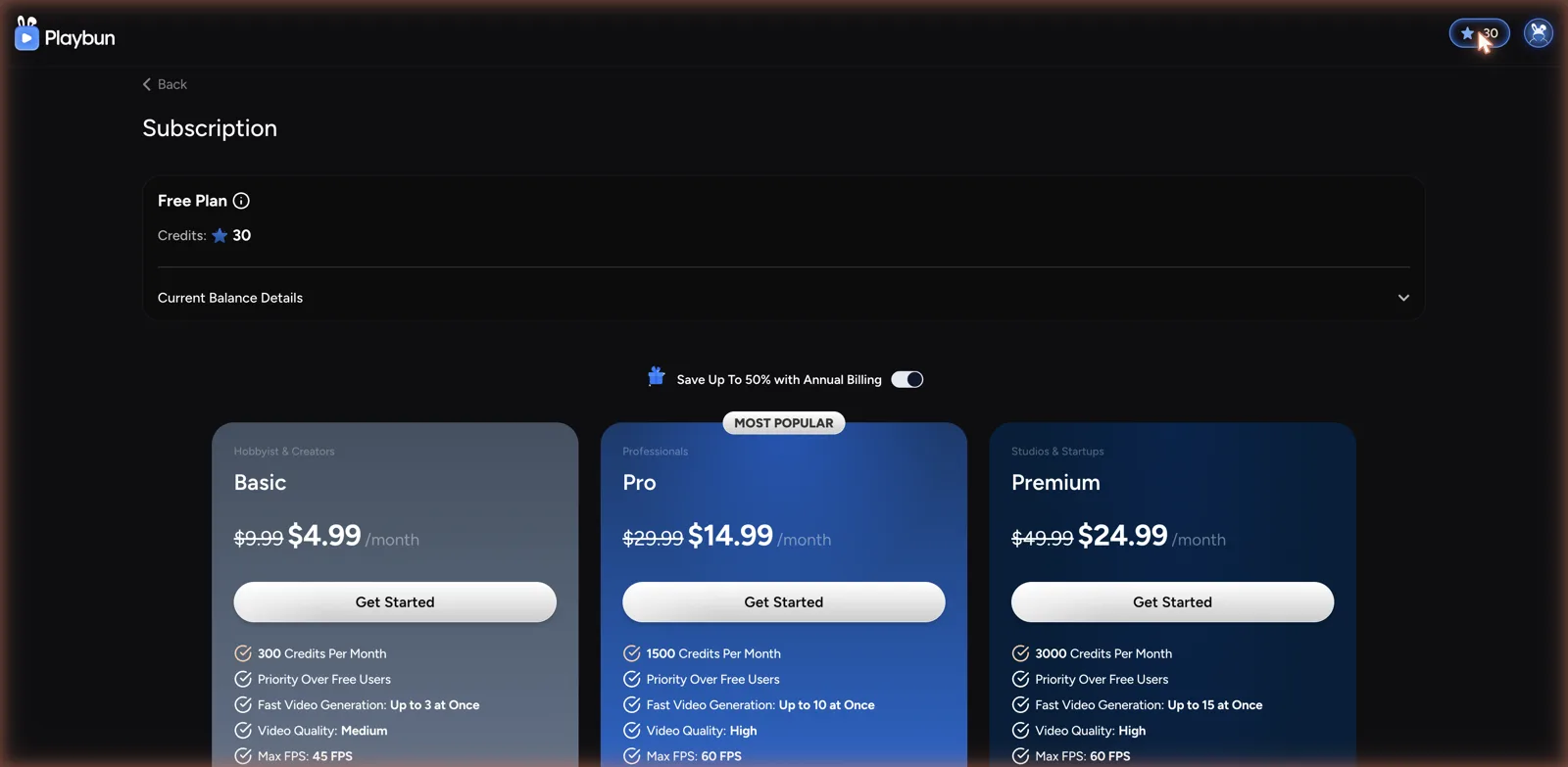
| Plan | Price per month | Credits per month | Concurrent generations | Video quality | FPS cap |
|---|---|---|---|---|---|
| Free | $0 | 30 starting credits | — | — | — |
| Basic Hobbyists and creators | $4.99 | 300 | Up to 3 | Medium | 45 FPS |
| Pro Most popular, aimed at professionals | $14.99 | 1,500 | Up to 10 | High | 60 FPS |
| Premium Studios and startups | $24.99 | 3,000 | Up to 15 | High | 60 FPS |
So the ladder scales on three things at once: how many credits you get, how many generations you can run in parallel, and the quality and frame rate of your video.
Grading tiers by frame rate and concurrency is unusual and reinforces the video-first identity. For a still-image user, Basic at $4.99 is cheap and probably plenty. For anyone serious about video, the jump to Pro buys you higher quality, smoother 60 FPS output, and far more parallel rendering, which is where the real value sits. As always, the discounts are aggressive and the credit costs per generation determine how far your monthly allowance actually goes, so treat the credit numbers as a ballpark until you see how fast your usage burns them.
How it stacks up
What works
- Video-first design. The frame-rate-graded pricing is a smart way to signal that video is the priority.
- A clean prompt-based generator. No sprawling tag menus to wade through before you can generate anything.
- A genuinely novel train-and-earn template system. The creator marketplace gives it a hook the plain generators lack.
- A free tier plus a cheap Basic plan. Easy to try before you commit any money.
What holds it back
The reservations are real, though.
- The prominent undress and photo-to-video ad slots are a bad look and point toward tools I cannot endorse, so you have to consciously stick to the prompt-based core.
- Less control than the deep menu-driven builders, since the generator is prompt-only with no tag system.
- Video is capped on the cheaper tiers, on both quality and frame rate.
If you want a menu-driven generator instead, the CreatePorn family offers more granular control, and my virtual girlfriends guide is the better read if you want chat rather than generation.
Who Playbun is for
Playbun is a good pick if:
- AI video is your priority.
- You want a clean prompt-based generator with quality and frame-rate options.
- The unusual ability to train templates and earn from them appeals to you.
The free tier and $4.99 Basic plan make it easy to start, and the video focus is a real differentiator.
It is a weaker pick if:
- You want fine tag-level control over your images.
- The prominent undress and photo-to-video ads put you off, which is a fair reaction.
My advice: stick strictly to the prompt-based generator and the train-your-own-template feature using content you have the right to use, avoid the photo-upload tools entirely, and start on the free tier before deciding. It is 18-plus, its video focus and creator payout are genuine differentiators, but use it with clear eyes about the tools it advertises around the edges.
Playbun FAQ
Is Playbun free?
There is a free tier with a small starting credit balance, flagged as 30 credits, which is enough to test the generator before paying. After that you are on a credit-based subscription starting at $4.99 a month, with an annual toggle that saves up to 50 percent.
Does Playbun do video, or only images?
Both. The generator has an Image and Video toggle, and video is treated as a first-class output rather than a bolt-on. The tiers are graded on video quality and frame rate, from a 45 FPS cap on Basic up to 60 FPS on Pro and Premium.
How many generations do the credits get you?
Credits are deducted per generation, and an image showed as 10 credits in my session, so Basic’s 300 monthly credits work out to roughly 30 images before any video is factored in. Video costs more, so treat the credit numbers as a ballpark until you see how fast your own usage burns them.
Can you actually earn money on Playbun?
The Train tab lets you train your own template and publish it so other people can generate with it, with the first training discounted at 300 credits. Whether the earnings are meaningful depends entirely on how many people use your template and what the platform pays out, and only a creator who has committed to it could tell you.
Is Playbun safe to use?
The prompt-based generator is the standard, defensible form of AI adult content, and there is a content-removal link in the footer for takedowns. The caution is the Undress Photo and photo-to-video slots advertised on the home page: those are non-consensual imagery tools, and I would avoid them entirely.