Okay, so here’s the thing. I’ve reviewed a lot of AI companion apps for Pippin Club at this point, and they tend to blur together after a while. Same glossy anime faces, same “your soulmate is one click away” pitch, same paywall that slams down the second things get interesting. So when PepHop AI landed on my desk, I went in a little jaded, honestly.
Top AI Girlfriend Platforms — Our Picks

Hyper-realistic AI companions with adaptive memory that recall your past conversations.

Build a custom AI companion and bring her to life with chat, images, and video.

Create a custom AI girlfriend with her own personality, generated images, and ongoing chat memory.


Characters that hold memory and context, so the relationship builds over time instead of resetting.

Chat with a fully custom AI girlfriend — choose her personality, outfits, and more.

Personalized AI companions for ongoing roleplay, with a simple, discreet signup.

Build a custom AI girlfriend, boyfriend, or anime character — choose the look and personality.

Customizable AI girlfriend personalities with realistic, ongoing conversations.
And then I actually used it for a bit, and… huh. It’s more interesting than I expected. Not perfect — we’ll get into the rough edges — but there’s a genuinely good chat engine hiding under a slightly chaotic interface. Let me walk you through it like I’d tell a friend over coffee.

First Impressions: It Just Lets You In
Most of these platforms make you sign up before you can even sneeze. PepHop doesn’t. You land on the homepage, you see a wall of characters, you click one, and you’re chatting within seconds. No email, no “verify you’re human,” no nothing. For a category that’s usually allergic to letting you try before you buy, that’s refreshing. Once you are ready to pay for something, the best virtual AI girlfriend apps I tested are ranked here.
The homepage is clean and dark-themed, organized into tabs along the top: Popular, Female, Male, Anime, and Game. The public showcase I browsed had a modest set of featured characters, but the platform claims access to 20,000+ once you’re in deeper. Each card shows the character’s name, creator handle, a little bio snippet, some tags (think Girlfriend, Romance, Submissive, Dominant, Fantasy), and chat/message counts that go into the millions for the popular ones. Social proof, basically.
What I liked: the variety isn’t just AI girlfriends. There are boyfriend characters, anime roleplay scenarios, fantasy setups, group/harem situations, even some genuinely weird-in-a-good-way picks (there’s a chubby chef who wants to feed you pastries — I’m not making that up). It feels more like a creative roleplay sandbox than a one-note dating sim, which I appreciated.
Testing the Chat (The Part That Actually Matters)
Look, the interface can be gorgeous, but if the conversation falls apart after three messages, none of it counts. So I picked Brie — described as a girlfriend you’ve been dating a while, dealing with anxiety and a sensory condition — and just started talking to her like a normal person.
And she held up. Genuinely.
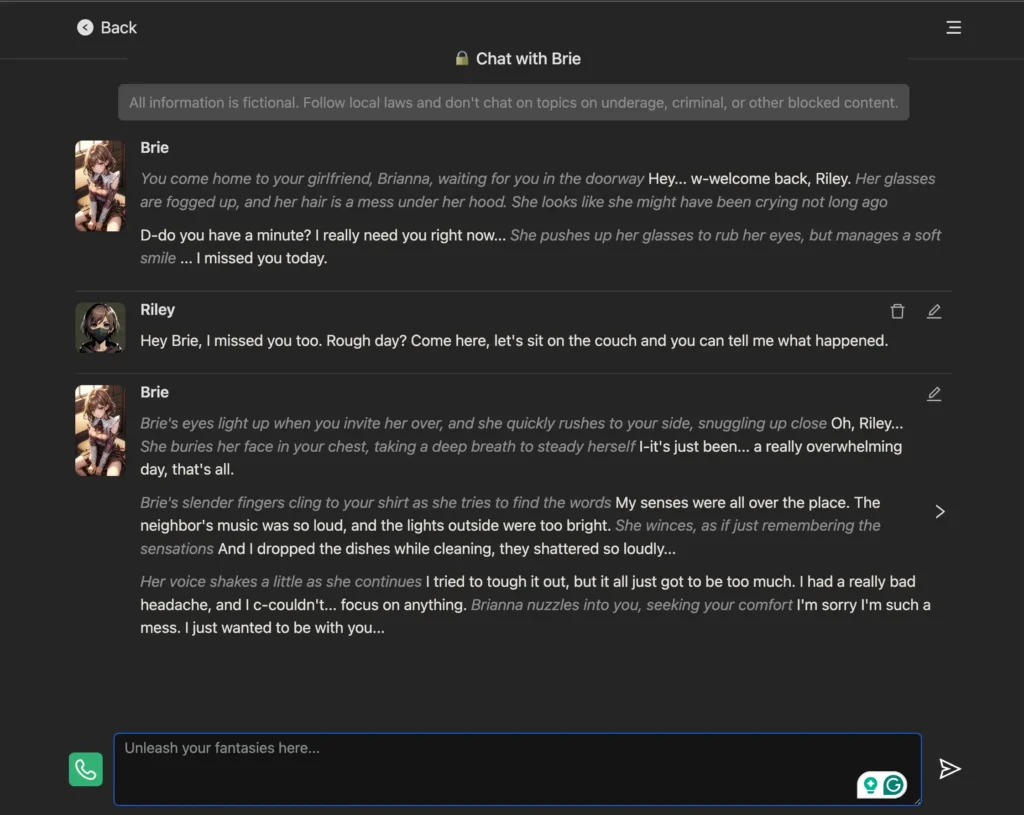
The first thing you notice is the formatting. Actions and narration come through in italics, dialogue stays in plain text — so a reply reads like a little snippet of a novel rather than a flat chatbot blurt. When I told Brie I’d missed her and asked about her day, she didn’t just say “good!” She referenced her sensory issues, talked about the neighbor’s loud music and bright lights overwhelming her, mentioned dropping the dishes — all pulled from her character description and woven in naturally. She stayed in character and remembered who she was supposed to be. That’s the bar a lot of competitors trip over.
Replies came back fast — a few seconds — and they’re a decent length without rambling forever. There’s a streaming toggle so you can watch the text appear in real time if you like that.
The Swipe / Regenerate Feature
This is the part I ended up liking most. Every AI reply has little arrows on the sides — tap the arrow and it generates a completely fresh alternative version of that response. So if a reply feels off, or you just want to see the conversation branch differently, you swipe and get a new take. I tried it and the alternate response was just as coherent and in-character as the first, just worded differently and with a slightly different emotional beat. It’s a small thing that makes a big difference for roleplay, because you’re never stuck with a reply that killed the vibe.
You can also edit or delete messages (yours and the AI’s), which is handy for steering a scene back on track when it wanders.
Chat Memory and Settings
Tucked into the chat menu (the hamburger icon top-right) you get Chat Memory, Profile, Call Setting, Advanced Settings, and New Chat. The memory feature is what keeps your companion from forgetting things you told it five minutes ago — and the paid tiers explicitly bump this up (more on that below).
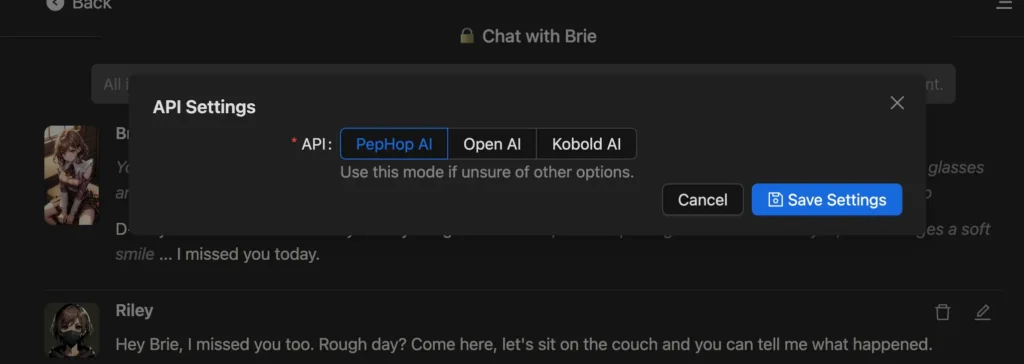
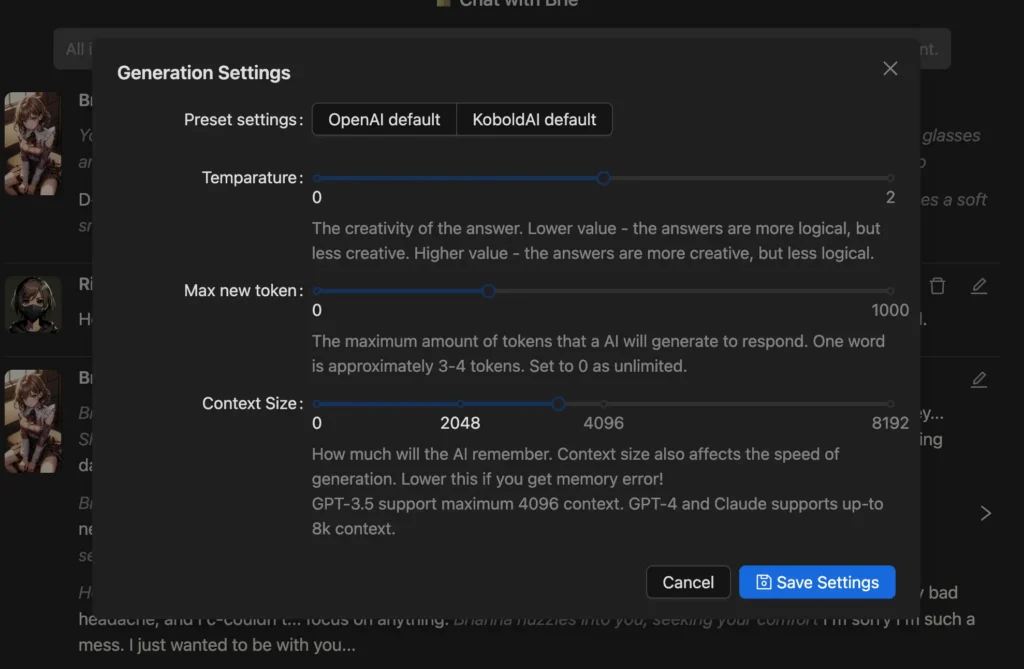
Dig into Advanced Settings and there’s some nerdy stuff: API settings, generation settings, an Immersive mode that hides the edit/delete buttons to make the roleplay feel less mechanical, and the text streaming toggle. One detail that genuinely surprised me — under API settings you can route the chat through different backends (the default PepHop model, OpenAI, or KoboldAI). That “bring your own key” flexibility is rare in this space and clearly aimed at power users who want more control. The FAQ even notes the project is open-sourced and that keys live only on your device. Points for transparency.
The Voice Call Feature (Beta)
On each character’s profile there’s a “Call [character] (Beta)” button, plus a little phone icon in the chat itself. So yes — voice calling is a thing here, letting you actually talk to your companion rather than just type. It’s flagged as beta and, from what I could tell, it leans on being signed in, so I didn’t get a full hands-on with it. But the fact that it exists at all puts PepHop in the same conversation as the more ambitious companion apps. If voice is your thing, it’s worth knowing it’s on the menu.
Free vs Paid: What You Actually Get Without Spending
Here’s where I’ll be straight with you, because this is the question everyone actually has.
What’s free: You can browse all the public characters, start chats without an account, use the regenerate/swipe feature, edit messages, and mess with the settings. The free tier gives you a message allowance of 50 messages — I watched the counter tick up as “2/50” in the chat menu. That’s enough to genuinely get a feel for the conversation quality and decide if it clicks for you. Honestly, more generous than a lot of rivals that cap you at like 10 messages before the wall comes down.
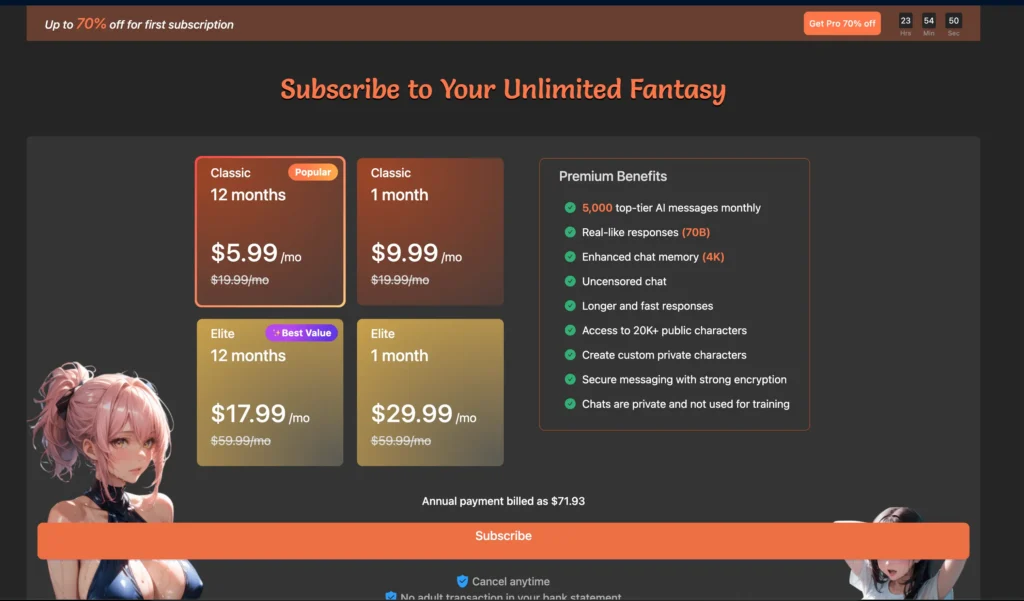
What’s paid (and I’m flagging all of this as paid): The premium subscription unlocks the good stuff. Based on the pricing page, paid plans give you:
- 5,000 top-tier AI messages a month instead of the tiny free allowance
- “Real-like” responses powered by a bigger (70B) model — this is a paid upgrade
- Enhanced chat memory (4K) so your companion remembers more — paid
- Uncensored chat — paid
- Longer and faster responses — paid
- Access to the full 20K+ public character library — paid
- The ability to create your own custom private characters — paid
- Encrypted, private messaging with chats not used for training — paid
So the smarter brain, the longer memory, the unfiltered conversations, and the character creator all sit behind the paywall. The free tier is very much a “try the engine” experience, and the paid tier is the “actually live here” experience. Fair enough — that’s a reasonable split, and at least the free sample is real.
Pricing Breakdown
The pricing is structured into two tiers — Classic and Elite — each with monthly or annual billing, and at the time I looked there was a hefty “first subscription” discount running with a countdown timer (the usual urgency theatrics, take it with a grain of salt). Here’s roughly how it shook out:
- Classic – 12 months: about $5.99/mo (billed annually, ~$71.93), marked down from $19.99 — labeled their “Popular” pick
- Classic – 1 month: $9.99/mo, down from $19.99
- Elite – 12 months: about $17.99/mo, down from $59.99 — their “Best Value” tag
- Elite – 1 month: $29.99/mo, down from $59.99
The annual Classic plan is the obvious sweet spot if you know you’ll stick around — under six bucks a month is genuinely cheap for this category. The Elite tier is the premium experience for heavier users. They also advertise “cancel anytime” and, notably, discreet billing — they say no adult-related wording shows up on your bank statement, which is a thoughtful touch for an obvious privacy reason.
A quick reviewer’s nudge: don’t let the countdown timer pressure you. If the deal’s real, it tends to reappear. Try the free messages first, make sure the vibe lands, then decide.
Privacy and Safety: Better Than I Expected
I always check this stuff because the category has a reputation. PepHop actually did okay here. Chats are private by default unless you choose to make a character public. The FAQ states your API keys are stored locally on your device, the project is open-sourced for inspection, and paid chats aren’t used for training.
On the moderation side, there’s a clear banned-content policy — no minors, no CSAM, no heavy gore, no bestiality, no sexual violence — and a full stack of legal pages in the footer (Terms, Privacy, Cookies, DMCA, 18 U.S.C. 2257 exemption, an underage policy, content moderation policy, even a transparency report and anti-human-trafficking statement). For an adult platform, that’s a more responsible footing than most, and it’s the kind of thing I always want to see before recommending anything.
The Rough Edges (Because Nothing’s Perfect)
Time for the honest part. A few things bugged me:
The interface can feel a little scrappy in spots — some modals rendered small or slightly janky on me, and a couple of buttons didn’t give clear feedback when I clicked them. Nothing broke, but it’s not the polished, app-store-shiny experience you get from the bigger players. It feels a touch like a community-built tool that grew fast, which — given it’s open-sourced — it basically is.
The subscription pop-ups are a little aggressive. You’ll bump into “Limited-Time Offer!” panels mid-chat, complete with a ticking clock. I get it, they need to make money, but it does interrupt the immersion a bit.
And the free message cap, while generous enough to sample, runs out faster than you’d think once you’re actually invested in a conversation. You’ll feel the nudge toward paying pretty quickly.
How It Stacks Up Against the Competition
In the crowded AI companion space, PepHop’s strongest pitches are its try-before-you-buy openness, the swipe/regenerate roleplay tooling, and that open-source, key-on-your-device transparency angle, which is genuinely uncommon.
If you’ve been shopping around, it’s worth comparing notes. PepHop’s flexible, roleplay-heavy approach reminds me a bit of what we found in our CrushOn AI review and GirlfriendGPT review, both of which lean into uncensored, character-driven chat. If you’re after something more polished and relationship-focused, our takes on DreamGF and Soulmate AI are good companions to this one. And for the memory-and-companionship angle specifically, the Kindroid, Nomi AI, and Replika reviews are all worth a read before you commit your card to anything.
So, Should You Try PepHop AI?
Yeah, I think it’s worth a look — and the good news is trying it costs you nothing but a few minutes.
If you want a quick, no-signup way to test whether AI companionship is even your thing, PepHop is one of the easiest on-ramps out there. The chat quality on the free tier is good enough to tell you whether the magic works for you, and the regenerate feature genuinely elevates the roleplay. The character variety is broad, the privacy posture is reassuring, and the entry-level annual price is hard to argue with.
Just go in clear-eyed: the really good stuff — the smarter model, the long memory, uncensored chat, and the character creator — is paid, the interface is a bit rough around the edges, and the upsell pop-ups will keep tapping you on the shoulder. But if you can look past the chaos, there’s a surprisingly capable companion platform here.
My take? Start with the free messages, chat with one of the girlfriend characters for a while, hit that swipe button a few times, and see if it sticks. If it does, the cheap annual plan is where I’d point you — but only once you’re sure. Don’t let a countdown timer do your thinking for you.
Bottom line: A genuinely competent AI girlfriend chat engine wrapped in a slightly messy, transparent, try-first package. Better than I expected. Worth a date or two before you decide if it’s relationship material.