If you have been anywhere near the AI roleplay scene for more than a year, you already know the name Pygmalion. It started life as an open-source language model that a community built specifically for character chat, back when most of the mainstream bots were getting more locked down by the month. That heritage matters, because pygmalion.chat is what happens when the people who care most about roleplay build the whole site instead of just the model. I spent a good while poking at it, testing the chat, digging through the settings, and pricing out the plans, and it is a different animal from the glossy girlfriend apps I usually cover.
Top AI Girlfriend Platforms — Our Picks

Hyper-realistic AI companions with adaptive memory that recall your past conversations.
Build a custom AI companion and bring her to life with chat, images, and video.

Create a custom AI girlfriend with her own personality, generated images, and ongoing chat memory.

Characters that hold memory and context, so the relationship builds over time instead of resetting.

Chat with a fully custom AI girlfriend — choose her personality, outfits, and more.

Personalized AI companions for ongoing roleplay, with a simple, discreet signup.

Build a custom AI girlfriend, boyfriend, or anime character — choose the look and personality.

Customizable AI girlfriend personalities with realistic, ongoing conversations.
Short version: this is a power-user roleplay platform with a real free tier, a deep bench of models, and settings that will either delight you or slightly intimidate you depending on how much you like tinkering. If you want something simpler, the top AI girlfriend apps I ranked take less setup. Let me break it down.
A community character library, not a curated cast
The first thing you land on is Explore, and the vibe is immediately different from the pre-packaged girlfriend sites. Instead of a grid of studio-made models, you get a wall of community-created character cards sorted into Featured and Trending rows.
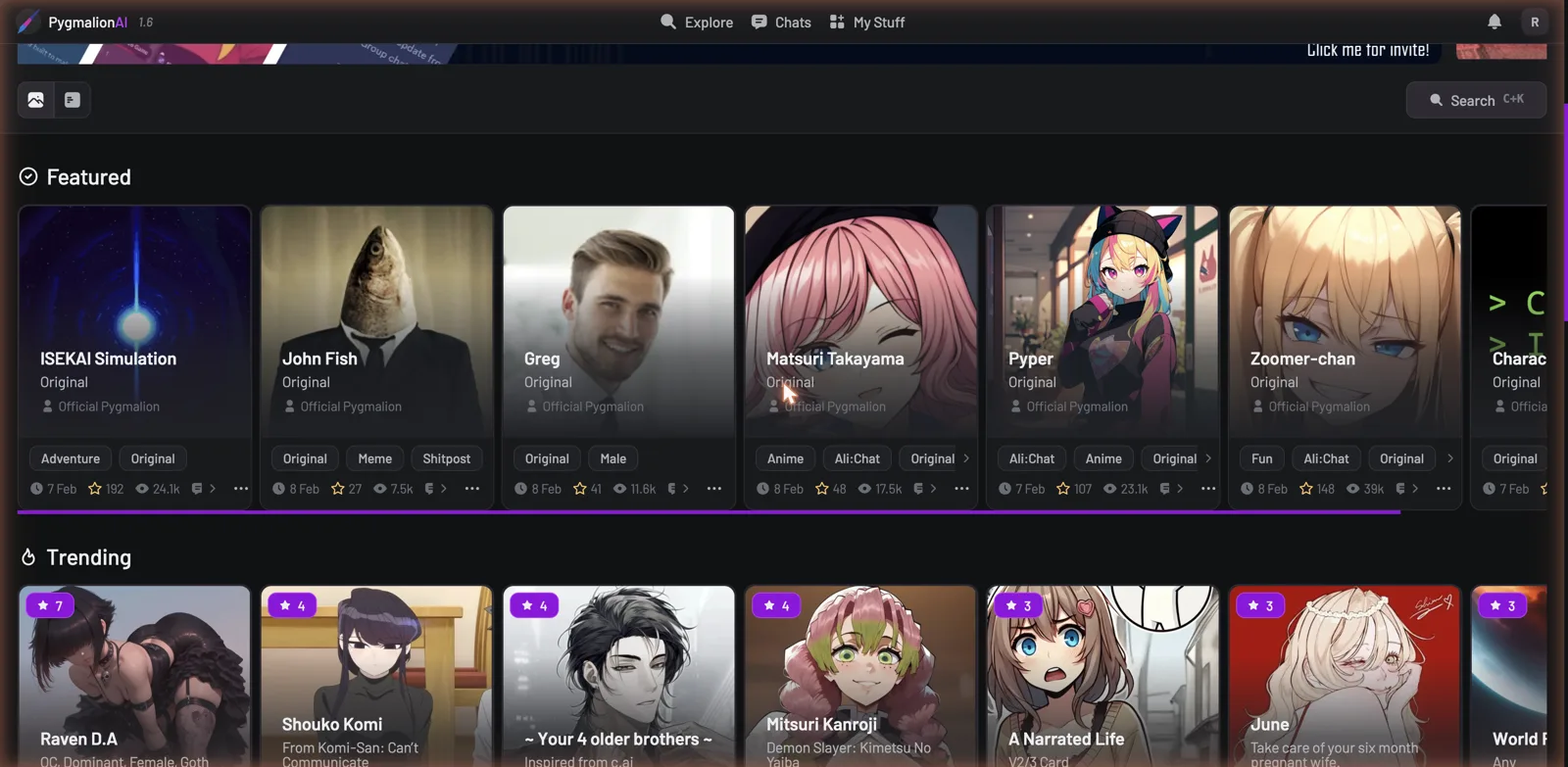
The range is genuinely all over the place, in a good way. There is ISEKAI Simulation for people who want an adventure scenario, a joke character called John Fish that is literally a fish in a suit, anime characters like Matsuri Takayama and Mitsuri Kanroji pulled from popular shows, original characters with detailed personalities, and plenty of “your four older brothers” style group roleplay setups. Cards carry tags like Adventure, Anime, Male, Meme, and Ali:Chat, and each one shows its star rating, view count, and how many chats it has racked up. Some are marked Official Pygmalion, most are made by regular users. It feels a lot closer to Chub AI or Joyland AI than to a dating app, which is to say it is about characters and stories first.
Click any card and you get a proper detail view before you commit to chatting.
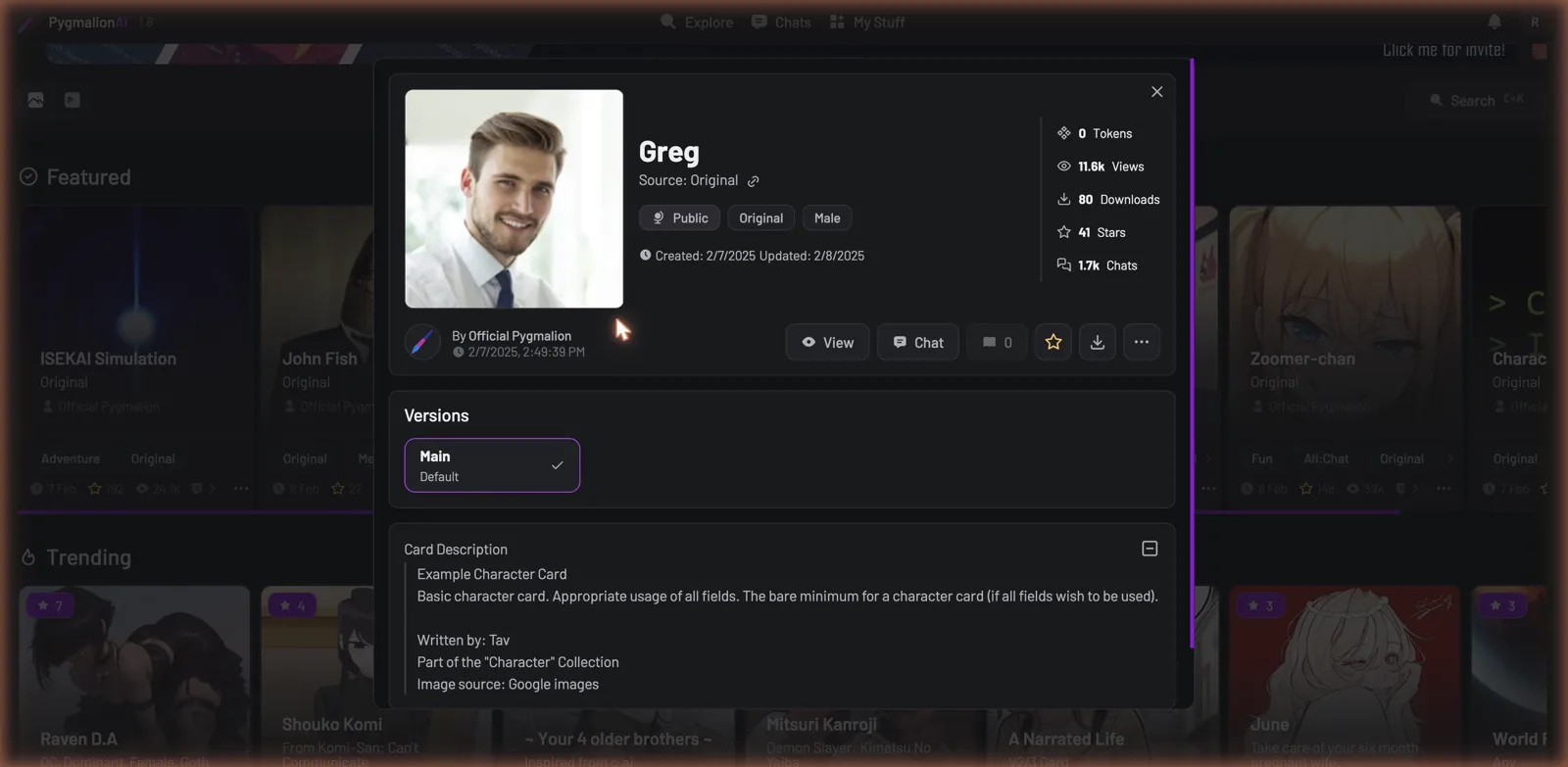
This is where the platform shows its roots. Every character is a card with a token count, download stats, star count, and version history. You can view the raw card, download it to use elsewhere, or just hit Chat. The one I opened, a plain example character named Greg, even had its description fields visible, showing exactly how the card was built. If you have ever made or traded character cards, this will feel like home. If you have not, it is a gentle introduction to how the whole ecosystem works under the hood.
Make your own, or bring your own
The My Stuff area is where you manage and build your own characters, and it is a big part of why people stick around. Because everything is a card, you are not locked into whatever the site decided to give you. You can write a character from scratch, filling in the personality, scenario, greeting, and example dialogue fields, or you can import a card you made elsewhere. The versioning I mentioned earlier means you can keep a Main version and tweak variants without losing the original, which is handy when you are still dialing in how a character talks.
This portability is a quiet but important selling point. The card format Pygmalion uses is the same rough standard the wider roleplay community trades in, so a character you build here is not trapped inside one company’s walled garden. That is a very different philosophy from the girlfriend apps, where your companion lives and dies inside their app. If you have spent hours crafting a character, being able to export and reuse it is the kind of thing you only appreciate after another platform has held one hostage.
The chat is the real test, and it holds up
None of the library stuff matters if the conversation is flat, so I started a fresh chat with Greg and kept my messages tame on purpose. I wanted to judge the writing, not the spice. A small banner up top reminds you that all conversations are fictional, which is a sensible touch.
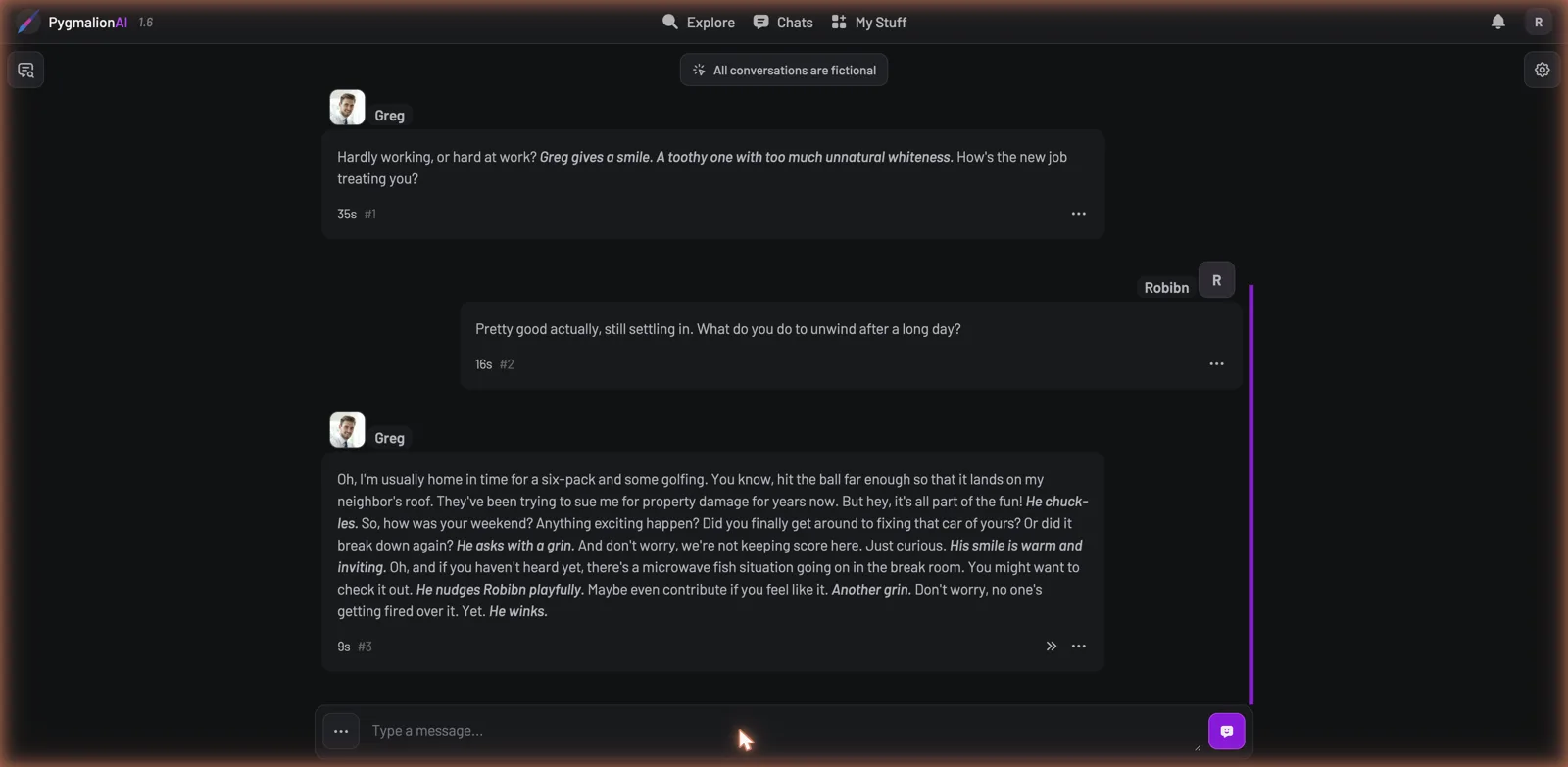
The opening message set the tone right away, mixing dialogue with roleplay narration written in italics, the classic asterisk-action style. I asked Greg what he does to unwind after a long day, and the reply was better than I expected. He rambled about getting home for a six-pack and some golfing, hitting the ball onto his neighbor’s roof, the neighbors trying to sue him for property damage, and a running bit about a microwave fish situation in the office break room. It stayed in character, it was actually funny, and it looped back to ask about my weekend and whether I had fixed my car yet. That last part is the tell of a good roleplay model. It does not just answer and stop, it keeps the scene alive and hands the story back to you.
Responses stream in as they generate, and the writing leaned long and descriptive rather than clipped. If you like meaty replies with narration and internal thoughts, that is the default flavor here. It reminded me of the more writing-focused platforms like DreamGen, where the model is clearly tuned for storytelling rather than quick one-liners.
Settings for people who actually read the settings
Here is where Pygmalion separates itself from the point-and-flirt crowd. Open the panel on the right and you get Chat, Completion, and Style tabs stuffed with controls.
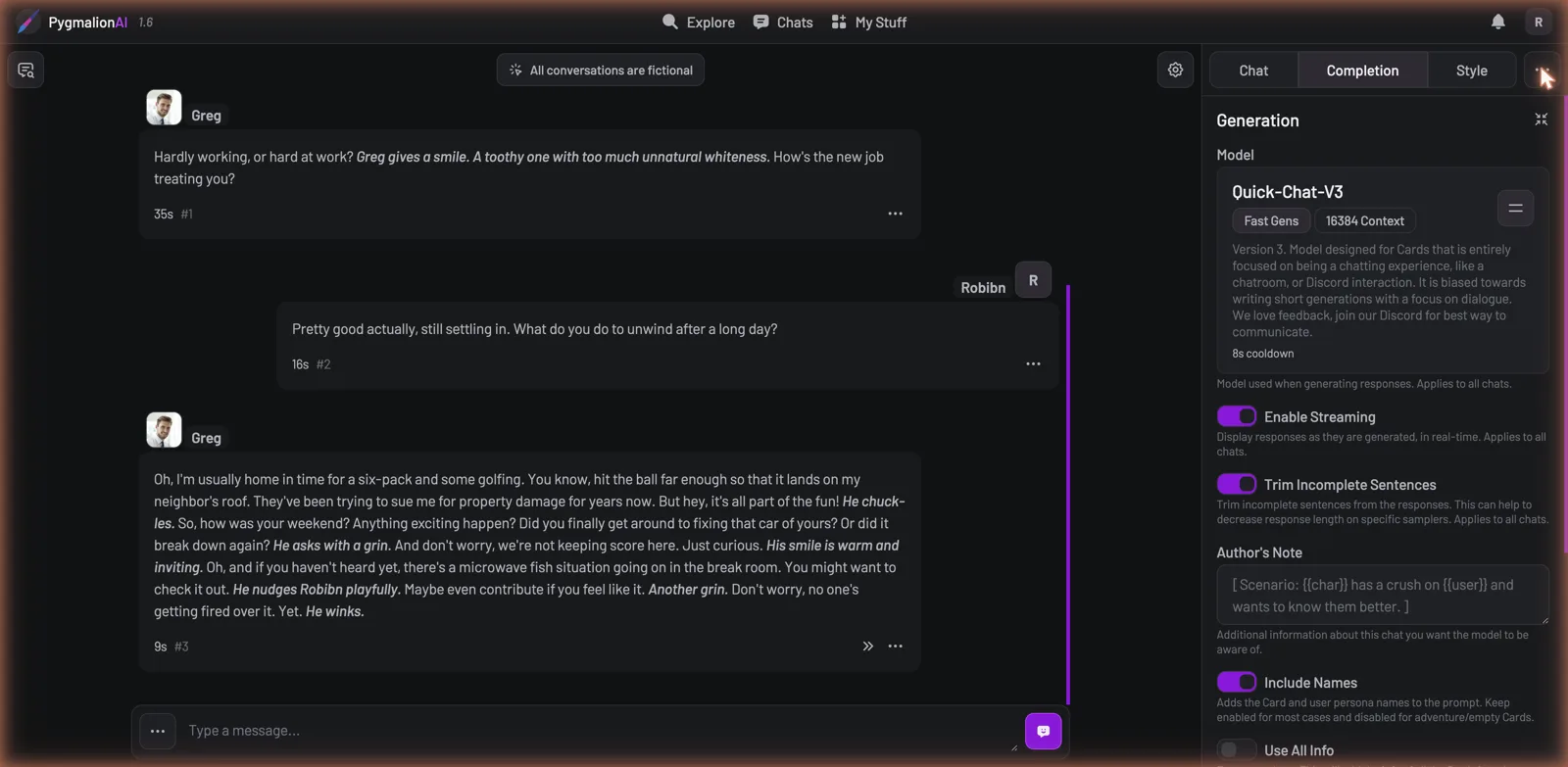
You can pick your model, toggle streaming, trim incomplete sentences, and write an Author’s Note that quietly steers the scene, for example nudging the character toward a particular scenario or mood. There are switches for including names in the prompt and pulling in all the card’s info. None of this is required, the defaults work fine, but if you are the kind of person who likes to tune your samplers and context handling, the knobs are all here. This is the stuff that usually lives in a separate front-end app like SillyTavern, baked right into the website.
The model selection deserves its own paragraph because it is the heart of the whole thing.
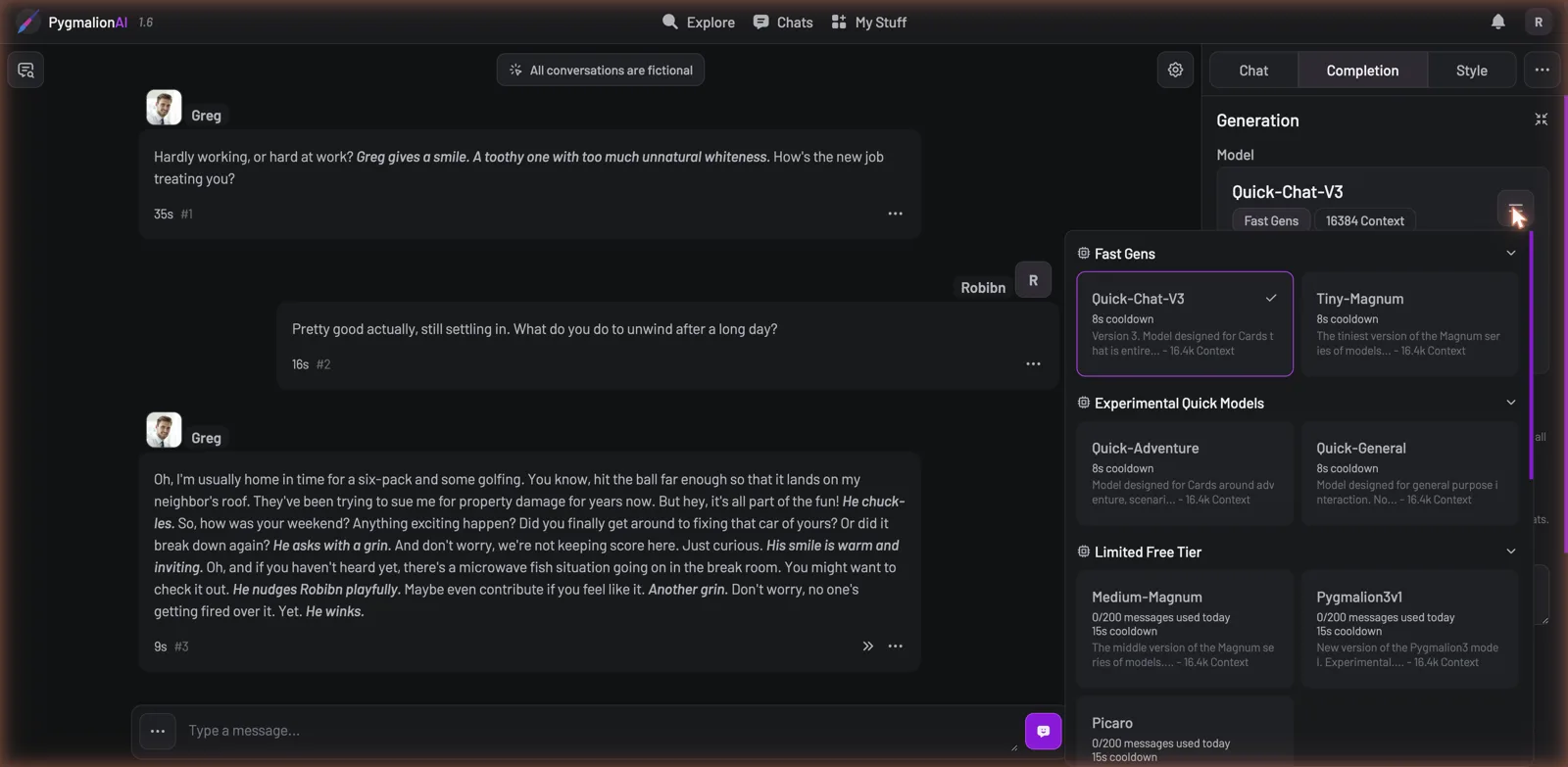
The models are sorted into groups. Fast Gens like Quick-Chat-V3 and Tiny-Magnum are quick and free with a short cooldown between messages and around 16k of context. There is a Limited Free Tier with beefier options like Medium-Magnum, Pygmalion3, and Picaro, capped at 200 messages a day with a slightly longer cooldown. Then there is a wall of locked models sitting at 32k context, and finally a Premium Models section with the big guns, including Hermes IV 405B courtesy of Nous Research and GLM 4.5 Air, both running around 131k of context. The point is that your subscription is really buying you access to better and bigger brains, not just cosmetic perks. That is a refreshingly honest way to sell a plan.
What it costs, and what the memory system is about
Pygmalion runs three plans, and the differences are mostly about models, context, and memory rather than gimmicks.
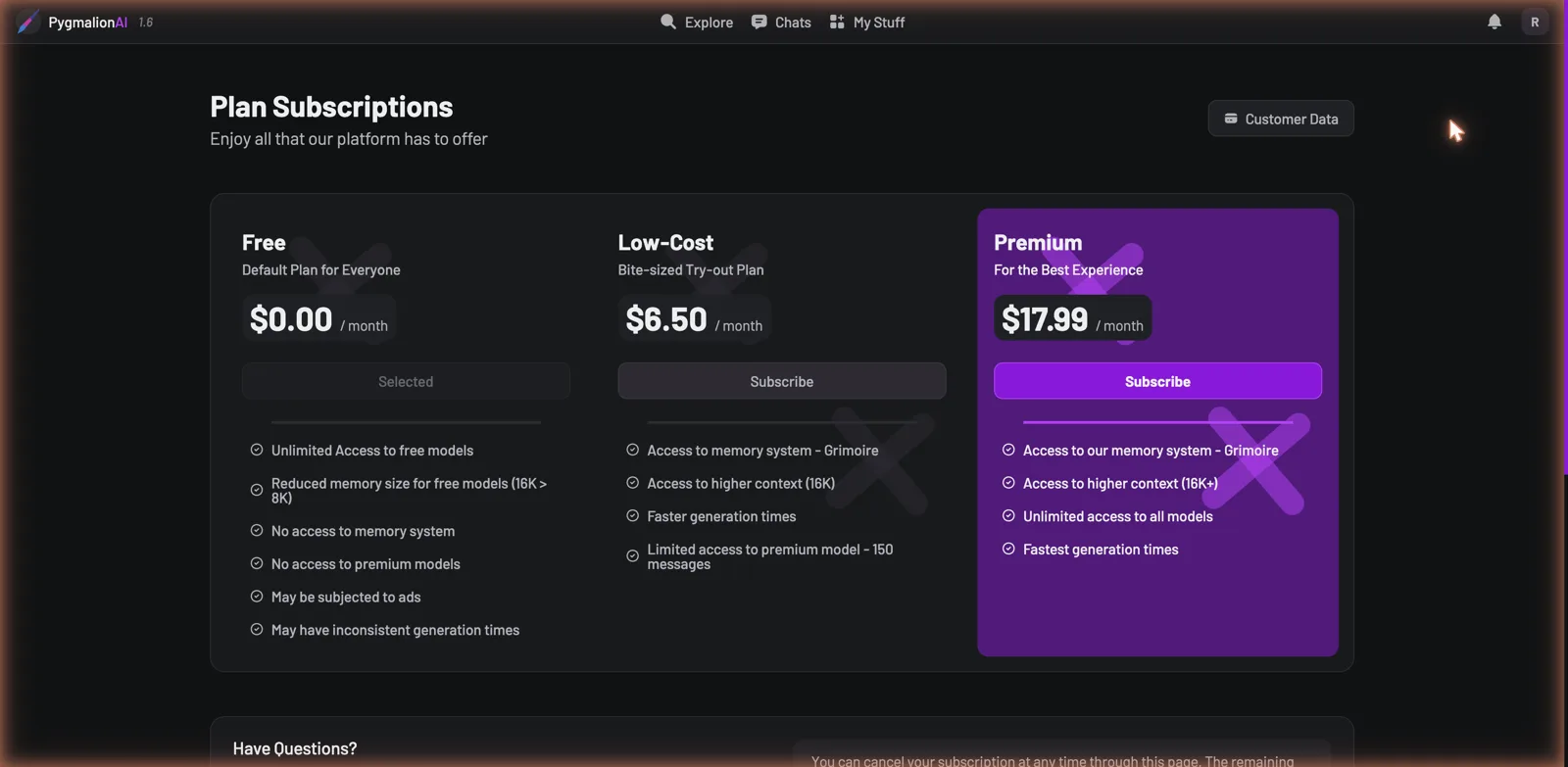
The Free plan is genuinely usable. You get unlimited access to the free models, though your memory is squeezed down from 16k to 8k, you get no access to the premium models or the memory system, and you might see ads and slower generation at busy times. The Low-Cost plan at $6.50 a month adds the Grimoire memory system, higher 16k context, faster generation, and limited access to a premium model with a 150-message allowance. The Premium plan at $17.99 a month is the full experience: Grimoire memory, higher context, unlimited access to every model, and the fastest generation times. You can cancel any time.
That Grimoire memory system is the piece worth understanding. On the free tier the character basically only remembers the recent conversation, so long roleplays start to drift. Paying unlocks a proper long-term memory layer, which is the difference between a character who forgets your backstory after an hour and one that actually keeps track. If long, continuous storylines are your thing, that feature is the reason to upgrade, not the model access.
The adult question, answered straight
People always want to know where a roleplay site lands on the NSFW spectrum, so let me be clear. Pygmalion is not marketed as a porn app. There is no wall of explicit thumbnails on the homepage and no “unlock nudes” paywall. It is a general roleplay platform where the community makes the characters, and because the models are relatively unfiltered, mature roleplay is possible if that is the card and direction you choose. The framing is fiction and storytelling first, with the spicier stuff being something users can steer toward rather than the headline product.
That puts it in the same family as CrushOn.AI and PepHop AI, character-card platforms where the range is wide and the direction is up to you, rather than the explicitly adult generators. If you want a site that leads with romance or leads with porn, this is neither. It leads with characters.
What I liked and what bugged me
On the plus side, the free tier is real and not a three-message tease, the chat writing has genuine personality, and the model variety is the best I have seen baked directly into a website. The character-card system is deep and familiar to anyone who has traded cards, and the settings give you the kind of control that usually requires bolting on a separate app. The pricing is also refreshingly transparent about what you are actually paying for.
On the downside, all that depth is a double-edged sword. If you just want to open a tab and start flirting with a pretty face, the character-card and settings machinery can feel like a lot. The interface is functional rather than glamorous, and the community-made art means quality and consistency vary card to card. The message caps and cooldowns on the better free models are fair, but they will nudge heavy users toward paying sooner than they might expect. And without the paid memory system, long roleplays do start to lose the thread.
One more thing worth setting expectations on: this is a text platform at heart. Unlike the image-forward apps I usually test, you are not here for photorealistic selfies or generated video of your companion. The characters have avatar art on their cards, but the product is the writing. If your idea of a good AI companion session involves a stream of pictures, Pygmalion will feel bare. If it involves a story you and the model build together over dozens of messages, it is right in its element. Knowing which camp you fall into will save you some disappointment.
The community angle is baked in too. A banner on the homepage points you to a Discord where the team talks to users, shares model updates, and runs events, and several of the model descriptions openly ask for feedback. That back-and-forth is part of why the platform keeps shipping new models and features, and it is a nice reminder that there are actual people iterating on this rather than a faceless company drip-feeding updates. If you like being close to the development of the tools you use, that access is a genuine perk.
Who Pygmalion is for
Pygmalion.chat is for the roleplay hobbyist. If you care about character cards, model choice, adventure scenarios, and long collaborative stories, and you want a site that respects your ability to tinker, this is one of the strongest picks around, and you can get a real feel for it without spending a cent. The heritage shows in the best way, this was built by people who actually roleplay.
If you are looking for a slick AI girlfriend with photos, voice notes, and a swipe-friendly interface, you will find the whole card-and-settings approach heavier than you want, and you would be happier on one of the girlfriend-first apps. But taken for what it is, a deep, model-rich, community-driven roleplay platform with an honest free tier, Pygmalion remains one of the names that earned its reputation. Just go in knowing the real upgrade you are buying is memory and bigger models, not blurred pictures.