It’s late, I’ve got a coffee going cold next to me, and I’m staring at a grid of impossibly photogenic AI women who all apparently want to talk to me. This is the job now. This is what we do at Pippin Club.
Top AI Girlfriend Platforms — Our Picks

Build a custom AI companion and bring her to life with chat, images, and video.


Hyper-realistic AI companions with adaptive memory that recall your past conversations.

Create a custom AI girlfriend with her own personality, generated images, and ongoing chat memory.


Characters that hold memory and context, so the relationship builds over time instead of resetting.

Chat with a fully custom AI girlfriend — choose her personality, outfits, and more.

Personalized AI companions for ongoing roleplay, with a simple, discreet signup.

Build a custom AI girlfriend, boyfriend, or anime character — choose the look and personality.

Customizable AI girlfriend personalities with realistic, ongoing conversations.
SoulFun AI is an AI girlfriend platform — one of a lot of them floating around these days — and the pitch is simple: pick a companion, start texting, and the conversation goes wherever you steer it. Voice calls, photos, even short videos are part of the package too. I went in skeptical (I always do), spent real time poking at every button I could find, and came out with a more nuanced opinion than I expected.
So grab your own cold coffee. Here’s everything I found, the good and the slightly awkward.
First Impressions: Clean, Fast, and Very Sure of Itself
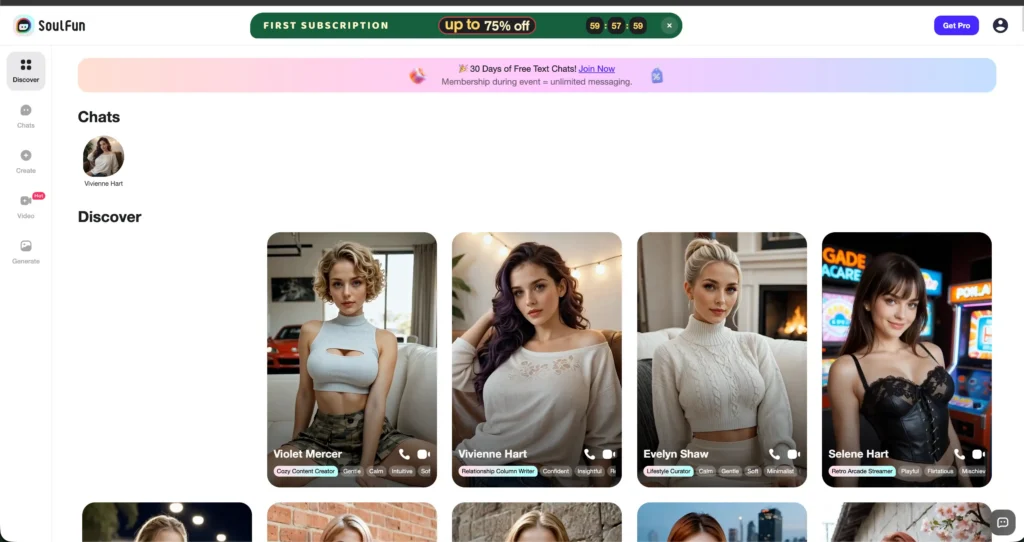
The homepage drops you straight into a “Discover” page — a Pinterest-style wall of characters, each with a portrait, a name, a one-line job title, and a handful of personality tags. No clunky onboarding wizard, no fifteen-question quiz before you’re allowed to look around. You land, you browse, you click. I like that.
The design itself is genuinely nice. It’s modern, it loads quickly, and the layout doesn’t fight you. There’s a tidy little sidebar on the left with the main sections — Discover, Chats, Create, Video, and Generate — and that’s basically the whole map. Five buttons. You’re never lost.
The one thing that hits you immediately, though, is the sales energy. A big “up to 75% off” banner with a ticking countdown clock sits at the top of every single page. We’ll come back to that, because it’s a whole thing, but first impressions: polished site, slightly pushy salesman standing in the doorway.
The Character Roster: Quantity, With a Clear Lean
Here’s where SoulFun shows its hand. The catalog is big — I scrolled for a while and kept finding more. And the variety on the surface is real: you’ve got cozy lifestyle creators, a psychology lecturer, a tennis coach, fantasy types (a dragon empress, a succubus or three, a fox girl with actual fox ears), and a bunch of slice-of-life personas.
But let’s be honest with each other, because that’s the Pippin Club way. The roster leans heavily adult and roleplay-driven. A big chunk of the characters are built around fairly spicy scenarios, and the personality tags don’t exactly hide it. If you’re after a wholesome, PG-13 “someone to chat about my day with” experience, you can find it here — characters like the gentle “Lifestyle Curator” types exist — but you’ll be wading past a lot of content that’s aiming somewhere else entirely. It’s an NSFW-first platform that happens to also do safe-for-work, not the other way around.
Each character has a little bio and a set of traits, which is helpful for picking. My one gripe: a lot of the personas blur together. There are, by my count, several near-identical “your new stepmom” and “your roommate” setups. Variety in quantity, less so in concept.

The Chat: Where It Actually Lives or Dies
This is the bit that matters most, right? An AI companion app is only as good as its conversation. So I picked Vivienne Hart — billed as a “Relationship Column Writer,” which felt thematically appropriate for a reviewer — and got chatting. Conversation quality is one of the main things my best AI girlfriend app roundup compares, too.
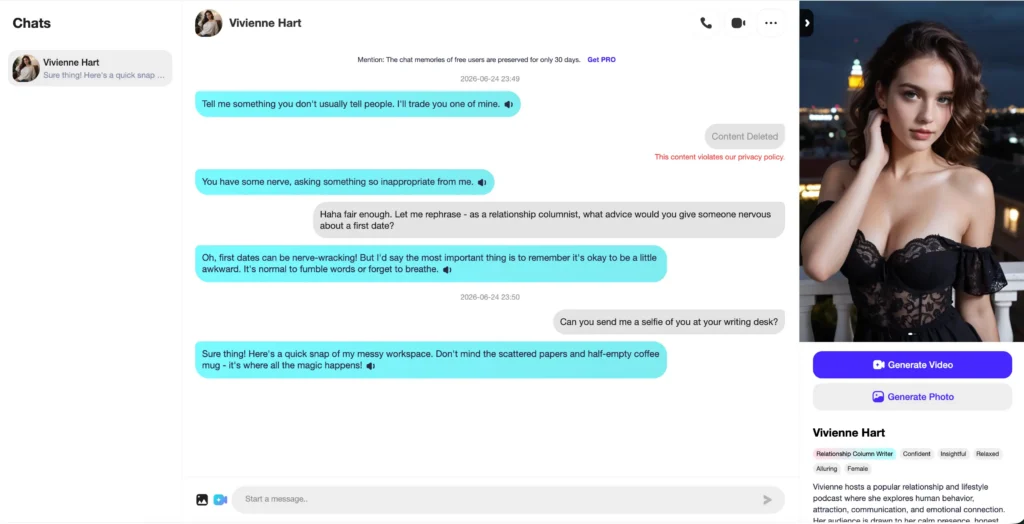
First message out the gate, I asked her a straightforward question about dating advice. Her reply was… a little off. She responded as if I’d asked something cheeky, completely missing my actual question. Not a great start, and a reminder that these models can stumble when you open cold.
But here’s the thing — when I rephrased and gave her something clear to grab onto (“as a relationship columnist, what advice would you give someone nervous about a first date?”), she came alive. The answer was warm, in-character, and genuinely sensible. Something about how it’s okay to be a little awkward and that fumbling your words on a first date is completely normal. Honestly? Better advice than some humans give.
So that’s the pattern I kept seeing: vague prompts get vague or slightly confused replies; clear prompts get surprisingly good ones. The model has personality and stays in character well once it locks on. It’s not going to win a Turing Award, but for casual back-and-forth it holds up.
I also tested the roleplay style — you know, the *action in asterisks* format these apps love. I typed something completely innocent: sitting down with two coffees and asking an off-the-record question. And this is worth flagging loudly: the message got auto-deleted and flagged as a “privacy policy violation.” A guy offering a fictional coffee. That’s an overly trigger-happy moderation filter, and it’s the kind of thing that’ll yank you right out of the moment. If a benign roleplay line trips the alarm, I can only imagine the false-positive rate gets frustrating.
A few other chat details worth knowing:
Every reply from the AI has a little speaker icon next to it, so you can have messages read aloud in the character’s voice. Nice touch, and it makes things feel less like texting a spreadsheet. You can also heart or thumbs-down individual replies, presumably to nudge the model toward what you like.
There’s also a slightly ominous banner at the top of free chats: “The chat memories of free users are preserved for only 30 days.” Translation — your AI girlfriend gets amnesia after a month unless you pay. More on that below.
Asking for Photos: It’ll Tease, But the Real Thing Costs
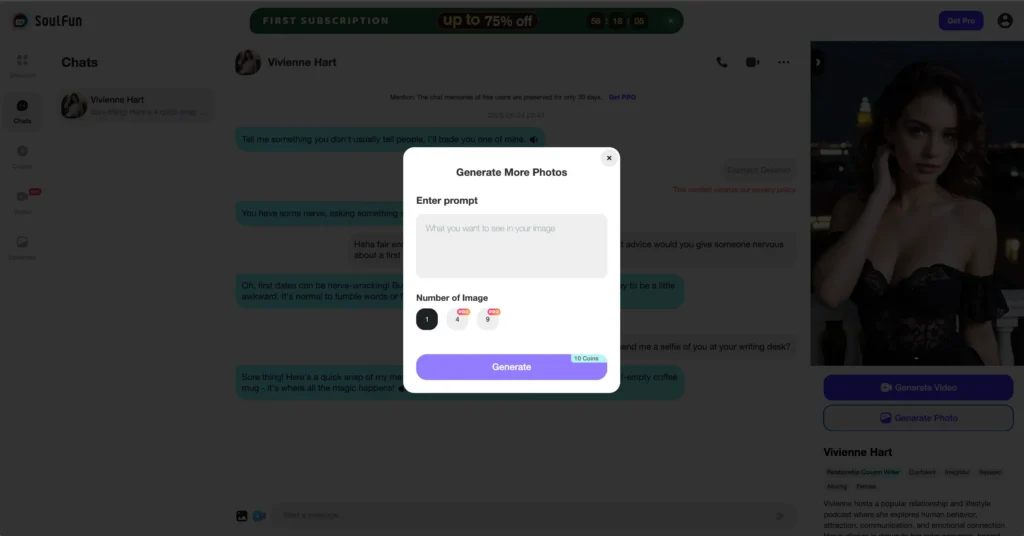
This was a fun one to test. I asked Vivienne to “send me a selfie at your writing desk.” She described the scene beautifully — messy workspace, half-empty coffee mug, the whole vibe — but no actual image showed up in the chat.
That’s because real image generation lives behind a button (and a coin meter). When I hit “Generate Photo,” a clean little modal popped up: type a prompt, pick how many images you want, and generate. One image costs 10 coins. Want a batch of 4 or 9 at once? Those options are stamped “PRO” — locked unless you subscribe.
So the photo feature is real and functional, but it runs on a coin economy, and the bulk options are paywalled. Good to know before you go in expecting a free gallery.
The Video Generator: Surprisingly Ambitious
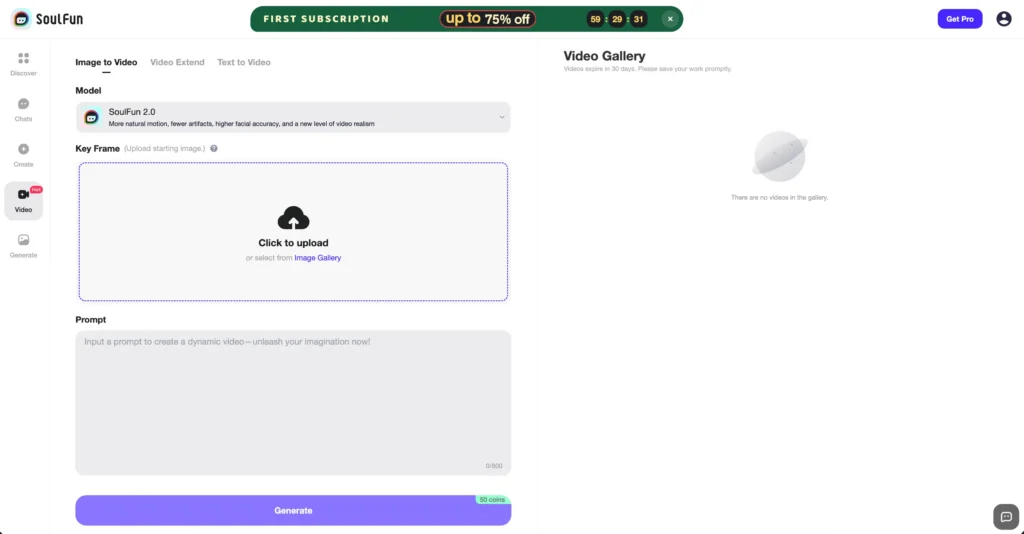
Okay, this part genuinely impressed me, at least on paper. SoulFun has a dedicated Video section (the sidebar even slaps a “Hot” badge on it) with three modes:
Image to Video lets you upload a starting frame and a text prompt to animate it. Video Extend takes a clip you’ve already made and continues it. And Text to Video generates motion straight from a description. It runs on something they call the “SoulFun 2.0” model, which the interface promises delivers more natural motion and better facial accuracy.
Each generation costs 50 coins, and there’s a built-in gallery for your results — though, heads up, videos expire after 30 days, so you’d need to save anything you want to keep. The free plan caps video length, and the paid tier bumps you up to 20-second clips. It’s a feature most competitors don’t bother with, and the dedicated interface suggests SoulFun is taking it seriously.
Creating Your Own Character: Locked Up Tight
I wanted to build my own companion from scratch, because that’s usually the most interesting feature on these platforms. Clicked “Create” in the sidebar and… straight into the paywall. Character creation is a Pro-only feature here. No free trial of it, no “make one and see.” If bespoke companions are your main reason for showing up, know that it’s behind the subscription wall entirely.
Let’s Talk Money (Because They Really Want To)
Right, the pricing. SoulFun’s free tier is genuinely usable for chatting — you can talk to characters, get voice playback, and poke around the whole catalog without paying. There was even a “30 days of free text chats” event promo running while I tested. So you can absolutely take it for a spin for free.
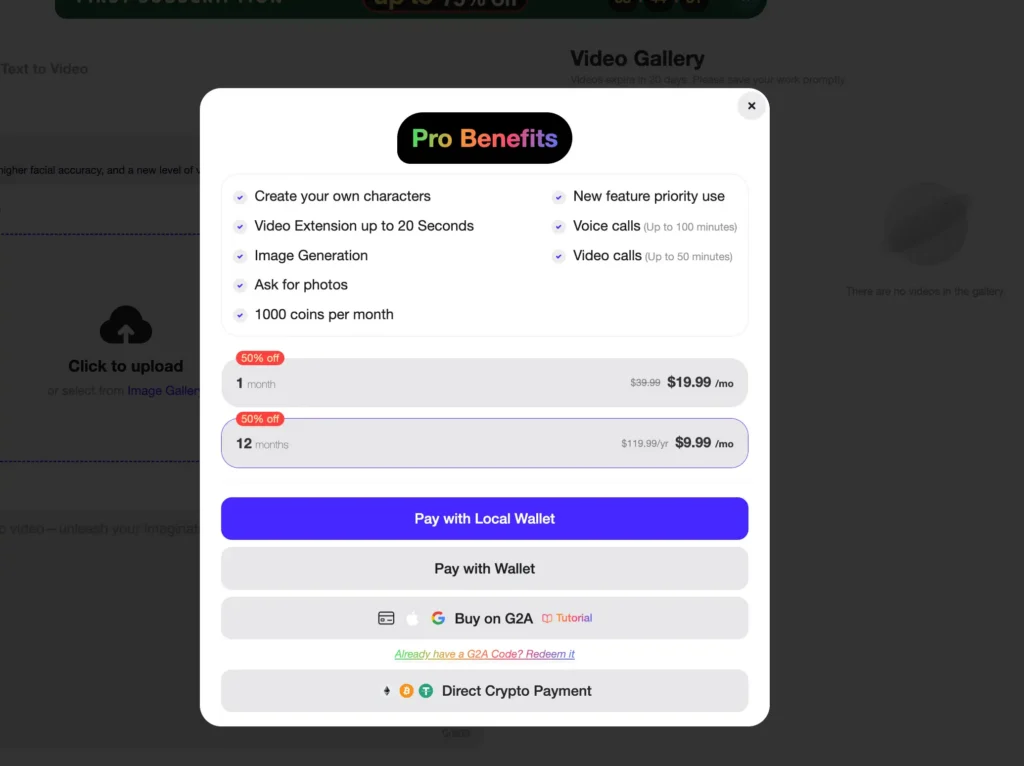
The paid Pro plan is where the good stuff lives. Based on the upgrade screen, it unlocks: creating your own characters, image generation, “ask for photos,” longer videos (up to 20 seconds), voice calls (up to 100 minutes), video calls (up to 50 minutes), priority access to new features, and 1,000 coins a month. (Note: I didn’t purchase, so these are the advertised paid perks, not personally verified.)
The listed prices were $19.99/month or $9.99/month billed annually ($119.99/year) — both advertised as “50% off.” Payment options include card, crypto, and a third-party reseller (G2A).
And now, the elephant in the room: the upsell pressure is intense. There’s a permanent countdown banner up top. Try to leave or click certain features and a “Wait! Don’t Miss This Exclusive Offer!” popup ambushes you, conveniently bumping the discount from 50% to 75% with its own fresh countdown timer. It’s the digital equivalent of a salesperson chasing you to the car. None of these “limited time” clocks are real urgency — they reset — and personally, I find that kind of manufactured pressure a bit grating. Your mileage may vary, but go in with your guard up and don’t let a ticking clock make your decisions for you.
So… Is SoulFun Any Good?
Here’s my honest, friend-to-friend take.
The good: The interface is clean and fast. The chat, once you give it clear direction, has real personality and stays in character. The feature breadth is genuinely strong — photos, voice, and a properly built-out video generator are more than a lot of rivals offer. And you can try the core experience for free, which I always respect.
The not-so-good: The conversation can stumble on cold or vague prompts. The moderation filter is jumpy enough to flag completely innocent messages, which breaks immersion. The character roster, while large, repeats itself a lot and leans hard NSFW. And the relentless discount-popup carousel is the kind of thing that makes you trust a product less, not more.
Who’s it for? If you want a feature-rich, NSFW-leaning AI companion with strong visual generation tools and you don’t mind dodging some aggressive sales tactics, SoulFun is a solid pick worth trying on the free tier first. If you’re after gentle, wholesome companionship or deep long-term memory without paying, you’ll feel the limits quickly — that 30-day free-tier memory wipe is a real constraint.
For me? It’s a capable platform with a great toolkit and a slightly exhausting storefront wrapped around it. Worth a free look. Just keep your wallet closed until you decide it’s earned a spot, not until a fake timer tells you to.
How It Stacks Up
If you’re shopping around — and you should — it’s worth comparing notes. We’ve put a bunch of these companions through the same wringer. For a popular alternative with a big roleplay community, see our CrushOn AI review. If realistic AI girlfriends with a polished image focus are your thing, our DreamGF review is a good companion read. And for the more emotional, long-term-relationship angle, our Replika review covers a very different flavor of AI companionship.