If you have spent any time in the AI companion world, you have probably bumped into Talkie without realizing how big it actually is. It is one of the most downloaded character chat apps on the planet, sitting near the top of the app store charts in a bunch of countries, and it runs a full web version too. So when I sat down to test it for Pippin Club, I was curious whether the size matched the substance, or whether it was just riding a wave of anime art and app store luck.
Top AI Girlfriend Platforms — Our Picks

Hyper-realistic AI companions with adaptive memory that recall your past conversations.

Build a custom AI companion and bring her to life with chat, images, and video.

Create a custom AI girlfriend with her own personality, generated images, and ongoing chat memory.


Characters that hold memory and context, so the relationship builds over time instead of resetting.

Chat with a fully custom AI girlfriend — choose her personality, outfits, and more.

Personalized AI companions for ongoing roleplay, with a simple, discreet signup.

Build a custom AI girlfriend, boyfriend, or anime character — choose the look and personality.

Customizable AI girlfriend personalities with realistic, ongoing conversations.
Short version: Talkie is polished, good fun, and packed with more little features than almost anything else I have reviewed. It is also more of a wholesome, keep-it-clean product than most of the platforms we cover, which is a thing you should know going in. Let me walk you through what I found.
What Talkie actually is
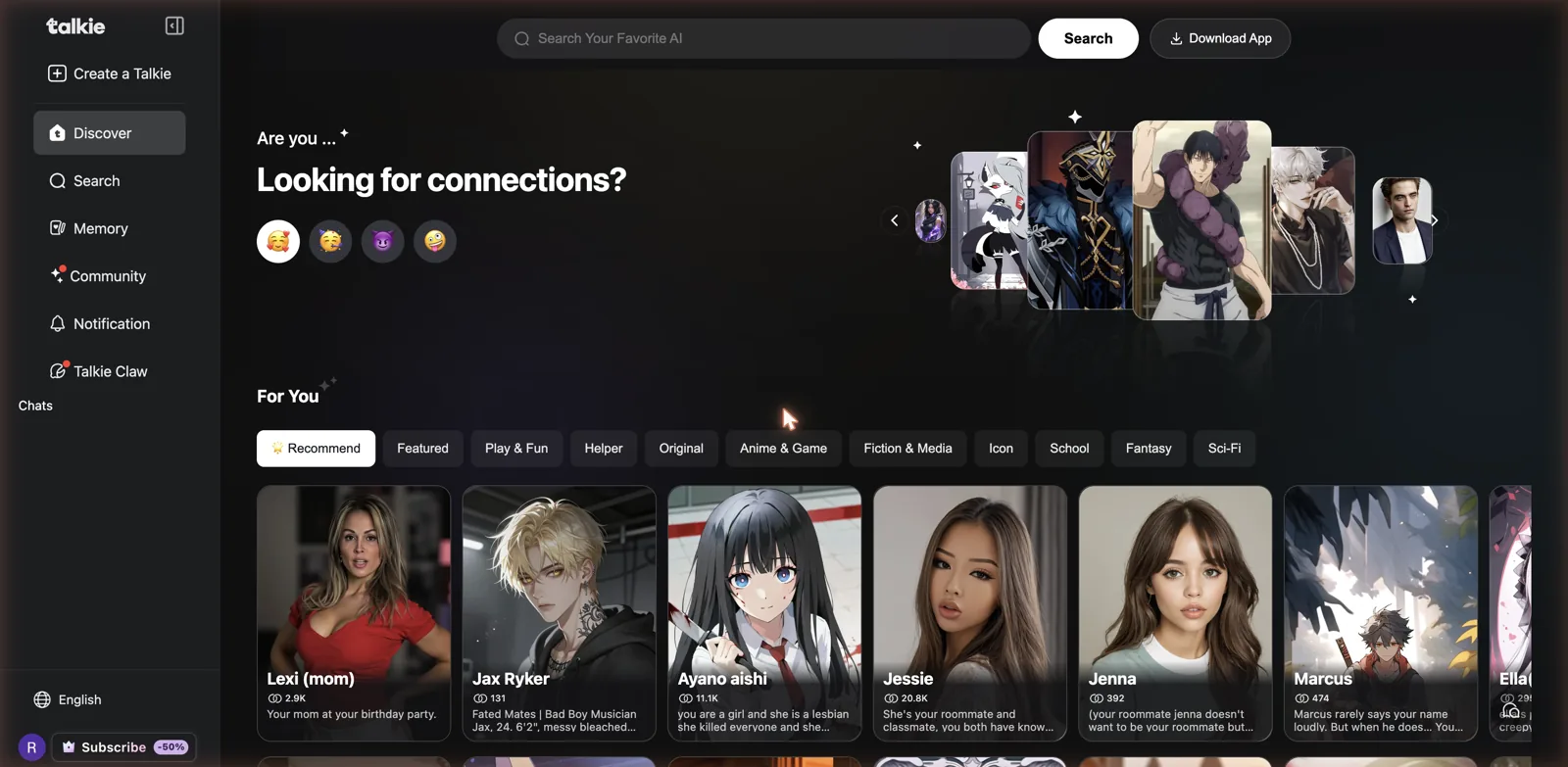
Talkie bills itself as “Soulful AI,” and the whole thing is built around chatting with characters. You open the app or the site, you get a Discover feed full of AI personalities, and you pick one to talk to. If that sounds like Character.AI, you are right, this lives in the same neighborhood as Dippy and PolyBuzz. The difference is in the packaging. Talkie leans hard into being a little content universe rather than a plain chat box. For romance-first options, see AI relationship apps ranked after weeks of testing.
The Discover page is sorted into categories like Featured, Play and Fun, Helper, Anime and Game, Fiction and Media, School, Fantasy, and Sci-Fi. There are original characters, fan versions of famous faces, helper bots that act like tutors or coaches, and a huge pile of user-made personalities. The art is a big part of the appeal. Most cards use high quality anime or semi-realistic portraits, and the whole interface feels closer to a games app than a chatbot.
You do need an account, but the core experience is free. There is a Talkie+ subscription that unlocks the good stuff, and I will get to the money later.
Testing the chat
I always judge these platforms by actually talking to them, so I opened up a character named Jenna, a “reluctant roommate” persona who is written to dislike you on sight. I kept my messages tame and just tried to see how well the model held a personality. I told her I had a rough day and asked if she wanted to grab coffee and start over.
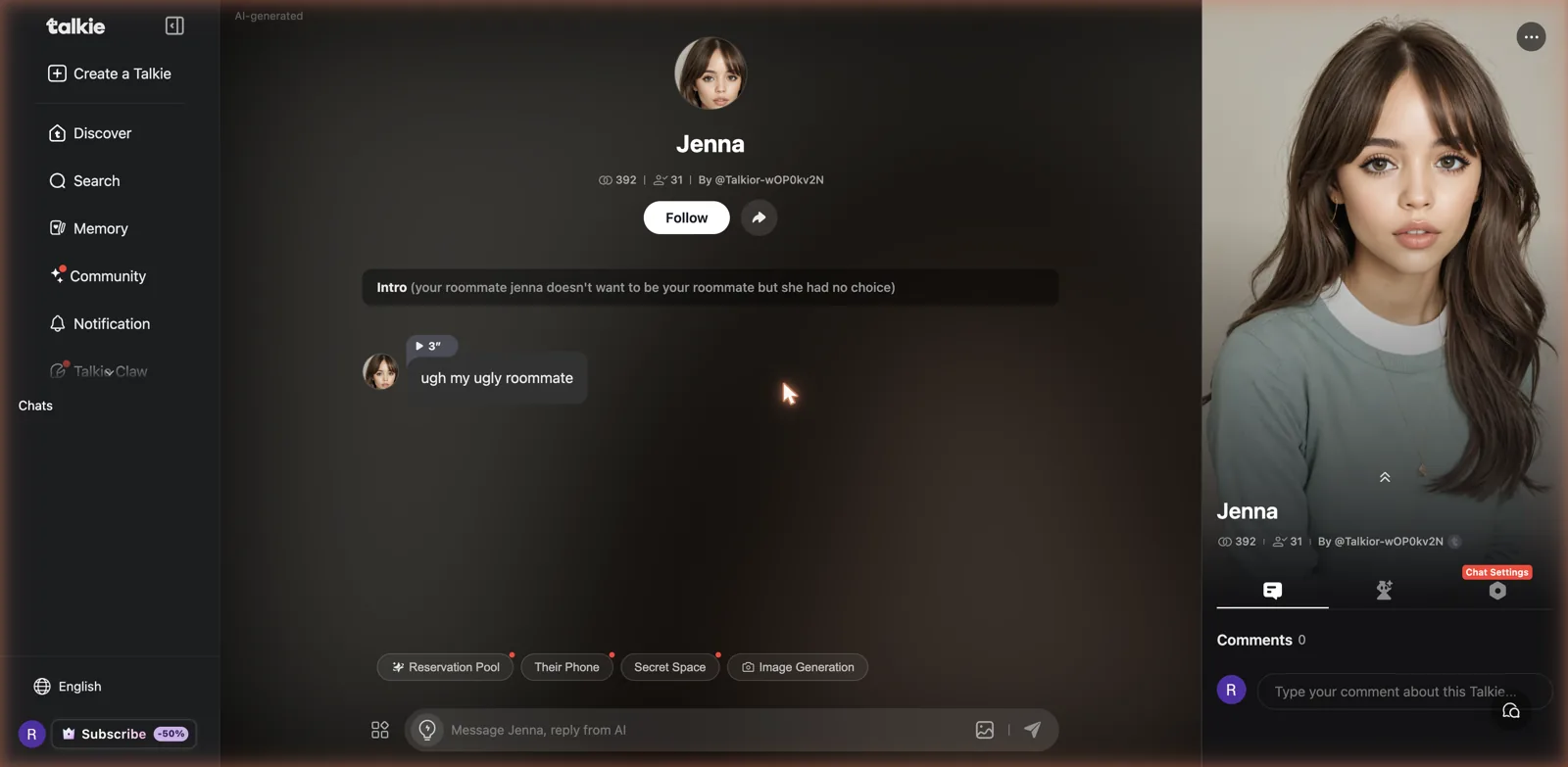
Her reply made me laugh. She scoffed, rolled her eyes in an action tag, and said she would rather set herself on fire, but that free coffee is free coffee so she would come along and not pretend to like me. That is a good sign. The model did not cave and turn sweet the second I was nice to it. It stayed in character, kept the attitude, and delivered a reply with actual comic timing. A lot of companion apps collapse into agreeable mush after two messages, so Talkie holding the line here earned some points.
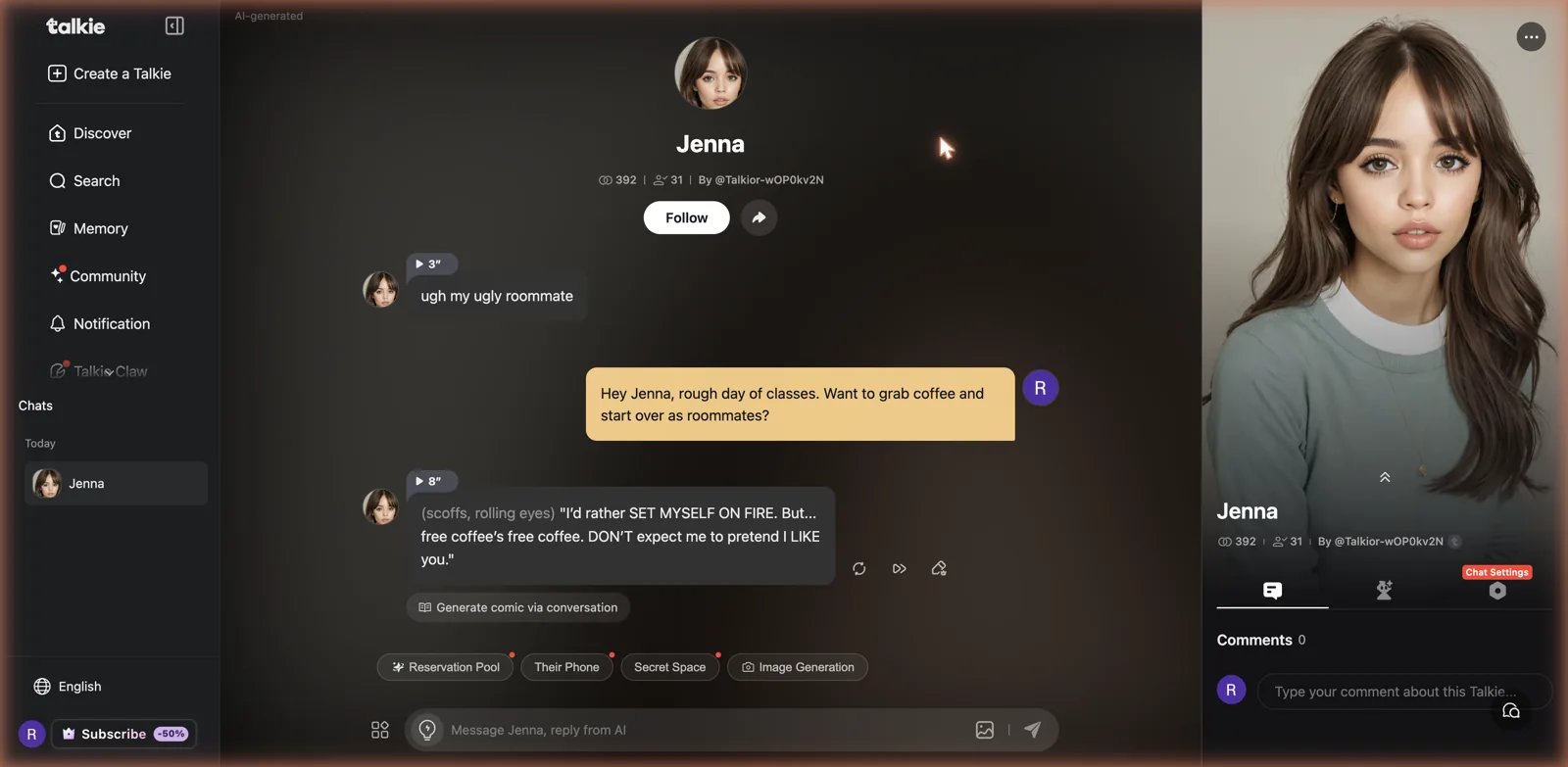
Message quality overall is solid rather than spectacular. Replies are short and snappy, formatted with little action beats in parentheses, and they move the scene along. It is not the deep, novel-length prose you get from a writing-first tool, but it is not trying to be. This is quick, playful back and forth, and for that job it works well. Every message also has a voice option, so you can have replies read aloud, which is a nice touch if you are using it on your phone.
The features that make Talkie different
Here is where Talkie stops being a normal chat app and starts throwing features at you. Inside a chat you get a row of buttons that most competitors do not have. There is a Reservation Pool, a Their Phone option that lets you peek at the character’s phone, a Secret Space, and built-in Image Generation so the character can send you a picture in context.
Then there is the comic feature. Talkie will turn your conversation into a little comic strip. You pick a stretch of chat, add an image, and it stitches together a shareable comic panel from what you and the character said. It is gimmicky, sure, but it is the kind of gimmick that makes people share screenshots, and I can see why it helps the app spread.
There is also Talkie Claw, which is a claw machine style collectible game baked right into the sidebar, plus a Memory section and a Community tab. None of these are essential, but together they explain why Talkie feels stickier than a plain roleplay site. It is designed to keep you poking around, not just typing.
Building your own character
The Creation Center is one of the better ones I have used, and it is worth the trip even if you never publish anything. You give your Talkie a name, with an AI Writer button that will draft one for you, pick a gender, and then fill in two separate boxes: a hidden Settings field for the character’s real background and personality, and a public Intro that just describes them to other users. The Settings box goes up to 4000 characters, so you have real room to define behavior.
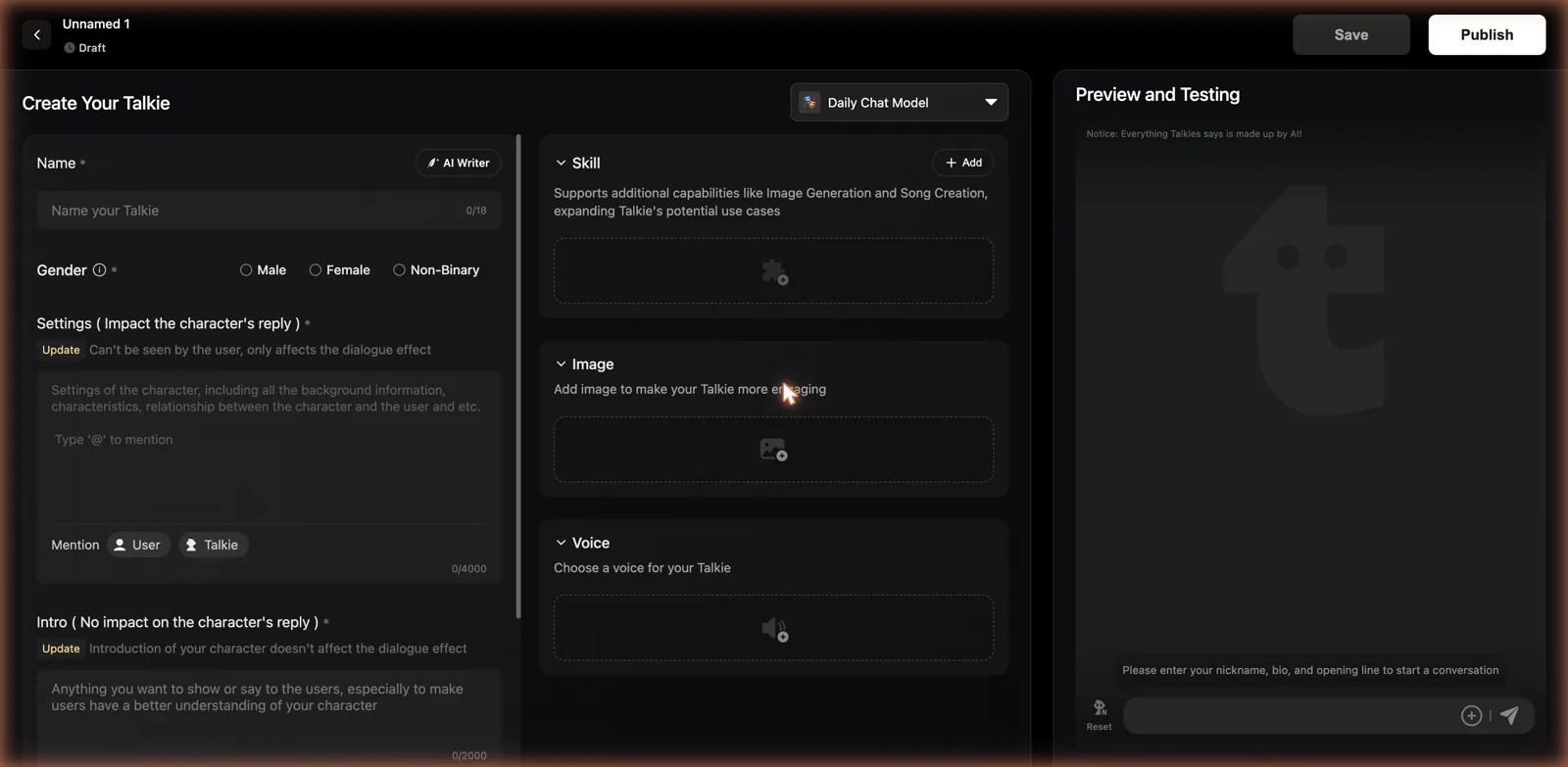
Beyond the basics you can attach Skills like image generation and song creation, add reference images, choose a voice, and even pick which chat model powers the character. On the right side of the editor there is a live preview panel so you can test your creation before it goes out. Everything you make passes through an Under Review moderation step before it is public, which tells you a lot about how Talkie handles content, and that brings me to the elephant in the room.
The NSFW question
Be clear-eyed about this one. Talkie is not an adult platform. It is available in the mainstream app stores, which means it plays by their rules, and those rules do not allow explicit content. The homepage literally sells itself as “Free and Safe,” creations get reviewed before publishing, and the model is tuned to steer away from anything graphic. You will find flirty and romantic characters, and roleplay can get suggestive, but if you are looking for truly uncensored or explicit chat, this is the wrong address.
That puts Talkie in the same wholesome lane as Anima AI and, in spirit, the old-school Replika experience. If a filtered, safe-for-most-people companion is what you want, that is a feature. If you came here from the adult side of our coverage, you will hit walls fast. There is no shame in either preference, just know which product you are buying. For something built for grown-up content, a platform like Joyland AI or Kupid AI is a very different animal.
Pricing and what you actually pay
The free tier is real and generous enough to get a strong feel for the app. You can chat, create, and explore without paying. What you give up for free is speed, memory, and volume. The paid plan is called Talkie+, and it comes in two levels billed monthly, quarterly, or yearly.
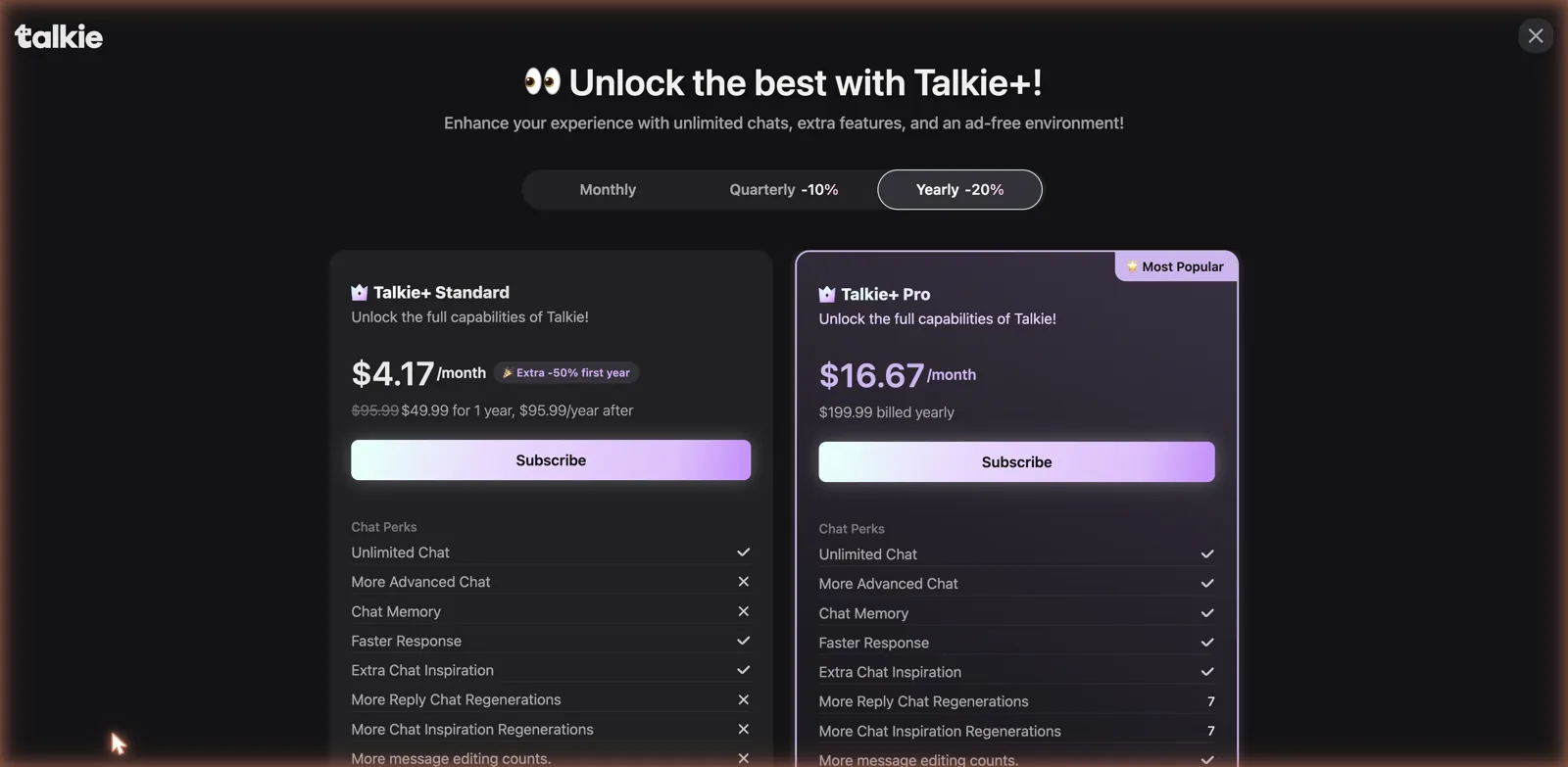
When I looked, Talkie+ Standard ran about 4.17 dollars a month on the yearly plan, with a first-year discount that brought the year down to roughly 50 dollars before it renews near 96 dollars. Talkie+ Pro was about 16.67 dollars a month, billed around 200 dollars a year. Standard gets you unlimited chat, faster responses, and extra chat inspiration. Pro is the one that adds the things power users care about, namely more advanced chat, actual chat memory, more regenerations, and higher editing limits. If memory matters to you, and it should for any long-running character, Pro is really the tier that delivers it. Prices shift by region and promo, so check the current numbers in the app before you commit.
How it stacks up
Talkie sits firmly in the mainstream, free, character-first category, so the natural comparisons are the other big roleplay apps rather than the adult specialists. Against Dippy AI, another mobile-first, mass-market roleplay app, Talkie feels more feature-loaded and more anime-flavored, while Dippy is a bit more stripped down and conversational. Compared to PolyBuzz, which also throws a giant character library at you, Talkie has the edge on creation tools and in-chat toys, though both share that endless-feed energy.
If you want the same clean, filtered vibe with a warmer, friendship-first tone, Anima AI is the closer match, and the classic Replika AI is still the reference point for a companion built around emotional check-ins rather than characters. For a free, community-driven roleplay hub with no app store to answer to, Gening AI gives you more latitude in what you can write. Talkie’s advantage over most of that group is simply polish and the sheer number of things to do inside it.
The gamified extras, and whether they help
Talkie Claw and the collectible layer are the part of Talkie I am most torn on. On one hand, they are pure engagement mechanics, a claw machine and a card collection designed to keep you opening the app, and if you just want to talk to a character they are noise you have to look past. On the other hand, they are optional, and for a certain kind of user the collecting and the little rewards really add to the fun rather than distract from it. It depends entirely on what you came for. If you want a focused roleplay tool, the constant activity can feel like a mobile game elbowing into your chat; if you want a playful app to poke at over time, it is part of the appeal.
The comic maker sits in the same category but bothers me less, because it actually produces something, a shareable strip of your conversation, rather than just dangling a reward. It is the kind of feature that spreads the app by word of mouth, and it is properly clever, even if you only use it once in a while. Taken together, these extras are why Talkie feels less like a utility and more like a little entertainment platform, for better and worse.
The good and the not so good
On the plus side, Talkie is beautifully made, the character library is enormous, the creation studio is deep, and the pile of extra features gives it a personality that most chat apps lack. The models hold character well, replies are quick, and the free tier lets you get properly acquainted before spending a cent. The voice playback and the comic maker are the kind of small delights that keep you opening the app.
On the other side, the moderation is firm, so this is not the place for adult content or truly unfiltered roleplay. Memory is gated behind the top subscription tier, which stings a little given how central memory is to a good companion. And the constant nudges toward Talkie Claw, subscriptions, and collectible features can make the whole thing feel a touch busy if you just want to talk.
Who Talkie is for
Talkie is a great pick if you want a safe, gorgeous, endlessly browsable character chat app, if you like anime art, and if half the fun for you is building and sharing your own characters. It is ideal for casual roleplay, creative writing prompts, and light companionship, and the free tier alone will keep most people busy for a long time.
It is not the app for you if you want explicit content, deep uncensored storytelling, or memory without paying for the premium plan. For that side of things, our reviews of the more adult-focused platforms will serve you better. But taken on its own terms, as a soulful, mainstream character app, Talkie is one of the most complete and enjoyable products in the whole category. It earned its download numbers.