

Xeve.ai leads with a pitch you do not see everywhere: AI girlfriends for video chat. Where most companion platforms are text-first with images bolted on, Xeve puts video and voice front and center, with a credits system that pays for the media rather than a flat subscription. I spent time browsing the roster, walking the character builder, pricing out the credits, and running a real chat with a tame prompt to see how the model actually behaves. It is a video-and-voice-forward platform with a chat that, in my testing, was more restrained than most. Here is the rundown.
The short take: Xeve.ai is a video-chat-focused AI girlfriend platform built around AI-generated images, video clips, and automatic voice replies, paid for with credits rather than a subscription. Its roster leans suggestive, it is adults-only, but the chat itself stayed conversational and on-topic in my test rather than rushing to the explicit.

Built around video and voice, not just text
The thing that sets Xeve apart is where it puts its emphasis. The homepage is headed AI Girlfriends for Video Chat, characters carry Live Now and Trending badges, and a video-call button sits at the top of every conversation. Inside the chat, alongside the text box, are dedicated Get an Image and Get a Video buttons, so generating media is a first-class action rather than a hidden extra. And every reply I got came with an AI-generated voice clip attached automatically, a short audio playback of what the character just said, without my having to ask for it.
That multimedia focus is the whole identity here. Plenty of platforms can generate a picture if you prod them, but Xeve is built so that images, video clips, and voice are the point rather than the afterthought. If you want a companion you can hear and watch rather than only read, that emphasis is a real differentiator, and it is more than most competitors bundle into one place. The trade-off, as I will get to, is that all of that media runs on credits, so the richer experience has a running meter attached.
It is worth being clear about what this design is trying to be. A text-only companion asks you to imagine the person on the other end; Xeve is trying to reduce how much you have to imagine by showing and voicing them. Whether that lands for you is a matter of taste. Some people find the added media pulls them into the illusion, and others find that a generated face or a synthetic voice breaks it rather than building it. I lean toward thinking the voice clips add more than the on-demand pictures do, because a voice arrives with every message for free while the images cost credits and interrupt the flow, but both are clearly central to what Xeve is selling, and if the multimedia angle is what drew you in, this is a platform that takes it seriously rather than treating it as a checkbox feature.
Human or AI-generated, your choice
The character builder opens with a question I have not seen framed quite this way before.
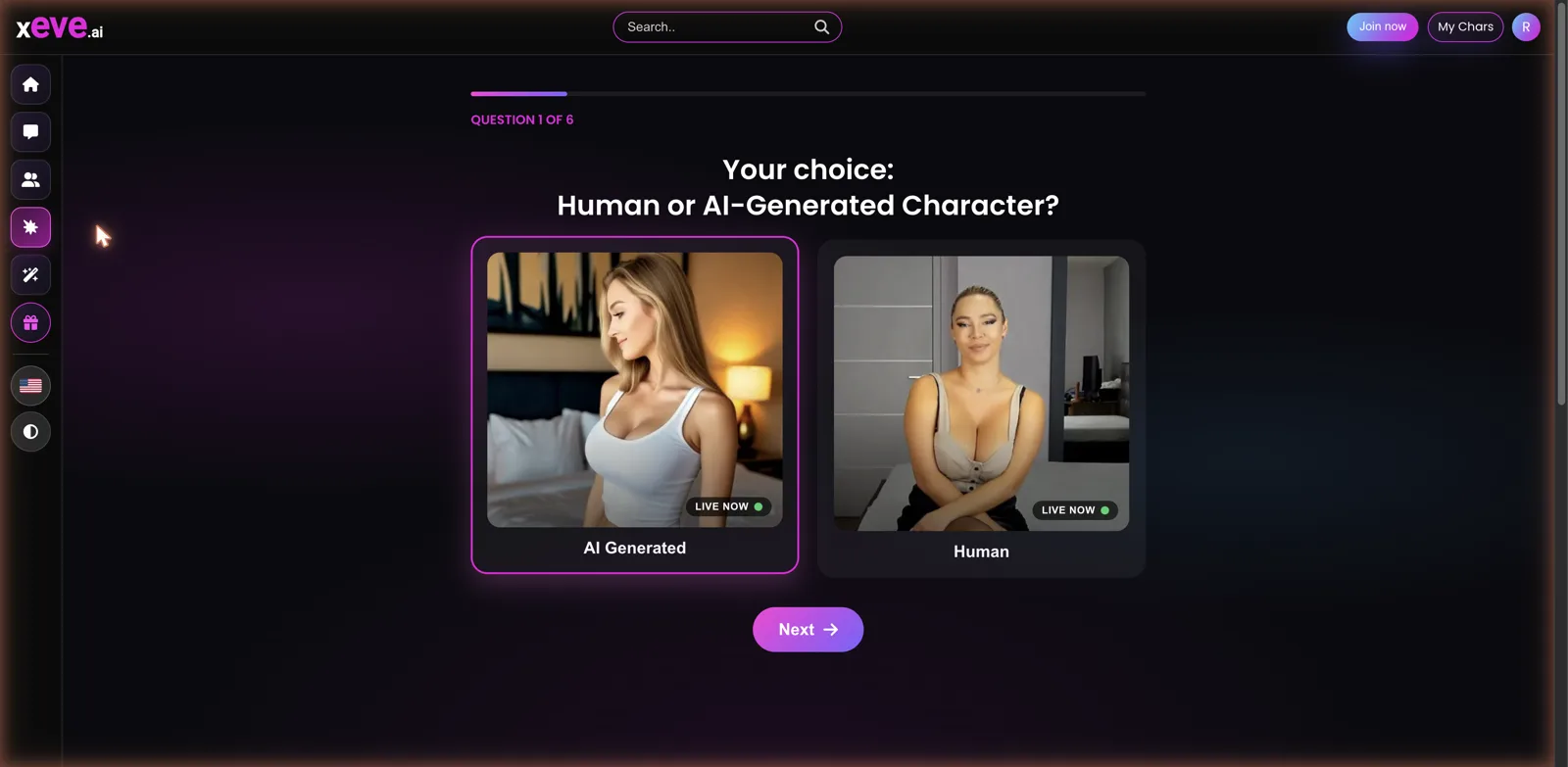
Question one of six asks whether you want a Human or an AI-Generated character, presenting the two side by side. It is an unusual first choice, and it signals that Xeve is blending photorealistic AI companions styled to look like real people with more openly synthetic ones, giving you a fork right at the start based on how lifelike you want your companion to look. The Human-versus-Avatar split also shows up as a filter on the main roster, so it runs through the whole platform rather than being a one-off toggle.
From there the wizard is a clean, six-step flow.
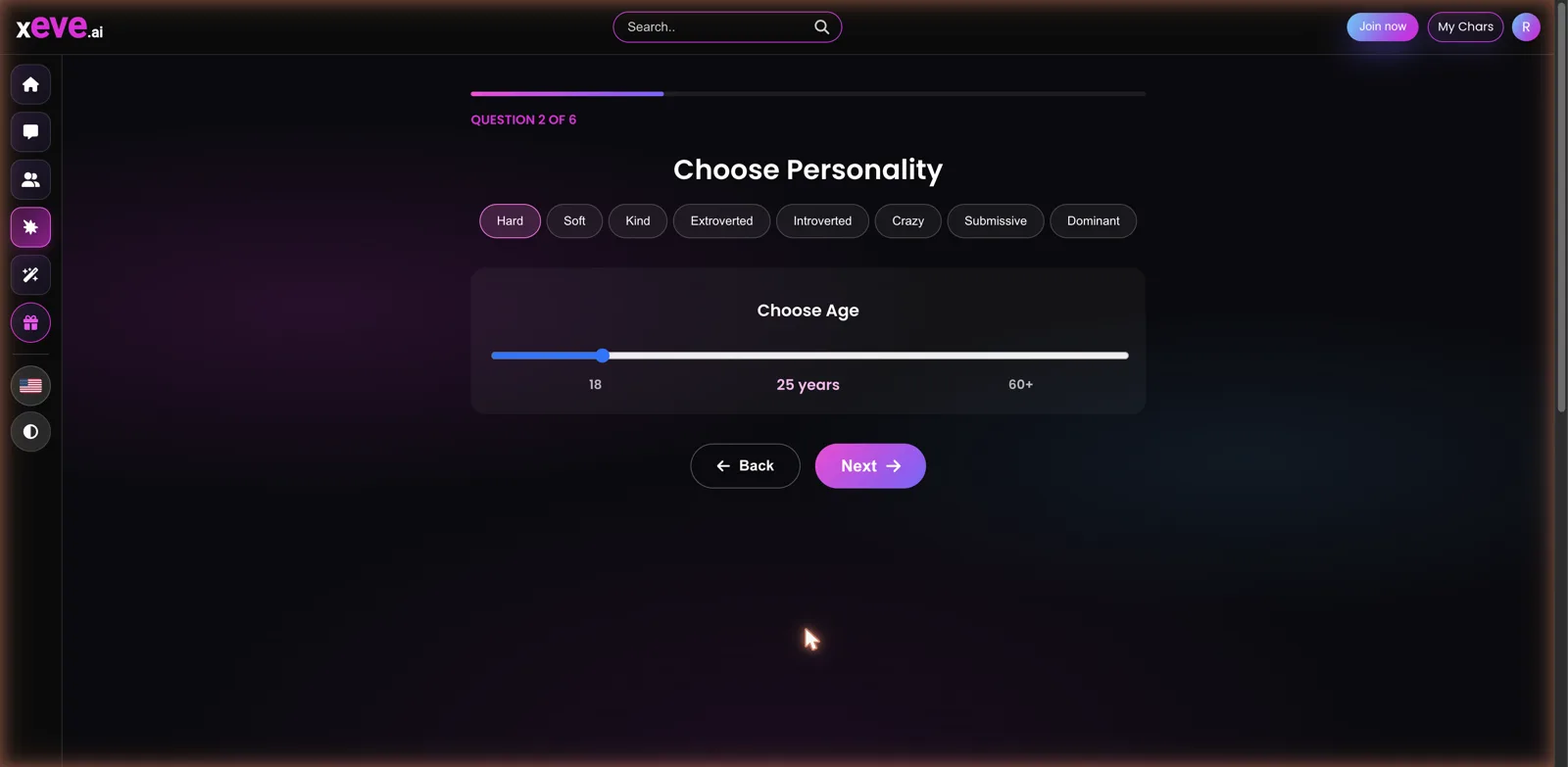
Step two lets you pick a personality from a spread of traits, Hard, Soft, Kind, Extroverted, Introverted, Crazy, Submissive, or Dominant, and set an age on a slider running from 18 up to 60-plus, defaulting to the mid-twenties. The remaining steps continue in the same guided style. It is not the deepest builder in the category, but the step-by-step structure keeps it approachable, and the personality and age controls give you enough to shape a companion to a specific vibe without drowning you in sliders.
The chat was more restrained than I expected
I opened a chat with Elise, a character framed as an easygoing outdoorsy type, and tested it with a deliberately tame opener: I introduced myself and asked whether she went camping often, staying well away from anything suggestive to see whether the model would match my register or push past it.
It matched it. Elise replied in character, said she liked camping and enjoyed getting away into nature with someone special, and turned the question back on me, all in a warm, conversational tone with a mild flirty lean but nothing explicit. The reply arrived with an AI-generated voice clip so I could hear it read aloud. That is a meaningful contrast with a lot of the more aggressive platforms in this space, where even a tame prompt gets yanked toward the bedroom. Xeve’s chat, at least on this character and this opener, was content to have an actual conversation. If you want a companion that can hold a normal, romance-leaning chat rather than one that treats every message as a cue to escalate, that restraint is a genuine plus, and it makes the platform feel less one-note than its lingerie-heavy shopfront suggests.
I should be measured here, because I tested one character with one line of conversation, and different characters, especially the more explicitly framed ones, will behave differently. But the model was coherent, stayed in character, and respected the tone I set, which is more than I can say for several competitors. The automatic voice on every reply is a nice touch that adds presence, and the suggested-reply chips keep things moving if you are not sure what to say next.
A suggestive roster, adults-only
Let me be clear about the content, because the shopfront sets a tone. The roster is lingerie-and-bikini-forward, with character cards leaning on suggestive imagery and short flirty bios, and the image and video generator can produce explicit results, with example outputs on the Generate page ranging up to near-nude. This is an adults-only platform, and the marketing leans on sex appeal throughout.
That said, in my hands the browsable character profiles I opened stayed on the swimwear side rather than explicit nudity, and the chat, as noted, was tamer than the imagery implies. So Xeve sits in an interesting middle: it looks racier than it necessarily plays, at least until you deliberately push it or spend credits on explicit generation. If suggestive imagery on the shopfront bothers you, this is not the platform for you. If you are comfortable with an adult, video-forward companion that can also just talk, it is more versatile than it first appears.
Browsing the roster and finding a character
The home page is a wall of characters, each with a short flirty bio, a Live Now or Trending badge, and a one-line hook: a flirty sales girl, a broke university student, a natural beauty at a lakeside campground. Clicking through to a character opens a detail page with a small gallery of that companion in different settings and a Chat button to jump straight in. The left sidebar keeps navigation simple, with Home, Chat, My Chars, Create a Character, Generate Video, and My Membership, and a filter rail lets you narrow the roster by All, Human, Avatar, Trending, or New.
The Human-versus-Avatar filter is the interesting one, echoing that first builder question and letting you sort for photorealistic companions styled like real people versus more openly synthetic ones. In practice the roster is broad enough to find a range of looks and personalities, and the Live Now framing gives the whole thing a slightly cam-site energy, leaning into the video-chat positioning. The bios are thin and the hooks are formulaic, so do not expect deep character writing from the pre-built roster the way a community-authored platform offers, but for picking someone to start a video-forward chat with, the browse experience does the job. If none of the pre-made characters fit, the six-step builder is there to make your own.
What it costs: credits, not a subscription
Xeve breaks from the subscription norm and runs entirely on credits, which you spend to generate media. Image generation costs 5 credits per shot and video generation costs 20 credits per clip, so your real spend depends heavily on how much media you make. Chatting itself is the cheap part; the pictures and especially the videos are where credits go.
The credit packs were 70 credits for $4.99, 200 credits for $9.99, 500 credits for $22.99, 1,000 credits for $39.99, and a best-seller 5,000-credit pack for $179.99, with first-time-buyer discounts of up to 40 percent advertised behind a countdown timer. As a rough guide the platform framed the mid pack as something like 100 image unlocks or 40 video unlocks, so a video clip is worth several still images in credit terms. The no-subscription model is a double-edged thing: you are never locked into a recurring charge, which is a real plus if you dislike auto-renewals, but heavy video use will burn through packs quickly, and the countdown-timer urgency on the pricing page is the kind of pressure tactic I would rather platforms skip. Buy a small pack first and see how far it goes before committing to a big one.
What I liked and what I did not
On the plus side, the video-and-voice focus is a real differentiator, the automatic voice clips on every reply add presence, and the chat was more conversational and less pushy than most of its rivals in my test. The Human-versus-AI-generated choice is a thoughtful bit of design, the builder is approachable, and the credits model means no forced subscription. Being able to request an image or video mid-chat is convenient.
On the downside, the credits system makes real costs hard to predict and heavy video use drains packs fast, the pricing page leans on countdown-timer urgency, and the roster and generator lean suggestive enough that the shopfront will put some people off. My testing of the video and voice-call features was limited, since those consume credits I did not spend, so treat them as present and central to the pitch but not something I stress-tested. And as always with a one-character chat test, your mileage with the more explicitly framed companions may differ.
Who Xeve.ai is for
Xeve.ai suits someone who specifically wants a video-and-voice-forward AI girlfriend rather than a text-only one, and who likes the flexibility of paying per credit instead of committing to a subscription. If hearing and seeing your companion matters to you, and you value a chat that can hold a normal conversation rather than one that rushes to the explicit, Xeve offers a distinctive mix. The credits model rewards light, deliberate users who generate media occasionally rather than constantly.
If you would rather pay a flat monthly fee and generate freely without watching a credit balance, a subscription platform will suit you better, and if you want the deepest possible character builder or a purely text-focused roleplay, other options go further on those axes. A memory-focused companion like Nectar AI or an image-and-chat all-rounder like DreamGF may fit those needs more closely. But taken for what it is, a video-chat-first, voice-enabled AI girlfriend platform with a credits economy and a surprisingly conversational chat, Xeve.ai is a distinctive pick. Go in knowing it is 18-plus, that the media runs on credits, and that the shopfront looks racier than the chat necessarily plays. For people who want to watch and hear their companion, it compares well with broader platforms like CraveU AI on the multimedia front.