HammerAI gets a lot right for privacy-minded roleplayers, unlimited free chat, real local model support through Ollama, and honest pricing from a solo developer. It also has real limits worth knowing before you commit: image and voice generation need paid credits from the first use, full local privacy requires the desktop app and decent hardware, the free context window tops out at 8,192 tokens, and cloud image credits run out fast if you generate a lot of pictures. If any of that sounds like friction you would rather avoid, here are eight platforms worth comparing it against, from other local and open-source options to polished hosted alternatives. Read the full HammerAI review for the complete picture.
Top AI Girlfriend Platforms — Our Picks

Hyper-realistic AI companions with adaptive memory that recall your past conversations.
Build a custom AI companion and bring her to life with chat, images, and video.

Create a custom AI girlfriend with her own personality, generated images, and ongoing chat memory.

Characters that hold memory and context, so the relationship builds over time instead of resetting.

Chat with a fully custom AI girlfriend — choose her personality, outfits, and more.
Personalized AI companions for ongoing roleplay, with a simple, discreet signup.

Build a custom AI girlfriend, boyfriend, or anime character — choose the look and personality.
Customizable AI girlfriend personalities with realistic, ongoing conversations.
The lineup at a glance
| Platform | Best for | Starting price | Free tier | Review |
|---|---|---|---|---|
| Chub AI | Tinkerers who want to tune the engine and treat roleplay as a sandbox | $5/mo (Mercury) | Good | Read the review |
| PepHop AI | No-signup roleplay fans who want API flexibility without an account | $5.99/mo (Classic, billed annually) | Fair | Read the review |
| Venice AI | Privacy-conscious users who want one private, do-anything AI, not just a companion | $18/mo (Pro) | Thin | Read the review |
| Pygmalion AI | Roleplay hobbyists who care about character cards and model choice | $6.50/mo (Low-Cost) | Good | Read the review |
| Kindroid | Power users who want deep memory and voice, and will pay a premium for it | $11.66/mo (billed yearly) | Good | Read the review |
| DreamGen | Writers and roleplayers who want depth and control over long-form scenarios | $7.83/mo (Starter) | Fair | Read the review |
| Muah AI | A flirty, deeply customizable, image-and-voice-capable companion | $5.83/mo (VIP Access, billed yearly) | Excellent | Read the review |
| Role Play Hub | Cheap, no-fuss uncensored text roleplay with chats private by default | $3.99/mo (Premium) | Good | Read the review |
Pricing and free tier, side by side
| Platform | Cheapest plan | Free tier generosity | NSFW level |
|---|---|---|---|
| HammerAI | $9/mo (Starter) | Excellent | Uncensored |
| Chub AI | $5/mo (Mercury) | Good | Uncensored |
| PepHop AI | $5.99/mo (Classic, billed annually) | Fair | Uncensored (paid upgrade) |
| Venice AI | $18/mo (Pro) | Thin | Uncensored |
| Pygmalion AI | $6.50/mo (Low-Cost) | Good | Community (unfiltered models, steerable) |
| Kindroid | $11.66/mo (billed yearly) | Good | Community (romantic-capable, not policy-organized) |
| DreamGen | $7.83/mo (Starter) | Fair | Community (uncensored but writing-first) |
| Muah AI | $5.83/mo (VIP Access, billed yearly) | Excellent | Uncensored |
| Role Play Hub | $3.99/mo (Premium) | Good | Uncensored |
Free-tier standouts
| Platform | Free tier | Why it stands out |
|---|---|---|
| HammerAI | Excellent | Local models via Ollama are free forever with no message cap, so the free tier never really runs dry if you are willing to run your own chat engine. |
| Muah AI | Excellent | Free photo generation rides along with unlimited chat, most companion apps meter images even on paid plans, let alone free ones. |
| Chub AI | Good | The character library, builder, and lorebook system are all free to use; only the larger models sit behind the $5 Mercury tier. |
| Pygmalion AI | Good | The free-model roster is unlimited, not a teaser, so text roleplay never actually stops, only bigger models and long memory are gated. |
| Role Play Hub | Good | A 2,000-word daily cap looks small until you notice unlimited character creation and private-by-default chats come with it at zero cost. |
Chub AI

Chub AI runs on the same do-it-yourself instinct as HammerAI: both are built for people who want to poke at settings, not just tap send on a pre-packaged girlfriend app. Chub keeps everything in the browser, so there is no Ollama setup and no desktop client to install, which makes it faster to try. The trade-off is where your data lives. HammerAI can run entirely on your own hardware; Chub’s chats, cards, and presets stay on Chub’s servers no matter which plan you pick. If you would rather pay for a hosted app, see the AI girlfriend apps worth paying for.
- Thousands of community character cards with a Timeline feed and stats
- Full chat-tree branching with edit, regenerate, and swipe
- Lorebooks (modular memory files) and shareable generation presets
- Voice generation available as a paid add-on
The free tier already lets you browse the full library, build characters, and chat on the default model. Mercury at $5/mo unlocks Mistral 7B and MythoMax 13B with 8K memory; Mars at $20/mo adds bigger models like Mixtral 8x7B plus voice. HammerAI’s chat stays free forever regardless of model size once you are running locally, while Chub charges even at the low end just to reach its bigger models.
PepHop AI

PepHop shares HammerAI’s open-source, bring-your-own-API-key streak, and it stores your keys locally the same way HammerAI’s proxy option does. Where it differs is the on-ramp: PepHop skips accounts entirely, you can browse and chat without signing up at all, while HammerAI still wants you to pick a path (cloud, local Ollama, or your own API) before you get moving. PepHop’s free sample is a hard 50-message allowance though, nothing close to HammerAI’s genuinely unlimited free chat.
- No-account browsing and chatting, with a 20,000+ character library
- Advanced settings that route requests to PepHop’s own model, OpenAI, or KoboldAI
- Swipe and regenerate alternates, plus message edit and delete
- Voice call in beta
Classic on the 12-month plan runs about $5.99/mo and unlocks 5,000 messages/mo on a 70B model with 4K memory and uncensored chat. Elite on the 12-month plan runs about $17.99/mo for a higher message ceiling and the best model. HammerAI’s local chat never hits a message cap once it is set up; PepHop’s paid tiers still meter messages monthly even after you pay.
Venice AI

Venice is the closest philosophical match on this list: both platforms lead with privacy-first, no-filter design instead of a slick girlfriend front end. The difference is scope. Venice is a general-purpose AI with chat, images, video, music, and code, where custom characters are one feature among many, not the whole product the way they are on HammerAI. HammerAI wins on raw chat volume since its free tier has no daily cap; Venice wins on model variety, with access to Kimi K2.5 and Grok 4.3, plus an anon proxy to Claude.
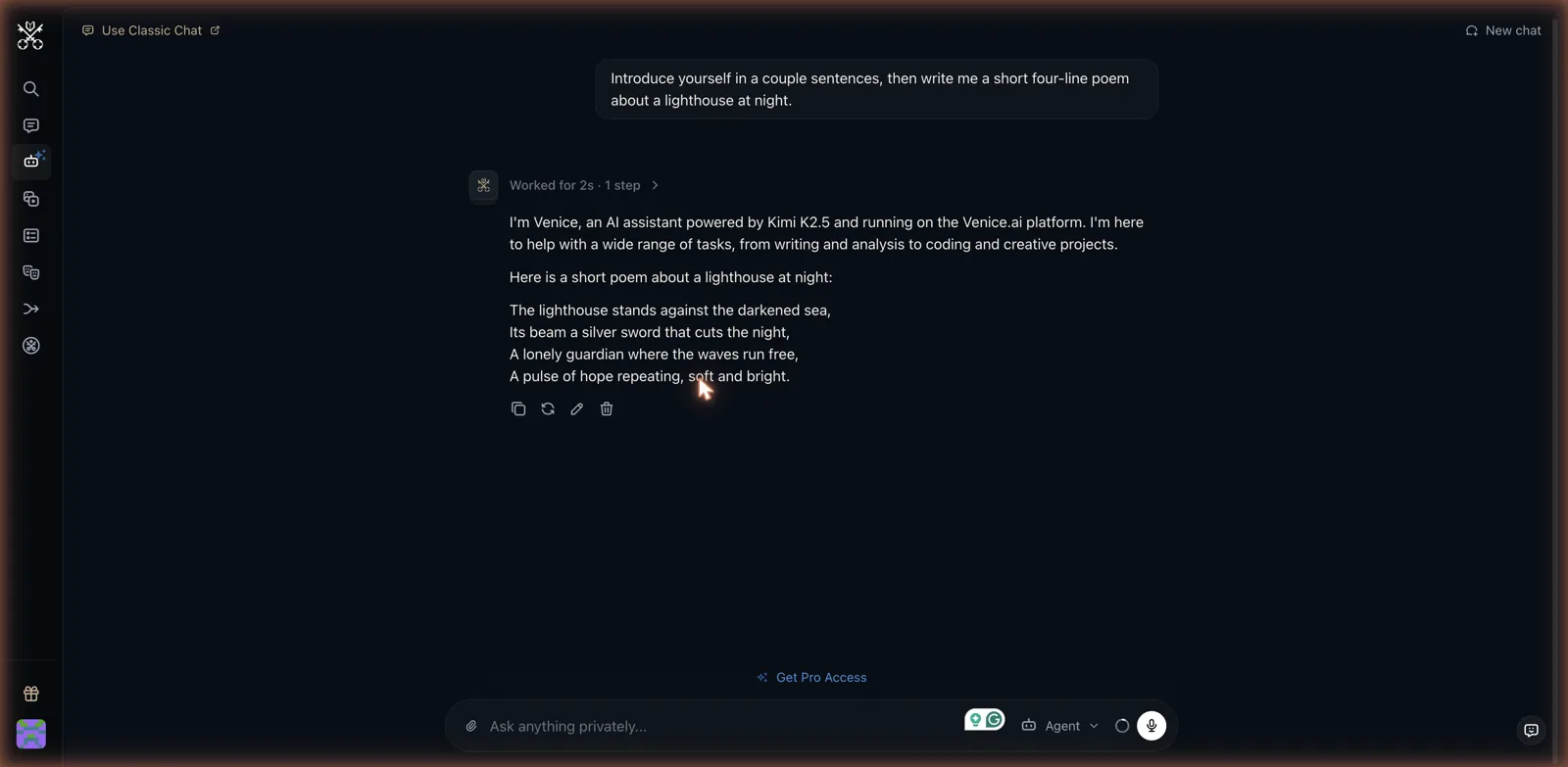
- Chat model choice between Kimi K2.5, Grok 4.3 (Private), and an anon proxy to Claude Sonnet 4.6 / Opus 4.7
- Agent mode that reasons in steps and pulls in live web search
- Image generation with upscale, variants, edit, and animate-to-video tools
- Private, uncensored AI Characters you can browse or build in seconds
The free tier gives 10 text prompts and 15 image prompts a day. Pro at $18/mo removes the text cap and raises the image limit to 1,000/day. HammerAI’s free chat has no daily prompt limit at all, so anyone chatting more than a handful of times a day runs into Venice’s free ceiling long before hitting any wall on HammerAI.
Pygmalion AI
Pygmalion grew directly out of the open-source Pygmalion LLM project, the same DIY lineage HammerAI draws on with its Ollama roots, and both give away a large slice of the product for free. The difference is model hosting. Pygmalion runs its models on its own servers, so there is no local setup and no hardware requirement, but you also lose the run-on-your-own-machine privacy that is HammerAI’s whole pitch.
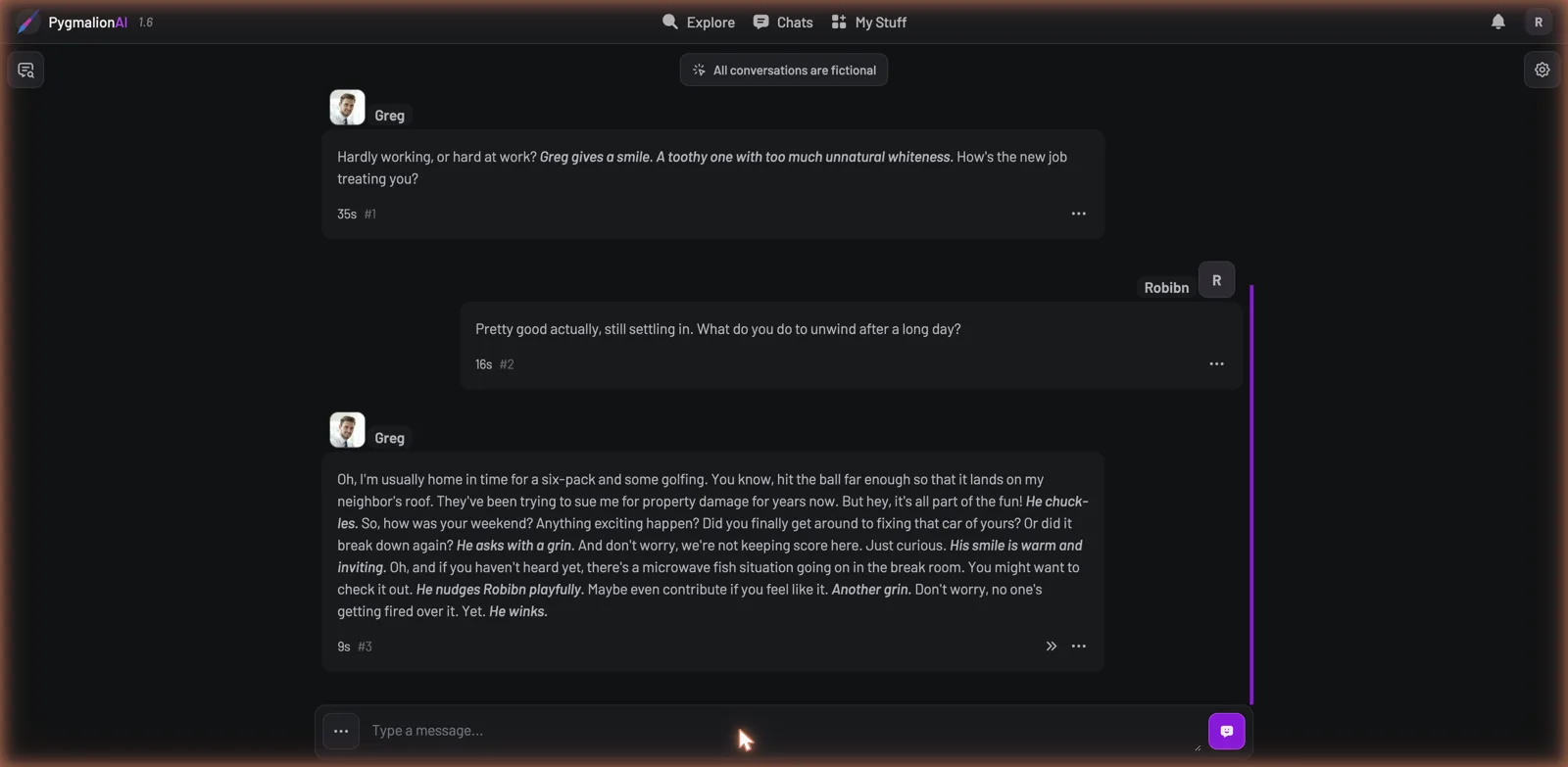
- Community character-card library with tags, ratings, and view/chat/download stats
- Portable, exportable character cards you can build and import elsewhere
- A large model roster from free options up to a 131k-context Hermes IV 405B
- Grimoire long-term memory system on paid plans
The free plan gives unlimited access to the free models (memory capped at 8K) plus 200 messages/day on better models. Low-Cost at $6.50/mo adds Grimoire memory and 16K context; Premium at $17.99/mo removes the model caps entirely. Both platforms keep base chat unmetered, but Pygmalion needs a paid plan for any real memory system, while HammerAI’s memory stays local and free regardless of tier.
Kindroid

Kindroid is a premium, polished, memory-obsessed companion built for people who want depth without any tinkering, close to the opposite instinct from HammerAI’s toolkit-for-power-users approach. Its cascaded memory system and real-time voice calls outclass anything HammerAI offers on that front. Everything runs server-side though: no local option, no bring-your-own API key, none of the privacy control that HammerAI is built around.
- Cascaded memory covering backstory, key memories, journal entries, and response directives
- Two in-house models: Lite (free) and Ember (paid)
- Real-time voice calls and AI selfies
- A roughly 47-parameter character builder plus SMS and calendar integration
The free tier gives unlimited text chat on the Lite model but only 2 selfie credits, and group chats stay fully paywalled. The single paid plan runs $11.66/mo billed yearly for the Ember model, full memory, and voice calls. That sits between HammerAI’s Starter ($9/mo) and Advanced ($18/mo) tiers, but buys memory quality and voice rather than more model choice or context.
DreamGen

DreamGen and HammerAI both run on their own fine-tuned or proxied models instead of one locked provider, and both treat text chat as effectively unlimited on their native models. DreamGen leans much harder into structured story authoring, with Building Blocks, game-state instructions, and a scenario wizard, tools HammerAI does not attempt. HammerAI keeps the edge on true offline privacy, since DreamGen still runs everything on its own servers.
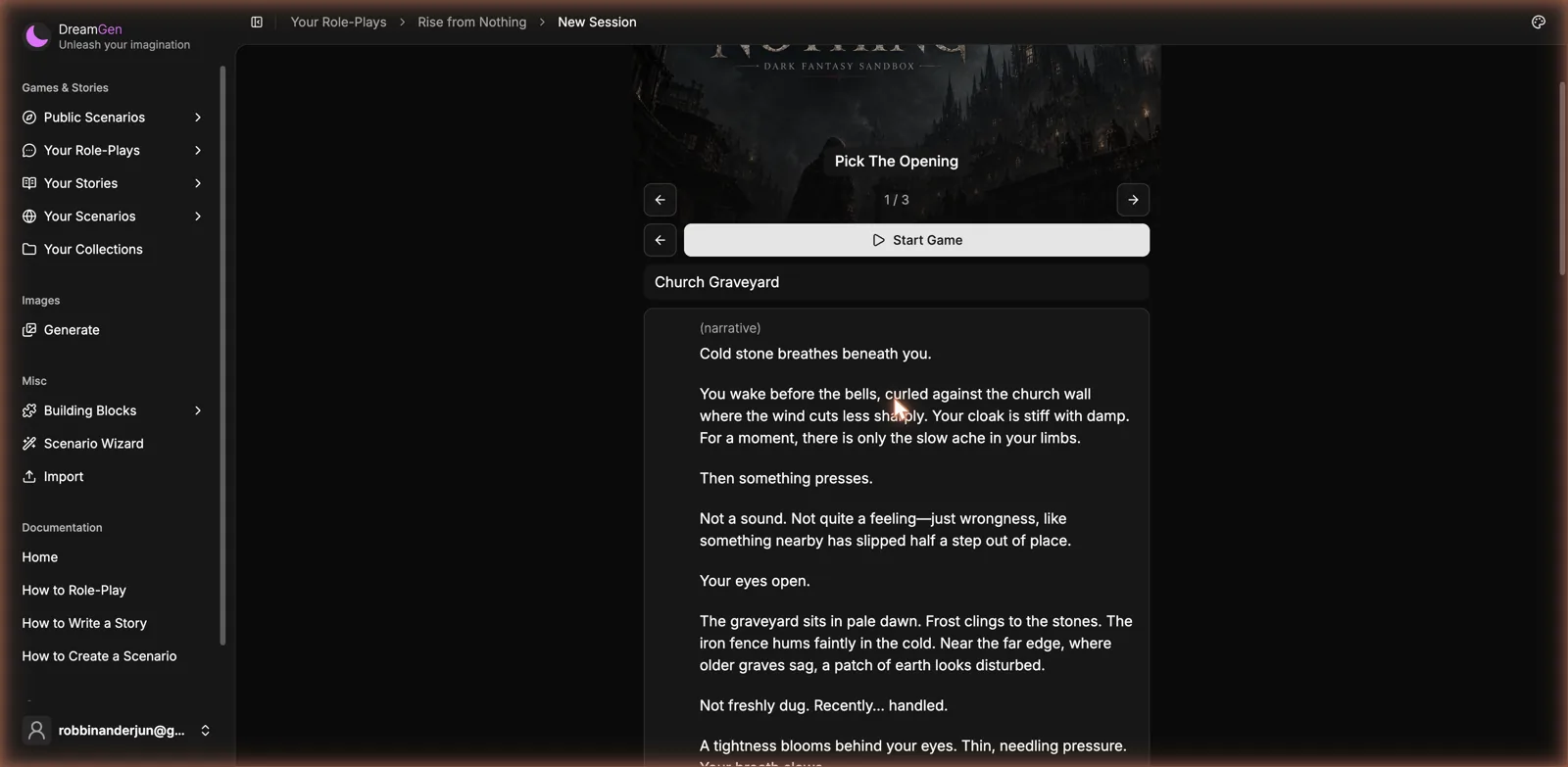
- Three modes: role-play, long-form story writing, and image generation
- Own fine-tuned creative-writing models, with optional routing to premium third-party models
- A deep scenario editor with Building Blocks, personas, and few-shot examples
- Image generation at roughly 1.7 credits per image
The free tier is usable enough to sample the native models. Starter runs about $7.83/mo for a 5,000-token context window and 375 monthly credits; Advanced runs about $19.35/mo for a 15,000-token window. DreamGen’s credits cover both third-party model routing and images, while HammerAI keeps the split simpler: chat and local models stay free, and only image and voice draw from paid credits.
Muah AI

Muah AI matches HammerAI’s generosity on the free tier, both give away unlimited chat, but Muah goes a step further by including free photo generation in that same free tier, something HammerAI paywalls behind credits from the very first image. Muah has no local or offline mode and no bring-your-own API key option though, so anyone who picked HammerAI specifically for the run-it-on-my-own-machine angle will not find that here.
- No-onboarding instant chat with working short-term memory
- Free in-chat AI photo generation with an auto-saved gallery
- Deep customization: personality presets, appearance prompts, voice choice, temperature slider
- Real-time voice phone calls
VIP Access runs about $5.83/mo (roughly $69.99/yr) for unlimited chat and upgraded photo quality. The ladder tops out at Ultra VIP around $82.30/mo for real-time calls and beta video. Muah’s entry tier undercuts HammerAI’s cheapest Starter plan while including more free image generation up front, but its top Ultra tier costs far more than anything HammerAI charges.
Role Play Hub

Role Play Hub is the leanest option here: text-only, no images, no voice. It still shares HammerAI’s opt-in-privacy instinct though, chats are not saved by default unless you flip the Save Chat toggle on. HammerAI gets its privacy by running models locally; Role Play Hub gets a lighter version of the same idea by simply not retaining your conversations server-side unless you ask it to.
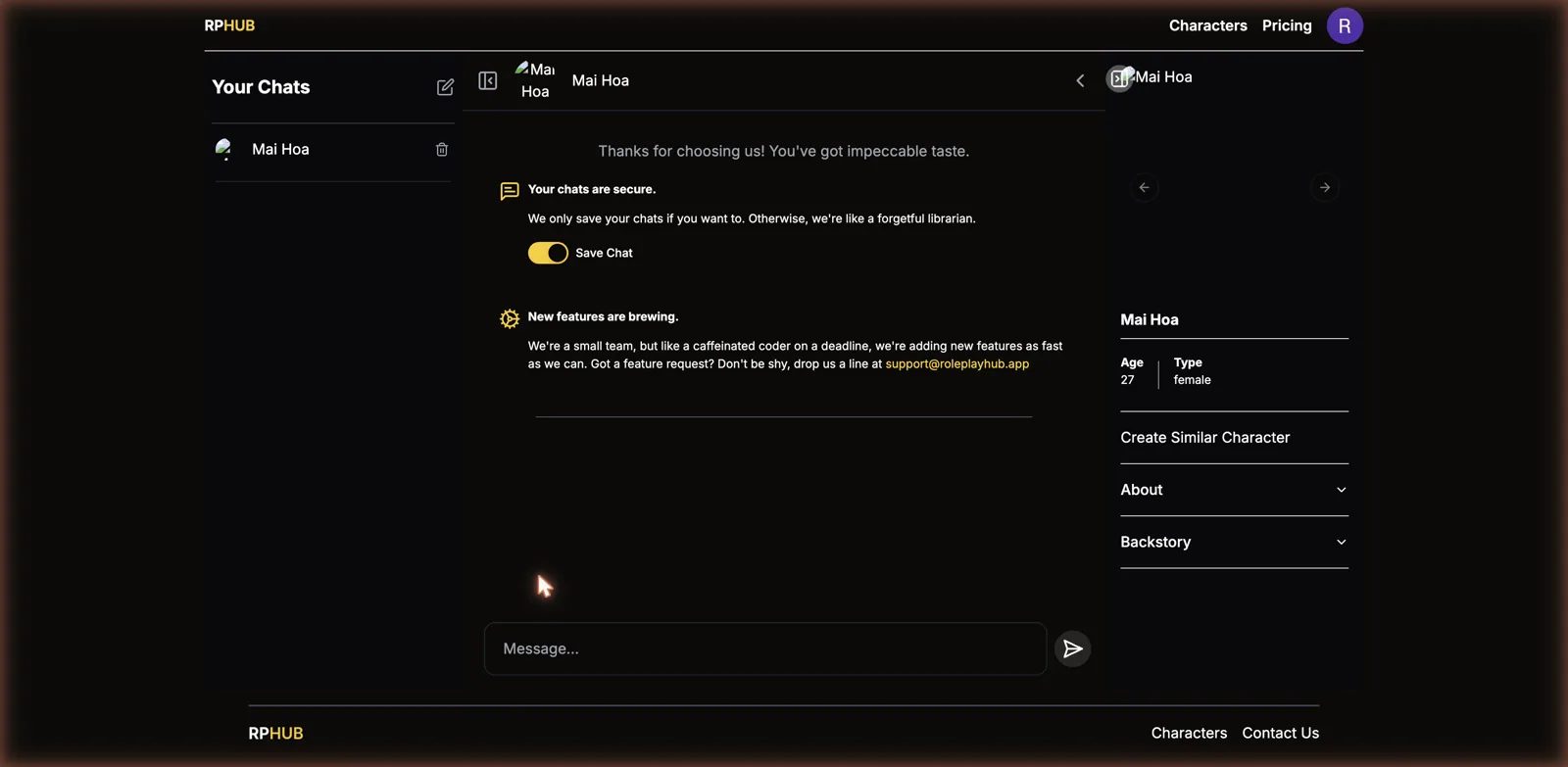
- Community character library with category filters and a Create Similar Character shortcut
- Opt-in Save Chat toggle, off by default
- Uncensored text roleplay behind an 18+ entry gate
- Build-your-own character creation and sharing
The free tier gives 2,000 words/day and 3 private characters, which is enough to actually use the platform, not just sample it. Premium is $3.99/mo for unlimited messages, unlimited characters, and higher-context models. That is the cheapest paid tier of anything on this list, well under HammerAI’s $9 Starter plan, but you give up image generation, voice, and local privacy entirely to get there.
Which one to pick
If you want HammerAI’s run-it-yourself philosophy but would rather skip the desktop app and Ollama setup, PepHop AI (bring-your-own API key, no signup at all) or Venice AI (privacy-first, broader frontier-model choice) get you closest without the local install.
If unlimited free chat plus real free image generation matters more than local privacy, Muah AI gives away more up front than HammerAI does on the image side, though you lose the offline option entirely.
For the deepest tinkerer’s sandbox, character cards, chat trees, presets, model tuning, Chub AI and Pygmalion AI both go further than HammerAI’s interface, at the cost of running on someone else’s servers.
If budget text-only roleplay with chats private by default is the whole goal, Role Play Hub’s $3.99/mo Premium plan is the cheapest paid tier on this list by a wide margin.
If you want premium memory and voice and do not mind paying for it or giving up local control, Kindroid delivers the best memory system here. If story and scenario depth matter more than a girlfriend-app feel, DreamGen’s authoring tools are the strongest of the bunch.
None of these fully replace HammerAI’s specific combination of free unlimited chat, true local model support, and transparent pricing. They each trade one piece of that combination for something else, more polish, more models, or a lower price of entry, so the right pick comes down to which piece you value least giving up.