Pygmalion built its reputation on an open, community-driven roleplay engine, and for tinkerers who like tuning models and character cards it remains one of the strongest free options around (read our full Pygmalion AI review for the details). But the same depth that makes it a favorite among power users can feel like homework if you just want to point and flirt, the interface stays functional rather than glamorous, community art quality varies, and the message caps and cooldowns on the better free models push heavy users toward a subscription pretty fast. It is also a text-first platform, so there is no photorealistic image or video generation of your companion. If any of that sounds familiar, here are 14 other roleplay and companion platforms Pippin Club has already reviewed, chosen because they share Pygmalion’s model-forward, open-source, or community-driven bent rather than being generic girlfriend-app swaps.
Top AI Girlfriend Platforms — Our Picks

Hyper-realistic AI companions with adaptive memory that recall your past conversations.
Build a custom AI companion and bring her to life with chat, images, and video.

Create a custom AI girlfriend with her own personality, generated images, and ongoing chat memory.

Characters that hold memory and context, so the relationship builds over time instead of resetting.

Chat with a fully custom AI girlfriend — choose her personality, outfits, and more.
Personalized AI companions for ongoing roleplay, with a simple, discreet signup.
Build a custom AI girlfriend, boyfriend, or anime character — choose the look and personality.
Customizable AI girlfriend personalities with realistic, ongoing conversations.
The lineup at a glance
| Platform | Best for | Starting price | Free tier | Review |
|---|---|---|---|---|
| Chub AI | Tinkerers who want to tune the engine, chat trees, and lorebooks | $5/mo (Mercury) | Good | Read the review |
| DreamGen | Writers who want the deepest scenario-authoring tools and the best prose | ~$7.83/mo (Starter) | Good | Read the review |
| HammerAI | Free, unlimited chat with local models and your own API key | $9/mo (Starter) | Excellent | Read the review |
| PepHop AI | No-signup trial and bring-your-own-API-key flexibility | ~$5.99/mo (Classic, annual) | Good | Read the review |
| Role Play Hub | Cheap, private, no-fuss text roleplay | $3.99/mo (Premium) | Excellent | Read the review |
| Girlfriendly AI | Seeing and choosing exactly which model writes each reply | $7.99/mo (Premium) | Fair | Read the review |
| Venice AI | One private, uncensored AI for chat, images, and more | $18/mo (Pro) | Good | Read the review |
| Joyland AI | Chat plus illustrated interactive novels | ~$7.92/mo (Annual, $95/yr) | Good | Read the review |
| CrushOn.AI | Huge library with an in-chat image-reply system | $14.99/mo (Premium) | Fair | Read the review |
| PolyBuzz | The single largest free character library | Not publicly quoted | Excellent | Read the review |
| Sakura AI | Deep per-character memory and customization tools | ~$11/mo (Diamond, yearly) | Thin | Read the review |
| Dippy AI | Genuinely unlimited free chat, no message meter | ~$10/mo (Super, annual) | Excellent | Read the review |
| xchar AI | A social-network-style companion with a full media toolkit | $14.95/mo (Premium) | Fair | Read the review |
| AI Girlfriend (MiniApps.ai) | One account covering chat plus a wider AI toolbox | $9.99/mo (Standard) | Good | Read the review |
Pricing and free tier, side by side
| Platform | Cheapest plan | Free tier generosity | NSFW level |
|---|---|---|---|
| Pygmalion AI (anchor) | $6.50/mo (Low-Cost) | Good | Community (unfiltered models, not marketed adult) |
| Chub AI | $5/mo (Mercury) | Good | Uncensored |
| DreamGen | ~$7.83/mo (Starter) | Good | Community (uncensored, writing-first) |
| HammerAI | $9/mo (Starter) | Excellent | Uncensored |
| PepHop AI | ~$5.99/mo (Classic, annual) | Good | Uncensored (paid upgrade) |
| Role Play Hub | $3.99/mo (Premium) | Excellent | Uncensored |
| Girlfriendly AI | $7.99/mo (Premium) | Fair | Uncensored |
| Venice AI | $18/mo (Pro) | Good | Uncensored |
| Joyland AI | ~$7.92/mo (Annual, $95/yr) | Good | Uncensored |
| CrushOn.AI | $14.99/mo (Premium) | Fair | Uncensored |
| PolyBuzz | Not publicly quoted | Excellent | Community |
| Sakura AI | ~$11/mo (Diamond, yearly) | Thin | Community |
| Dippy AI | ~$10/mo (Super, annual) | Excellent | Community |
| xchar AI | $14.95/mo (Premium) | Fair | Uncensored |
| AI Girlfriend (MiniApps.ai) | $9.99/mo (Standard) | Good | Community |
Chub AI

Both platforms are built for tinkerers who like reading their settings panel. Chub AI goes further into pure customization, with chat-tree branching, lorebooks, and a Presets panel for tuning prompt structure and temperature, but it runs looser moderation than Pygmalion. Chub’s NSFW toggle is on by default across an unfiltered library, while Pygmalion frames itself as a general roleplay platform where mature content depends on the card and direction you choose. Pygmalion counters with a broader base model roster, including 131k-context premium options, against Chub’s two-tier ladder gated mainly by model size. If you would rather pay for polish than tinker, see the companion apps that justify the monthly fee.
- Thousands of community cards in a Timeline feed with view, chat, and download stats
- Chat-tree branching, memory controls, and a Presets panel (prompt structure, temperature, TTS)
- Lorebooks: modular memory files that supplement in-chat memory
- Free “Create +” builder for making your own cards
Chub’s Mercury tier costs $5/mo for smaller models like Mistral 7B and MythoMax 13B with 8K memory, a cheaper entry than Pygmalion’s $6.50 Low-Cost tier, but Mars at $20/mo for larger models runs well past Pygmalion’s $17.99 Premium, which unlocks every model Pygmalion offers. The free tier lets you browse the full library, build lorebooks, and chat on the default model, a similar spirit to Pygmalion’s free plan, though Chub’s default-on NSFW setting is a bigger swing than what Pygmalion ships out of the box.
DreamGen
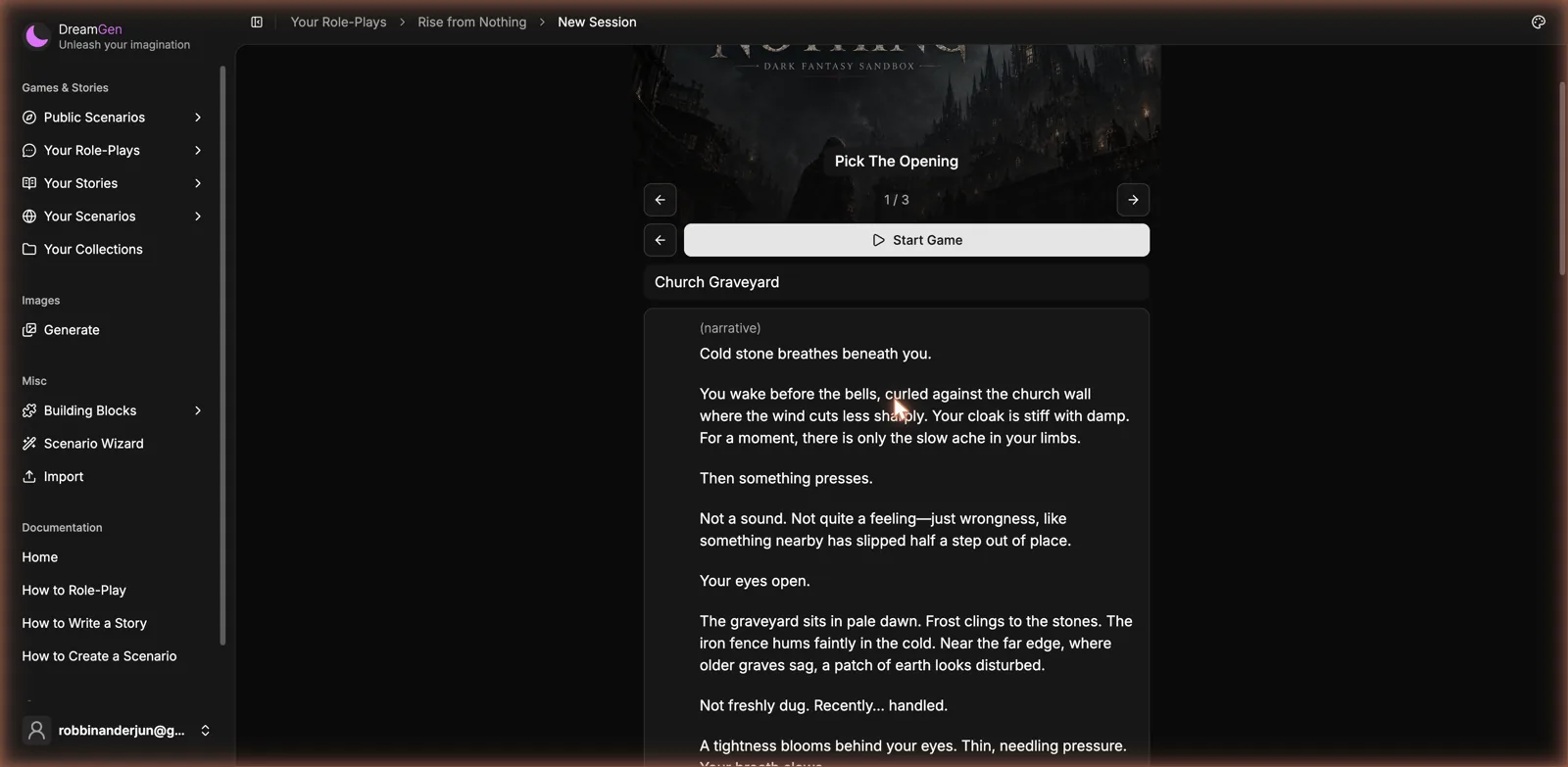
Both platforms are text-first, uncensored-leaning, and model-forward, with public character and scenario libraries built by the community. DreamGen goes deeper into authored world-building, with Building Blocks, multiple openings, few-shot examples, and structured game-state instructions, than Pygmalion’s card-and-chat setup, and its models are purpose-trained for fiction rather than adapted for general chat. That buys noticeably stronger prose but adds a steeper learning curve than even Pygmalion’s own settings panel.
- Three modes: Role-Play (turn-based), Story Writing (long-form prose), and Image Generation
- Own fine-tuned creative-writing models, with routing to premium third-party models for a credit cost
- Deep scenario editor: Setting/Style/History modifiers, Building Blocks, multiple Openings, few-shot Examples
- Large public scenario library plus a Scenario Wizard for AI-assisted authoring
DreamGen’s cheapest plan runs about $7.83/mo (roughly $6.26 for the first month) for a 5,000-token context window, a bit pricier than Pygmalion’s $6.50 Low-Cost tier, though it includes unlimited use of DreamGen’s own text models. The free tier is described plainly as real and usable to sample the models. Vs Pygmalion, DreamGen buys a genuinely stronger prose engine before you spend anything, but its two-currency system, unlimited text against credit-metered images and third-party models, takes longer to learn than Pygmalion’s simpler message-cap structure.
HammerAI

Both platforms let power users pick or bring their own models, but HammerAI pushes the open, tinkerer ethos further. It lets you run models entirely locally through the Ollama desktop app or proxy to any LLM API you already pay for, an option Pygmalion does not offer since its model roster is hosted only. HammerAI’s chat is also unlimited and free forever, a wider allowance than Pygmalion’s 200-message daily cap on its better free models, though HammerAI has nothing like Pygmalion’s Grimoire long-term memory system unless you pay.
- Three model paths: cloud, local via the Ollama desktop app, or bring-your-own API key
- Deep roleplay toolkit: Impersonate, Author’s Note, Dice, inline image, group chat, lorebooks, personas
- Bundled Stories mode, image generation across 22 models, and TTS with 746 voices in 34 languages
- Cross-platform: web, desktop app, and a newer Android app
HammerAI’s cheapest paid plan is Starter at $9/mo, pricier upfront than Pygmalion’s $6.50 Low-Cost tier, but the free plan already includes unlimited cloud chat messages, every local model, and proxying to your own API key, with only image generation and TTS metered behind credits. Vs Pygmalion, if what you want is unlimited free chat and real model ownership rather than a hosted library, HammerAI’s free tier goes further; you pay HammerAI for media generation and memory summaries, not for the chat itself.
PepHop AI

Pygmalion still asks you to make an account before chatting with a saved card; PepHop lets you browse and chat with no account at all, with a 50-message allowance before you hit a wall. Both lean into openness: PepHop is open-sourced with API keys stored locally, and its Advanced settings let you route chat through PepHop’s own model, OpenAI, or KoboldAI, a similar bring-your-own-key spirit to Pygmalion’s model selector, just wired through third-party APIs instead of a hosted roster.
- No-account browsing and chatting across a 20,000+ character library (Popular/Female/Male/Anime/Game)
- Advanced settings with API routing (default PepHop, OpenAI, or KoboldAI); keys stored locally
- Swipe/regenerate alternates, novel-style italic narration, and chat memory
- Voice call (Beta) and custom private character creation on paid tiers
PepHop’s cheapest plan is the 12-month Classic at roughly $5.99/mo, undercutting Pygmalion’s $6.50 Low-Cost tier and unlocking a 70B model, 4K memory, and uncensored chat. The free allowance, 50 messages with no account, is generous for a quick test but shallower than Pygmalion’s ongoing free access to its unlimited lower-tier models. Vs Pygmalion, PepHop wins on the frictionless try-it-right-now experience; Pygmalion wins if you plan to stick around, since its free tier does not run out the way PepHop’s 50-message sample does.
Role Play Hub

Both platforms are stripped-back, text-only, community-built roleplay tools without image or video generation, and both keep a real free tier front and center. Role Play Hub’s free plan, 2,000 words a day plus 3 private characters, is a different shape than Pygmalion’s model-based caps, but its Premium tier at $3.99/mo is dramatically cheaper than Pygmalion’s $6.50 Low-Cost tier, at the cost of a much smaller model roster. Role Play Hub also runs opt-in chat privacy, conversations are not saved by default, something Pygmalion does not call out as a feature.
- Community-made character library filtered by category (Girlfriend, Boyfriend, Fictional, Fantasy, Anime, Mystery)
- Create-your-own characters with a Create Similar Character fork shortcut
- Opt-in chat privacy: a Save Chat toggle, conversations not retained by default
- Premium tier unlocks unlimited messages, higher-context models, and premium characters
At $3.99/mo, Role Play Hub’s only paid tier costs roughly a third of Pygmalion’s Low-Cost plan, and its free tier (2,000 words/day, 3 private characters) is plainly usable rather than a teaser. Vs Pygmalion, Role Play Hub trades depth for price: there is no Grimoire-style memory system or 131k-context premium model here, but if cheap, private, uncensored text roleplay is all you want, this beats Pygmalion’s cheapest paid tier on cost alone.
Girlfriendly AI
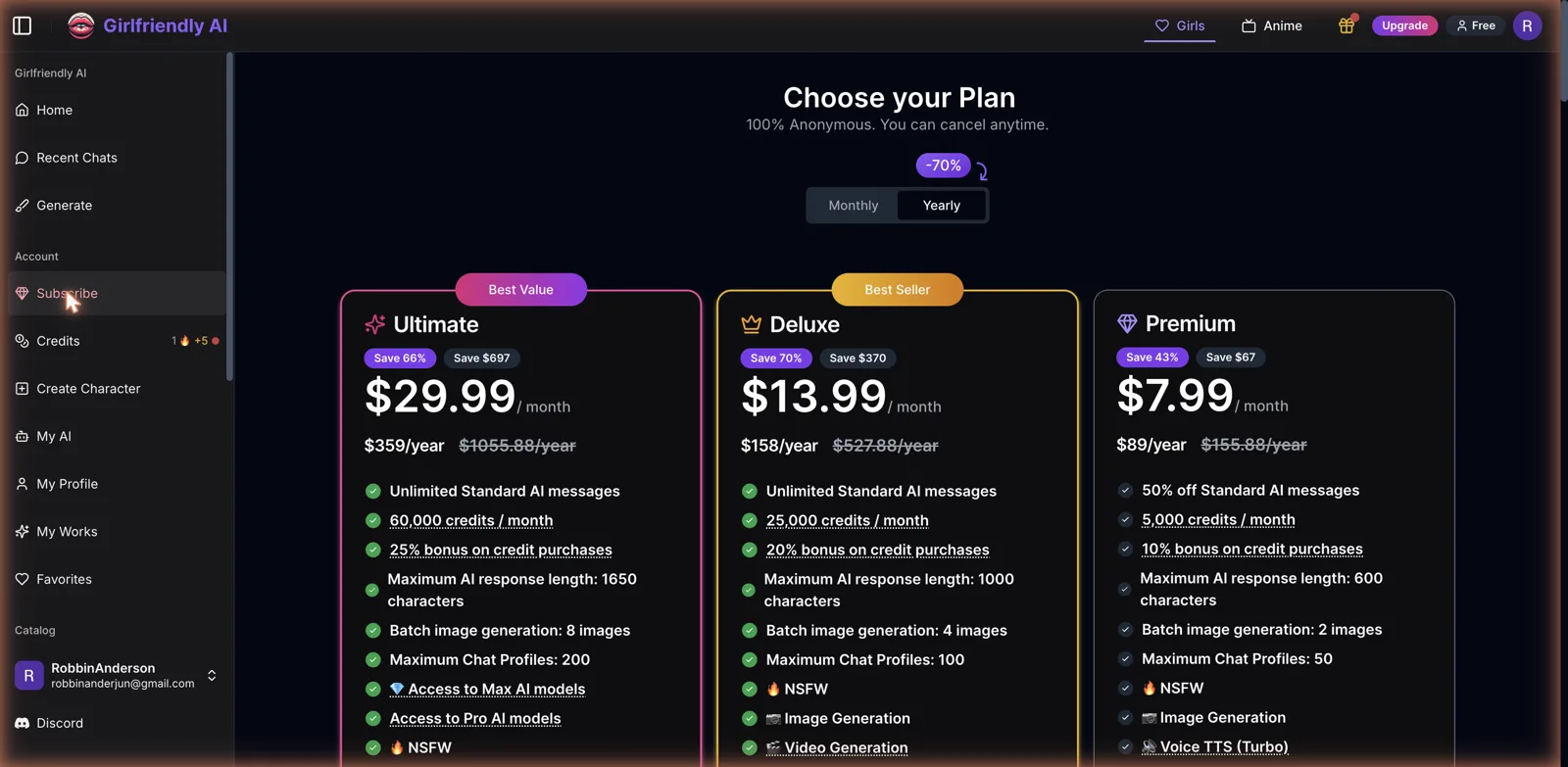
This is the closest match to Pygmalion’s actual pitch, seeing and choosing which model writes your reply, except Girlfriendly AI labels the model on every message in the chat itself, a step further than Pygmalion’s model-selector dropdown. Where Pygmalion’s best models, Hermes IV 405B and GLM 4.5 Air, sit on its $17.99 Premium tier, Girlfriendly AI locks its top models, GPT-4o and Claude, to the pricier $29.99 Ultimate tier, a narrower path to frontier models than Pygmalion offers.
- Open model selection in-chat with per-message model labels; standard models free, GPT-4o/Claude on the top tier
- Create Character builder plus image generation, with video generation on Deluxe and above
- Voice selection (TTS) and per-message star rating with regenerate
- Daily-rewards credit streak worth up to 50 credits a day
Girlfriendly AI’s cheapest plan is Premium at $7.99/mo, a little above Pygmalion’s $6.50 Low-Cost tier, and its free tier runs on standard models plus a daily credit streak rather than an ongoing unlimited allowance. Vs Pygmalion, you pay more to reach Girlfriendly AI’s ceiling, GPT-4o and Claude sit behind the $29.99 Ultimate tier, well above Pygmalion’s $17.99 top plan, but you get image and video generation along the way, which Pygmalion’s text-only product does not offer at any price.
Venice AI
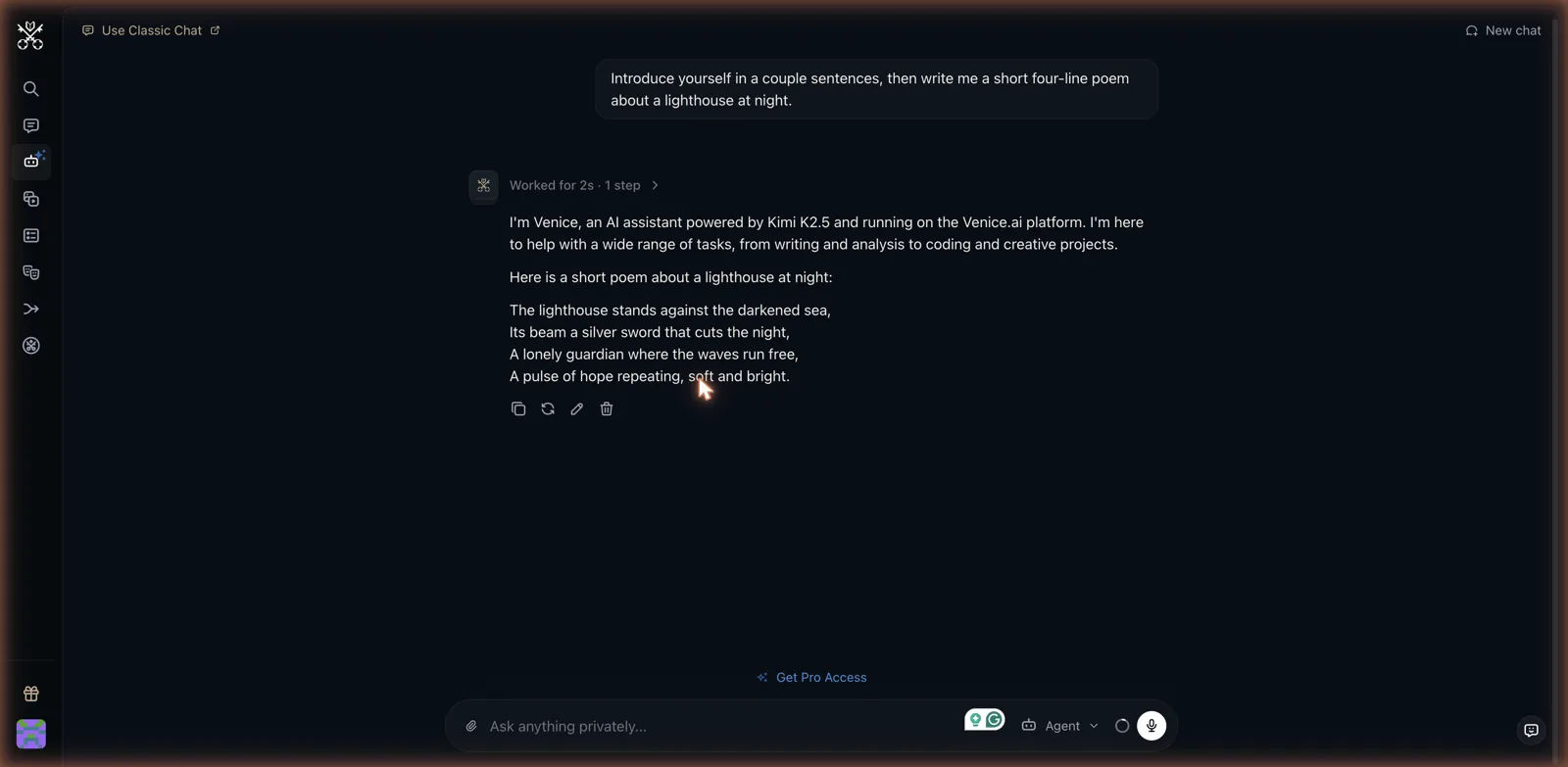
Venice is not a dedicated roleplay platform the way Pygmalion is; it is closer to a private, uncensored ChatGPT that happens to let you build custom characters. Its model choice, Kimi K2.5 and Grok 4.3 privately, plus Claude Sonnet 4.6 and Opus 4.7 through an anonymized proxy, is broader and more mainstream than Pygmalion’s roleplay-tuned roster, and its privacy framing, minimal data retention and a low-friction guest mode, goes further than anything Pygmalion states about its own data handling. What Venice lacks is Pygmalion’s character-card system or a memory tool built around ongoing roleplay.
- Model choice in chat: Kimi K2.5 and Grok 4.3 (Private), plus Claude Sonnet 4.6/Opus 4.7 via an Anon proxy
- Agent mode that reasons in steps and pulls in web search
- Image generation with upscale, variants, edit, and animate-to-video tools
- Private, uncensored AI Characters you can browse or build in seconds
Venice’s cheapest paid plan is Pro at $18/mo, well above Pygmalion’s $6.50 Low-Cost tier and even its $17.99 Premium plan, though that price covers unlimited text prompts plus image, video, and music generation, not just chat. The free tier gives 10 text prompts and 15 image prompts a day with API access, useful for testing but thinner day-to-day than Pygmalion’s unlimited free-model chat. Vs Pygmalion, Venice is worth the extra cost only if you want one account that also handles image and video generation; for roleplay-only use, Pygmalion is the cheaper, more purpose-built option.
Joyland AI
Joyland trades Pygmalion’s card-and-settings depth for breadth: alongside chat it runs an illustrated Novel mode and a public Story mode, neither of which Pygmalion offers. Joyland’s in-chat model picker, Free, Roleplay, StoryStream, Lifelike, Vividtale, plus a paid DeepSeek option, covers similar ground to Pygmalion’s model roster, but the labeling is looser, most models sit under a rotating Limited Time Free banner, compared with Pygmalion’s clearly split free/limited/premium tiers.
- Huge, varied catalog: girlfriends/boyfriends, fantasy RPG, anime, villains, open-world scenarios
- Novel mode: illustrated, choose-your-path fiction built from characters
- Deep Create-a-Bot tool with a 5,000-token budget, public or private
- In-chat model picker plus AI-suggested replies, two per turn
Joyland’s Annual plan works out to about $7.92/mo ($95/yr), close to Pygmalion’s $6.50 Low-Cost tier, or $19.99/mo paid monthly. Its free tier is broad, chat, search, novels, stories, and bot building are all open, similar in spirit to Pygmalion’s usable free plan, though persistent memory and photo unlocks sit behind the paywall. Vs Pygmalion, pick Joyland if the illustrated Novel mode and interactive-fiction angle appeal to you more than Pygmalion’s deeper card and settings system.
CrushOn.AI

CrushOn’s library dwarfs Pygmalion’s in raw size and adds an image-reply system, keyword-triggered image albums tied to each character, that Pygmalion’s text-only product does not attempt. Both run a free default model, CrushOn’s CO Leo 8K against Pygmalion’s Fast Gens, but CrushOn’s free daily allowance runs out sooner than Pygmalion’s, and CrushOn gates memory (400 remembered messages on Premium) behind a subscription the same way Pygmalion gates its Grimoire memory system.
- Uncensored chat on a free default model (CO Leo 8K), 70+ tags, Animated and Unfiltered toggles
- Image-reply system: keyword-triggered image albums tied to each character
- Creator tools for photo and scene cards, plus a custom voice option in beta
- Rankings page and an affiliate program
CrushOn’s cheapest plan is Premium at $14.99/mo (on sale from $19.99), more than double Pygmalion’s $6.50 Low-Cost tier, for 6,000 credits and access to Pro Models. Its free tier covers the full library and free-model chat but with a small daily allowance that Pygmalion regulars, used to unlimited free-model access, may find tight. Vs Pygmalion, CrushOn is worth the higher price only if the image-reply system and library size matter more to you than Pygmalion’s cheaper, more transparent per-model pricing.
PolyBuzz

PolyBuzz’s free tier is about as generous as this list gets: browse all 20 million-plus characters, chat heavily, build your own, and even migrate or upload cards, all without paying, a wider free allowance than Pygmalion’s model-capped plan. What PolyBuzz lacks is Pygmalion’s transparency about what a subscription buys; PolyBuzz’s Membership pricing is not published on the site, where Pygmalion states its Low-Cost and Premium prices plainly.
- 20 million-plus user-made characters with a Netflix-style Discover feed showing chat counts
- Deep Create Character tool with a 10,000-character private Background field and JSON/character-card import
- Image generator with a Ship Them couple-shot feature
- Extensive category tabs spanning Anime, Webtoon, Mafia, Yandere, Furry, and Harem
PolyBuzz’s Membership price is not publicly quoted, so there is no clean cost comparison against Pygmalion’s stated $6.50 and $17.99 tiers, only that PolyBuzz’s free tier is unusually generous and its paid tier mainly unlocks faster and better image generation rather than gating chat itself. Vs Pygmalion, if free access to the largest possible character library matters more to you than knowing exactly what an upgrade costs, PolyBuzz is worth trying before committing to a Pygmalion subscription.
Sakura AI

Sakura leans further into anime aesthetics and per-character control, Character Memories that persist across all chats, editable Custom Name/Persona/Description/Scenario, than Pygmalion’s more utilitarian card system, but its free tier is thinner: a daily message limit you can only extend by supporting the platform on social media, versus Pygmalion’s straightforward unlimited access to its lower-tier models. Sakura also gates image generation behind paid tiers entirely, which Pygmalion does not offer at any price.
- Large card library, some characters with millions of logged chats
- Character Memories that persist across all chats with a given character
- Full builder: image upload or AI-generate, Model Instructions field, Example Conversation few-shot training
- Report Character and Block Creator moderation tools
Sakura’s cheapest plan is Diamond at $19/mo, or about $11/mo billed yearly (roughly $132/yr), noticeably pricier than Pygmalion’s $6.50 Low-Cost tier for unlimited messages and a better memory model. The free Sage tier’s daily cap, extendable only through social-support tasks, is a harder limit than Pygmalion’s genuinely free unlimited access to its lower-tier models. Vs Pygmalion, Sakura’s deeper per-character memory tools come at a real price premium, and only make sense if Pygmalion’s card system feels too utilitarian for your taste.
Dippy AI

Dippy takes the opposite approach to gating: chat itself is free and unlimited on the basic model, with no message meter at all, a wider open allowance than Pygmalion’s 200-messages-a-day cap on its better free models. The trade is depth. Dippy has none of Pygmalion’s card-building tools, model transparency, or settings panel; its Super tier sells memory and coin-based media instead of model access, a simpler but shallower pitch than Pygmalion’s model-forward approach.
- Free, unlimited chat on the basic model, the platform’s core draw
- Discover grid split into Trending, New, For You, and Editors Pick, plus category browsing
- In-chat model selector, Persona system, and a voice-call option
- Dippy coins currency for videos, in-chat images, and experimental features
Dippy’s Super plan runs $12.99/mo, or about $10/mo billed annually ($119.99/yr), in the same range as Pygmalion’s Low-Cost tier, and adds long-term memory plus a coin allowance for media. Vs Pygmalion, Dippy’s free tier is more open, truly unlimited chat against Pygmalion’s daily caps, but you lose Pygmalion’s card portability, deep settings, and transparent model roster; Dippy is the simpler, more casual pick of the two.
xchar AI
xchar wraps its community-made character roster in a social-media layer, stories, profiles, follower stats, a Top Creators leaderboard, with no equivalent on Pygmalion, and adds images, voice, and video generation that Pygmalion’s text-only product does not attempt. Its Personas and Edit Memories controls cover some of the same ground as Pygmalion’s Author’s Note and memory settings, though xchar’s memory tools work per-conversation rather than through a dedicated system like Pygmalion’s paid Grimoire.
Dreemy AI's video generation includes audio in the same clip, worth a look if generated video with sound matters more than a still image.
- Social-media style character profiles with feeds, follower stats, and a Top Creators leaderboard
- Response Style, Flirtiness, Choose Scenario, and Edit Memories chat controls
- Personas system for defining your own side of the roleplay
- Images, voice, and HD video generation, plus a creator economy with Earn Credits
xchar’s cheapest plan is Premium at $14.95/mo, more than double Pygmalion’s $6.50 Low-Cost tier, for 8,000 monthly credits that fuel media generation on top of unlimited messages. The free tier lets you start on credits earned through activity rather than a flat daily allowance. Vs Pygmalion, xchar costs more to reach a usable subscription tier, but that price buys a full multimedia toolkit and social discovery layer that Pygmalion’s plain text interface does not offer.
AI Girlfriend (MiniApps.ai)

Like Pygmalion, this platform lets you swap models mid-conversation, but the selection sits inside a much wider marketplace of image, music, and language tools rather than a roleplay-specific roster, so the choice is more about general capability than fiction-writing quality. Its free tier refreshes 100 credits daily, a different shape than Pygmalion’s unlimited-on-lower-tier-models approach, and free accounts can only see their latest three conversations, a real limit Pygmalion’s free tier does not impose.
- AI Girlfriend (RolePlay v4) app with roughly 5.9 million logged chats and a 4.6 rating
- Model selector, with paid plans unlocking access to every model
- Voice conversations, Persona system, and image send/analyze
- Single credit balance shared across the whole MiniApps.ai marketplace, including image, music, and Claude/Grok wrapper apps
The Standard plan costs $9.99/mo for 8,000 credits, all models, voice, and unlimited chat history, a bit above Pygmalion’s $6.50 Low-Cost tier but bundling access to tools well outside a roleplay platform’s scope. Vs Pygmalion, this is worth considering only if you want one account and one credit balance covering chat plus a grab-bag of other AI tools; for roleplay specifically, Pygmalion’s dedicated model roster is the more focused pick.
Free-tier standouts
Four of these alternatives stand out even against Pygmalion’s own genuinely usable free plan. Here is what actually separates them, in one line each.
| Platform | What you get free | Why | Review |
|---|---|---|---|
| HammerAI | Unlimited cloud chat messages, every local model via Ollama, and the option to proxy your own API key, all free forever | Chat itself is never metered; only image generation and text-to-speech draw from paid credits | Read the review |
| Role Play Hub | 2,000 words a day and 3 private characters you can build and keep | A real daily word budget plus room to build your own characters, not a three-message tease | Read the review |
| PolyBuzz | The full 20-million-plus character library, heavy chatting, character creation, and card migration | Nothing about browsing, chatting, or building is paywalled, only faster image generation is | Read the review |
| Dippy AI | Unlimited chat on the basic model with no message meter at all | A session never just cuts off mid-conversation the way message-capped free tiers do | Read the review |
Which one to pick
If Pygmalion’s card system and settings depth is the friction, and you just want something simpler and cheaper, start with Role Play Hub at $3.99/mo or Dippy AI’s free, uncapped chat on the basic model. Neither asks you to learn a card format first.
If you like Pygmalion’s model-forward, bring-your-own-key idea but want it to go further, especially fully local or genuinely free, HammerAI is the more open version of the same philosophy, and PepHop AI gets you chatting with zero signup at all.
If prose quality and deep scenario-building matter more to you than Pygmalion’s card system, DreamGen and Chub AI both push further into power-user territory, at a higher price and a steeper learning curve.
If you want to actually see and choose your model the way Pygmalion lets you, but wrapped in a more visual, anime-leaning app with image and video generation, Girlfriendly AI is the closest match.
If Pygmalion’s lack of images and video is the actual dealbreaker, Joyland AI, CrushOn.AI, xchar AI, or the AI Girlfriend app inside MiniApps.ai all add media generation Pygmalion does not have, each with its own flavor of community and creator tools.