Top AI Girlfriend Platforms — Our Picks

Hyper-realistic AI companions with adaptive memory that recall your past conversations.

Build a custom AI companion and bring her to life with chat, images, and video.

Create a custom AI girlfriend with her own personality, generated images, and ongoing chat memory.


Characters that hold memory and context, so the relationship builds over time instead of resetting.

Chat with a fully custom AI girlfriend — choose her personality, outfits, and more.

Personalized AI companions for ongoing roleplay, with a simple, discreet signup.

Build a custom AI girlfriend, boyfriend, or anime character — choose the look and personality.

Customizable AI girlfriend personalities with realistic, ongoing conversations.
What Is Kupid AI?
Kupid AI is an AI companion platform where you can chat with pre-made or custom-built virtual characters. Think of it as part chat app, part character creator, with a spicy switch that unlocks NSFW territory once you sign up. The name is a nod to Cupid from Roman mythology, the god of love and attraction, which honestly is about as on-the-nose as it gets. If you are still shopping around, I compared the main AI girlfriend app options in one ranking.
The audience skews heavily toward people who want roleplay and sexting rather than the more emotionally focused AI companion experience. That’s not a criticism, just worth knowing going in so your expectations are calibrated right.
Traffic-wise, the US leads with about 29% of users, followed by Brazil and Germany. It’s genuinely popular across different markets, which says something about the product being accessible and not too language-locked.
First Impressions: The Homepage
You land on a gallery of pre-made AI girls, each with a name, age, and short personality description. Jolene, 42, charismatic vineyard owner. Anastasia, 29, strategic Ukrainian consultant. Mariko, 22, shy Japanese literature student. It’s immediately clear what kind of platform this is.
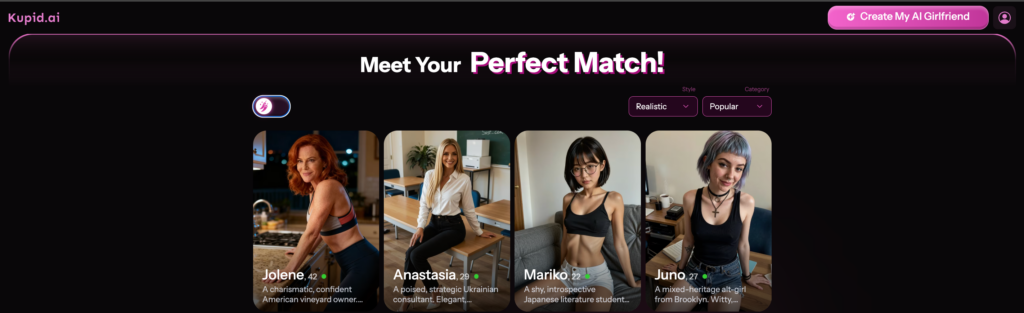
There’s a spicy switch in the top-left corner of the gallery. You can’t flip it without signing up, which is a decent nudge to create an account. Smart, if a bit obvious.
Two filters sit at the top right: one for style (Realistic vs Anime) and one for category. The category dropdown is where it stops being subtle:
- MILF
- Teen
- Lingerie
- Girl Next Door,
- Pregnant, Goth.
All listed without ceremony. If that sentence made you recoil, this is probably not the platform for you. If you scrolled through nodding, you’re in the right place.
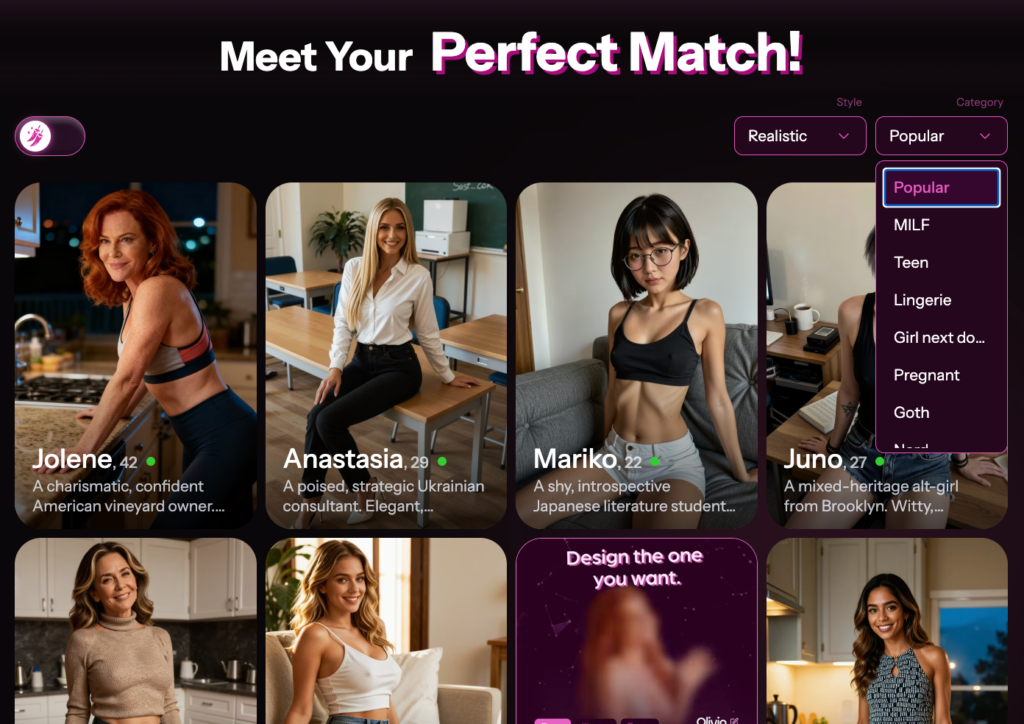
At the bottom of the gallery there’s a card that reads “Design the one you want” which takes you into the character creator.
Character Creation: Actually Pretty Good
This is where Kupid AI earns some genuine points. The character creation is multi-step, organized, and goes further than most platforms in this space bother to go.
Step 1: Style choice. Anime or realistic. Straightforward.
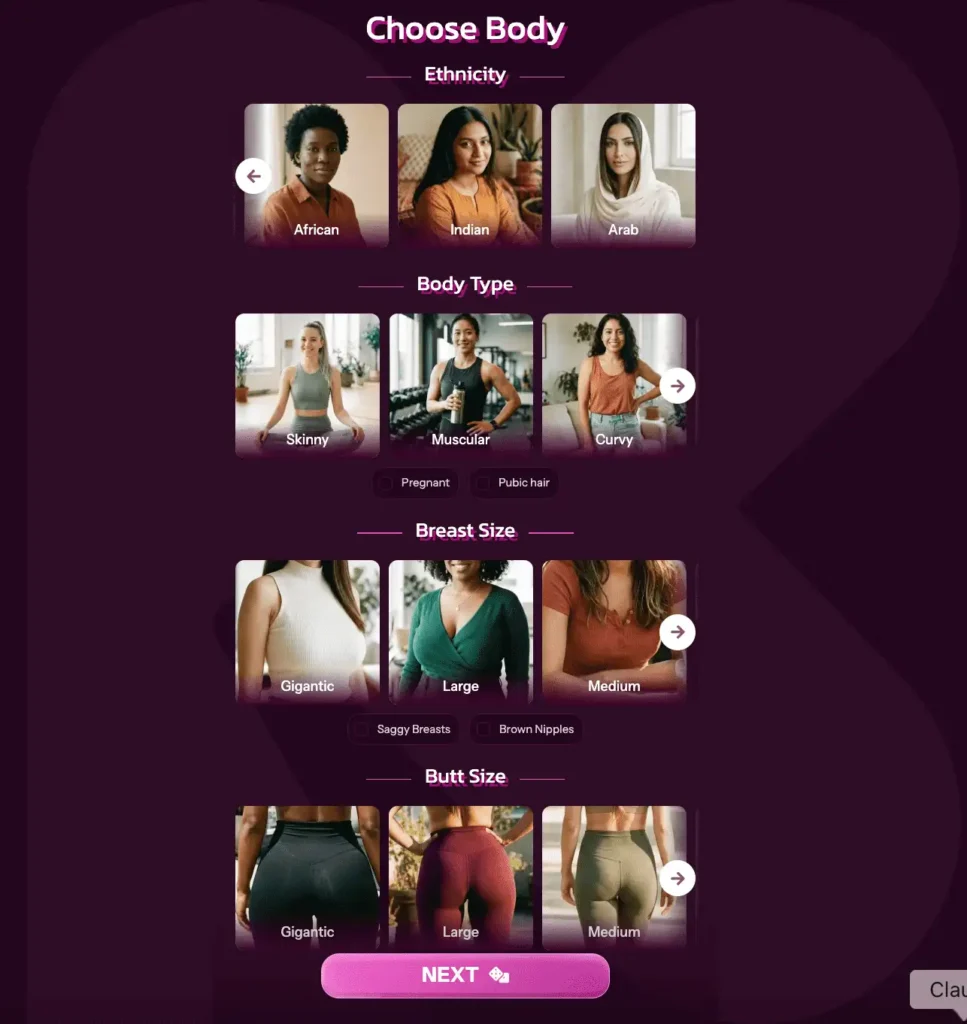
Step 2: Body customization. Ethnicity (African, Indian, Arab, and more), body type (Skinny, Muscular, Curvy), breast size, butt size, and a few optional extras like pubic hair and pregnancy. The screenshot grid makes each option visually clear rather than just a dropdown label.
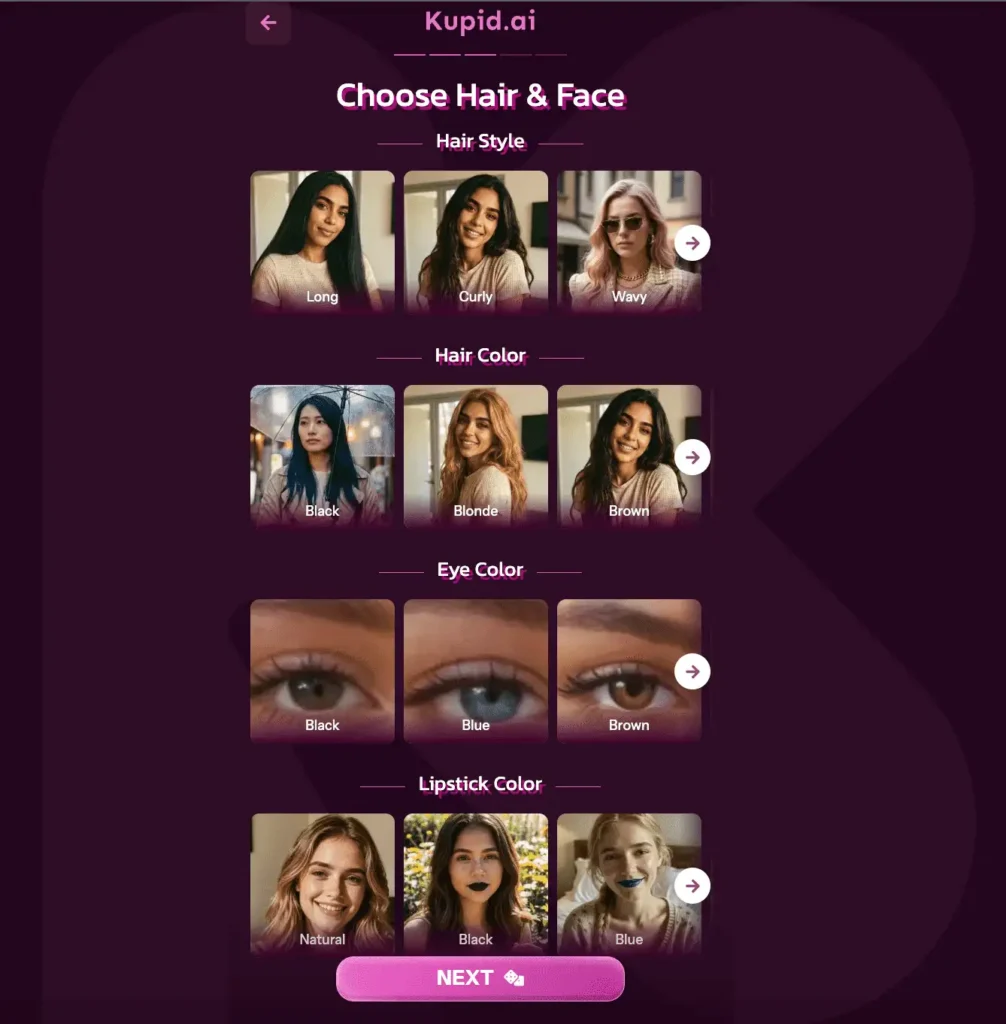
Step 3: Face and hair. Hair style (Long, Curly, Wavy), hair color, eye color, and lipstick color. Each with a preview photo. It’s genuinely nice that they show real visual examples rather than just text labels.
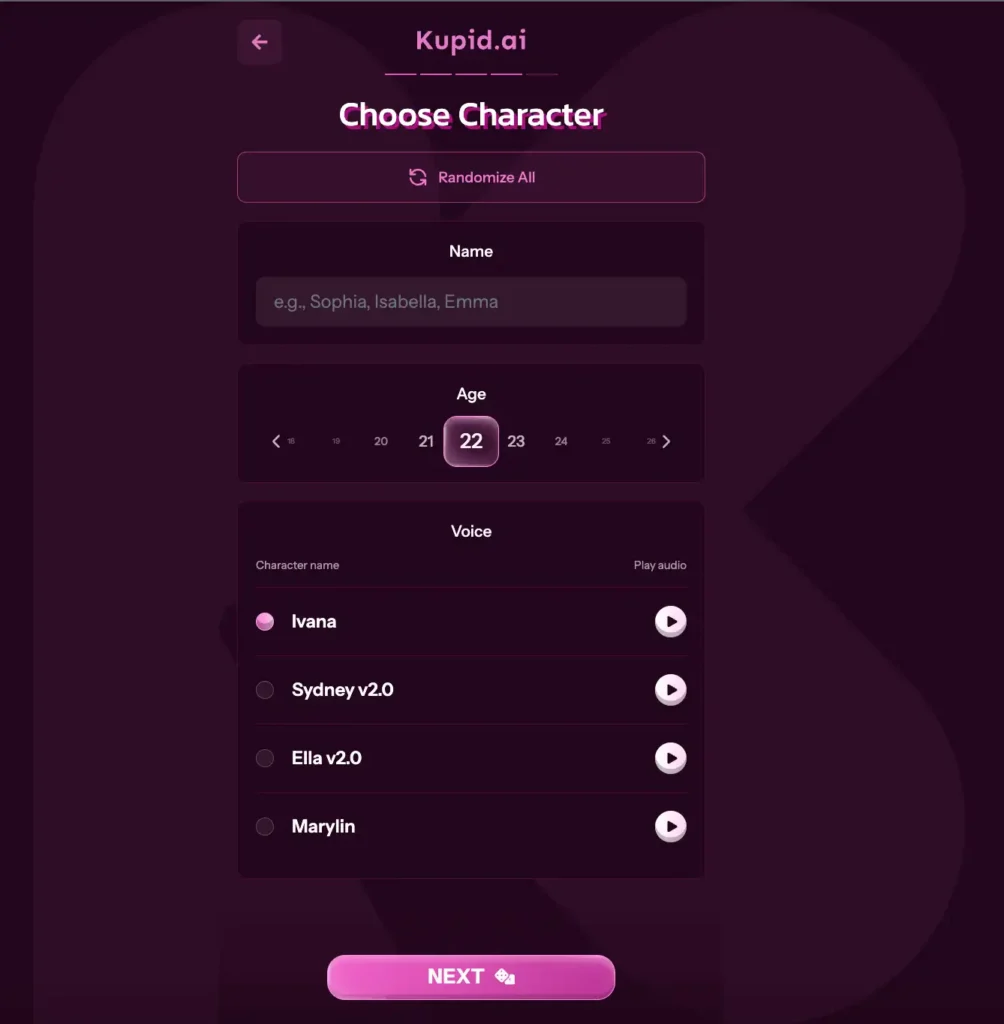
Step 4: Name, age, and voice. You type in a name, scroll through ages, and pick a voice. The voices available during my testing included Ivana, Sydney v2.0, Ella v2.0, and Marylin, with audio previews for each. That’s a small selection but the fact you can preview before picking is a nice touch.
Step 5: Personality. This is the deepest step. You choose from a list of personality traits:
- Personality traits: Sweet, Flirty, Shy, Playful, Seductive, Submissive, Sassy, and about a dozen more
- Job/occupation: Stripper, Doctor, Teacher, Porn Star, Maid, Social Media Influencer, plus a fully custom option
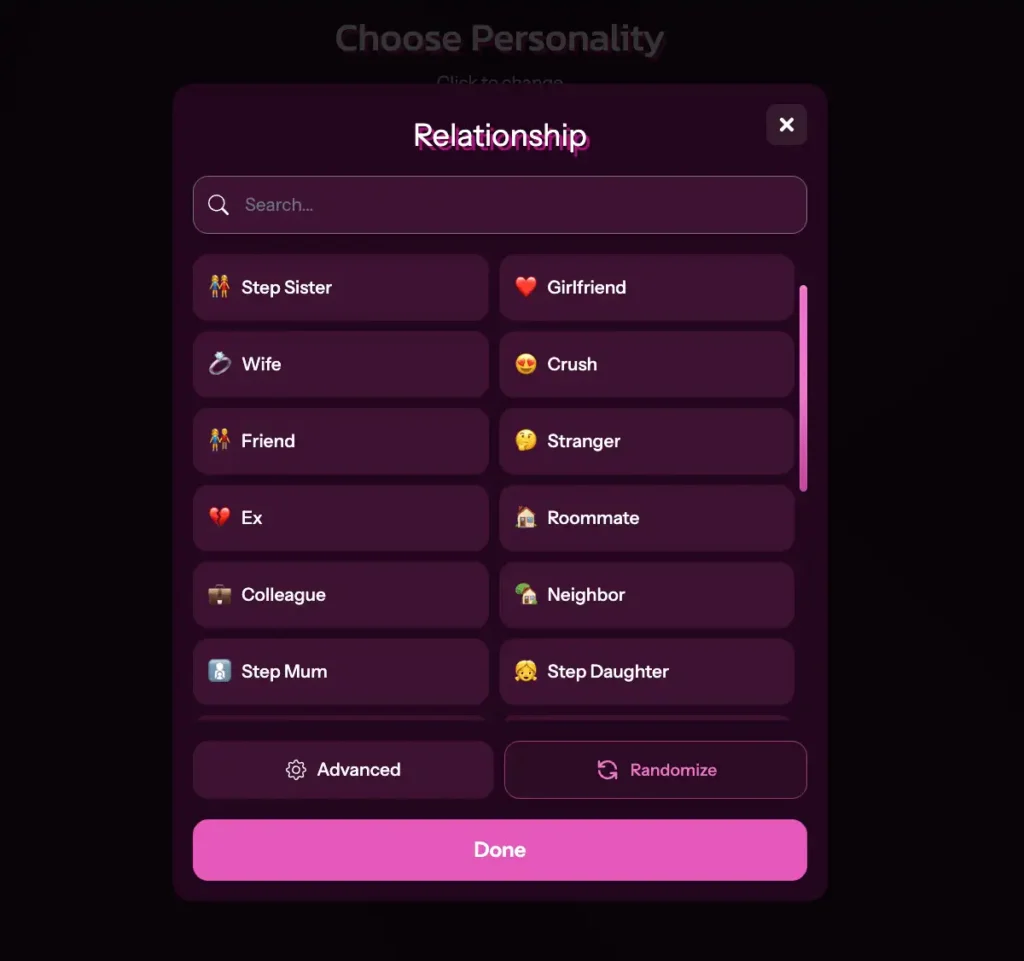
- Relationship type: Girlfriend, Wife, Step Sister, Step Mum, Ex, Roommate, Crush, Stranger, and more
- Kinks: Bondage, Femdom, Femsub, Exhibitionism, Praise Kink, Feet, Stockings, Uniforms, and plenty besides
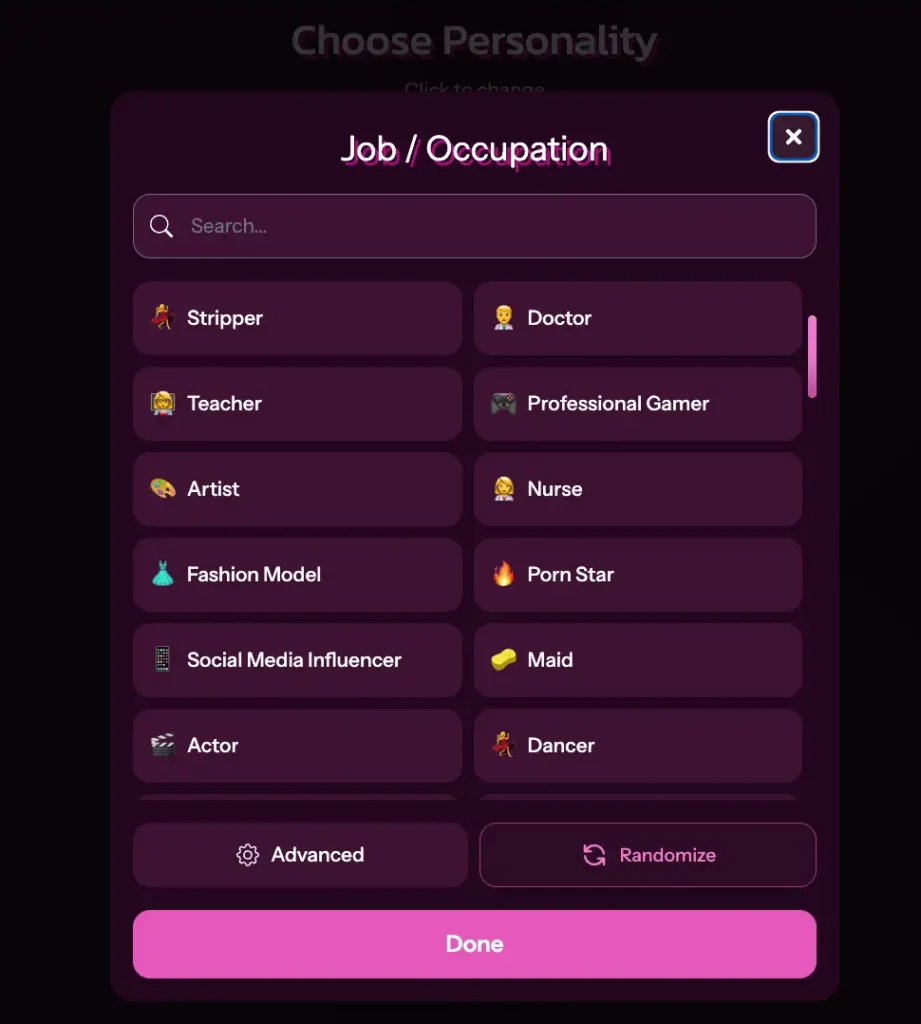
The number of combinations here is genuinely large. Your character won’t feel like a template someone else already has.
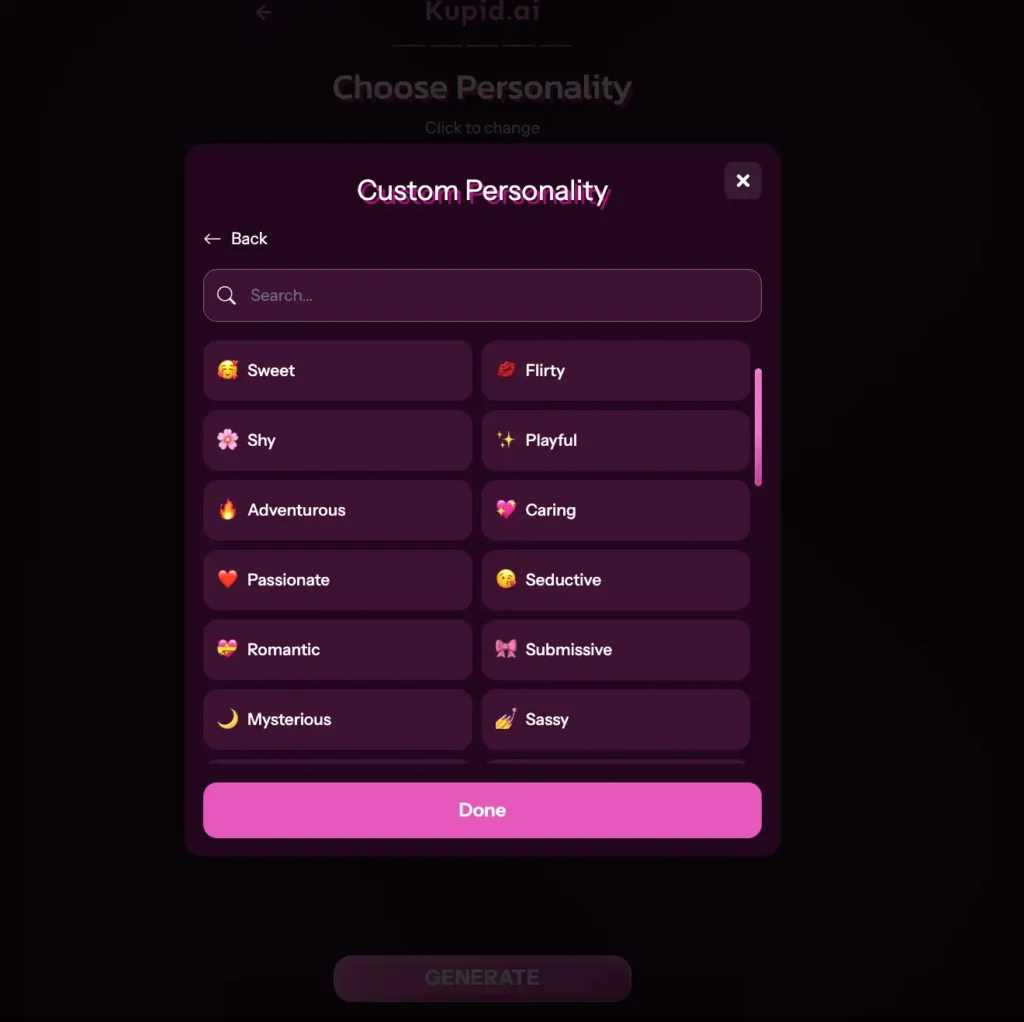
The depth here is real. The number of combinations you can make means your character doesn’t feel like a template someone else already has. After a few seconds of generation, your character is ready.
One catch: the moment your character is ready, a subscription popup drops with a countdown timer and an Easter discount. It’s dismissible, but it’s the first of what feels like a two-step upsell sequence that can get annoying fast. You can close it and go straight to the chat, which most people probably figure out, but it’s still a slightly sour end to an otherwise smooth creation flow.

The Chat Experience
Chat starts with a scenario. By default it’s auto-generated based on your character setup, but you can edit it or write your own from scratch. The scenario I got was genuinely well-written: full roleplay opening with sensory detail, dialogue, and a clear starting situation. It felt like the first message of a story, not a chatbot greeting.
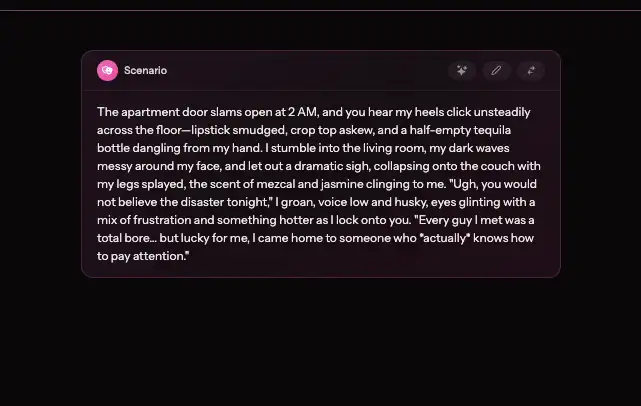
The chat itself uses roleplay action lines mixed with dialogue, formatted in the style you’d see in collaborative fiction writing. Action lines appear in asterisks or italics. Dialogue is direct. It’s more immersive than a straight message thread and clearly aimed at people who enjoy the creative writing angle of roleplay rather than just quick sexting.
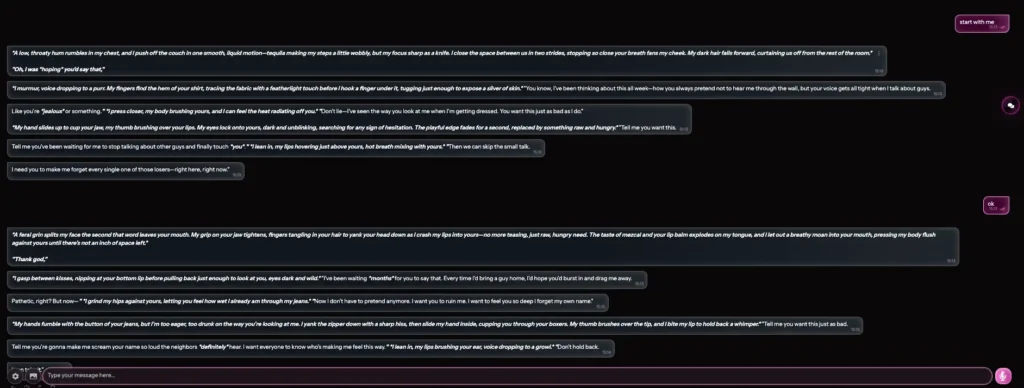
On the paid plan, a voice button lets you listen to messages with the character’s selected voice. The voice quality is one of Kupid’s stronger points according to most people who have paid for it: genuine emotional variance, not flat text-to-speech. Voice messages are also supported, so the character can send you audio.
There’s a small icon on the left side of the chat input that looks like it’s for attaching images but it’s actually the content request button. That’s how you ask for pictures from your character (paid only). The wording in the UI is a bit confusing at first glance, so worth knowing before you spend ten minutes looking for an attach button that doesn’t exist in the way you expect.
Overall the chat leans harder into roleplay and sexting than emotional companionship. If you’ve tested something like Kindroid or Soulmate AI and found them a bit too emotionally focused for what you want, Kupid’s vibe will probably suit you better.
Image Generation: Close But Not Quite There
The image generation on Kupid AI works well enough that it doesn’t get in the way, but it’s not something you’ll screenshot and show people. The realistic model in particular feels a bit behind where the industry is right now. Backgrounds can look like stock photos: perfectly lit, oddly generic rooms that don’t match the character’s vibe at all. The character itself usually comes out fine but occasionally you get the classic AI image failures: six fingers, plastic-looking skin, slightly uncanny proportions.

The anime model holds up better. It’s more consistent and the stylization covers a lot of the artifacts that make realistic generation look off. If you prefer anime characters, the image quality will bother you a lot less.
When you request images through the content button in chat, you’re mostly working with prompt-guided generation tied to your character. Results vary. Some come out exactly right, others need a retry or two, which eats through your coin allocation faster than you’d expect on lower-tier plans. The NSFW image generation is gated behind the paid plans entirely, so free users can’t really evaluate that side of things before committing.
Video generation exists but it’s still early. It’s not a feature you’d rely on regularly at this point, more of a nice-to-have that will probably get better over time.
The Stories Feature
There’s an Instagram stories-style element at the top of the screen once you’re logged in. Characters post images that show up in a horizontal scroll, and tapping one opens a fullscreen view with a message box at the bottom, exactly like a social media story.

It’s a small feature but it actually works quite well as an engagement hook. You land on the platform and there’s already something happening, your characters are “posting,” there’s a sense of activity rather than an empty chat list. It pulls you into a new conversation more naturally than just staring at a chat menu. The image quality in the stories tends to be better than what you’d get from the standard in-chat requests, which makes it an odd inconsistency but a pleasant one.
AI Boyfriend: Not an Afterthought
Kupid AI has an AI Boyfriend option aimed at women, which the notes in my research describe as “same, but targeted towards women.” That’s accurate at the feature level. Same creation flow, same customization depth, same chat structure. It’s not a separate product bolted on, it’s the same system with male characters.
This matters because a lot of platforms in this space treat female users as a secondary audience and it shows in the quality gap between the male and female character options. Kupid AI doesn’t have that problem. The boyfriend characters get the same level of visual detail and personality depth as the girlfriend options.
Pricing: What You’re Actually Paying
The pricing structure from my testing is as follows. The free tier exists and lets you chat, but it’s more of a demo than a usable long-term experience. Memory resets, no images, no voice. It’s enough to get a feel for the chat quality and the character creation, nothing more.
The Pro/Premium plan comes in around $13.99 per month at the standard rate, with significant discounts for annual billing that can push it down to roughly $7 per month. This gets you unlimited text messaging, a coin allowance for images (around 140 per month at this tier), 8 minutes of voice messages, and 48-hour chat memory.
The Ultimate plan runs around $49 per month, or closer to $24 per month on the annual plan. This bumps coins to 800 per month, extends voice messages to 45 minutes, improves memory depth, and generally removes most of the friction from the experience.
The lifetime plan exists at $777, which is worth considering if you’re a heavy user and plan to stick around long-term.
One thing worth flagging: the weekly billing option shown in the subscription popup looks cheap at first glance. It isn’t. The weekly rate works out to more than the monthly plan on an annual basis. The popup timer and the weekly price displayed prominently is one of those dark pattern-adjacent design choices that you should just skip past. Always go monthly or annual.
Kupid also promises no adult transactions showing on your bank statement, which is a practical consideration for some users.
Compared to something like HerAHaven, the pricing lands in a similar range, though what you get per tier differs enough that it’s worth comparing feature-by-feature depending on what you actually care about.
Who Is Kupid AI Actually For?
This is probably the most useful question to answer before you sign up.
Kupid AI clicks for people who want good-looking characters, actual depth in the customization, and a chat style that leans into creative roleplay and sexting rather than emotional journaling. The scenario-based chat opening, the action lines in the roleplay, and the kink/relationship customization all point in one direction. It’s for people who know what they want and want to configure it properly.
It’s probably not the right pick if you want deep emotional connection or long-term memory that actually holds. The 48-hour memory window on Premium is a real limitation for anyone building something that feels like a continuous relationship. For that use case, Nomi AI does a better job. And if the emotional companionship angle is your primary driver rather than the spicier stuff, it’s worth reading the Soulmate AI review before committing here.
But for roleplay-focused use, Kupid AI is genuinely one of the more complete options in its price range. The character creation alone puts it ahead of a lot of competitors who give you five dropdown menus and call it customization.
How Kupid AI Compares
Kupid AI vs DreamGF: DreamGF and Kupid AI are the two closest competitors in the visual-and-explicit lane. DreamGF wins on character builder depth — body type, face style, ethnicity, environment, and more — and its image generation actually stays consistent with the character you built. Kupid AI has a more generous free tier and slightly better voice quality on paid plans. If the builder matters most, DreamGF. If you want to chat before you commit, Kupid.
Kupid AI vs Brazzers AI: Brazzers AI leans on brand recognition and a pre-made cast of original fictional characters — no builder, no customisation. Kupid AI’s creation flow gives you far more control over appearance, personality, and kink preferences. Brazzers AI starts at $19.99/month with no free chat at all; Kupid’s free tier lets you actually try it first.
Kupid AI vs Anima AI: Anima is a different product entirely — conversational, warm, fully SFW, with one of the more generous free tiers in the category. Kupid AI is roleplay-forward and explicitly adult. They’re not really competing for the same user, but if you want to understand the emotional-companion end of the market before going explicit, Anima is worth the detour.
Final Take
Kupid AI is a solid platform that does most things well and a few things that could be better. The character creation is legitimately good. The free tier is honest about what you’re getting without being completely useless. The roleplay chat quality is above average. The voice on paid plans sounds more human than most competitors bother to make it.
The image generation has some catching up to do. The upsell popup after character creation is irritating every time. And if you want something that actually remembers your relationship long-term without paying for the top tier, you’ll hit walls.
At the $13.99 per month level it’s a reasonable choice. At $49 per month for Ultimate, the competition starts to look more compelling. The sweet spot is the annual Premium plan, which gets you the core experience at a price that doesn’t require much justification.
Worth trying on the free tier before deciding. The character creation alone gives you a decent read on whether the platform suits your taste.