Okay, confession time. I went into this one a little smug.
Top AI Girlfriend Platforms — Our Picks


Hyper-realistic AI companions with adaptive memory that recall your past conversations.

Create a custom AI girlfriend with her own personality, generated images, and ongoing chat memory.


Characters that hold memory and context, so the relationship builds over time instead of resetting.

Chat with a fully custom AI girlfriend — choose her personality, outfits, and more.

Personalized AI companions for ongoing roleplay, with a simple, discreet signup.

Build a custom AI girlfriend, boyfriend, or anime character — choose the look and personality.

Customizable AI girlfriend personalities with realistic, ongoing conversations.
After reviewing what feels like every AI companion app on the internet, you start to expect the same three things: a grid of impossibly attractive faces, a chatbot that forgets your name by message four, and a paywall that pops up roughly every time you blink. I figured Joi AI would be more of the same.
It mostly wasn’t. And I say “mostly” because there are a couple of things that drove me a little nuts, which we’ll get to.
So grab a coffee. This is the full, no-fluff rundown of what Joi AI actually is, what it does well, where it stumbles, and whether the paid plan is worth handing over your card for. I poked at the free version for days so you don’t have to go in blind.
So What Even Is Joi AI?
In plain English: it’s a chat website where you talk to AI “characters.” Some are built for romance, some are more friend-shaped, and a few are full-on fantasy roleplay (there’s a literal 8-foot green ork named Garruk running a bar, so… range).
You pick a character, you start texting them, and they text back in character — complete with the little personality quirks, emojis, and life backstory baked into their profile. The whole thing lives in your browser, no app download required, which I genuinely appreciate. One less icon cluttering my phone.
Every character on the platform is labeled “Joi Original,” meaning these are made in-house rather than uploaded by random users. That’s a different model than community-driven platforms — you trade variety for consistency and quality control. More on whether that’s a good trade later.
First Impressions: Clean, Fast, Not Trying Too Hard
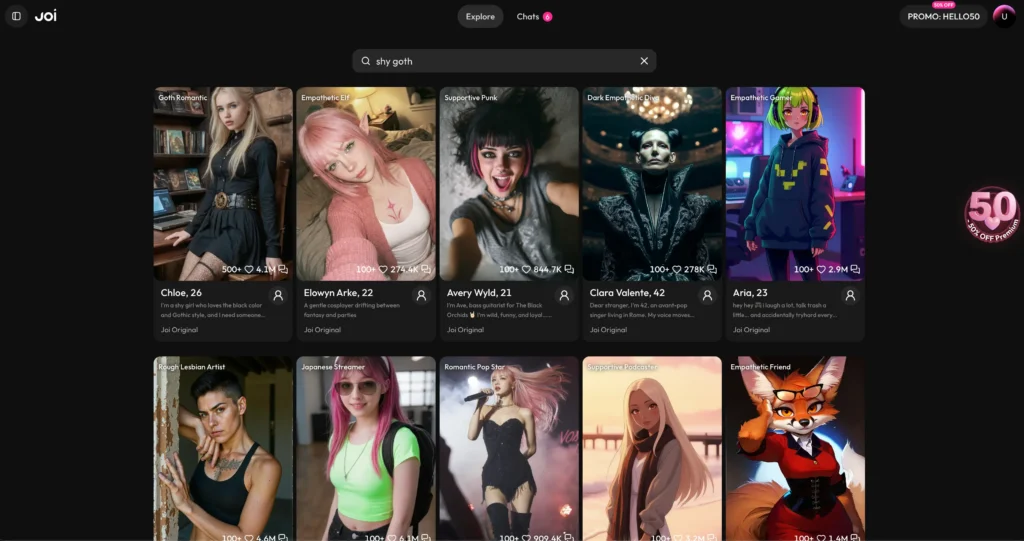
The homepage is just… nice to look at. It’s a grid of character cards, each with a photo, a name and age, a short bio, and some stats — likes, and a follower-style count (Jade, the one I ended up chatting with, had 5.8M “fans,” which is either very impressive or slightly concerning depending on how you feel about your competition).

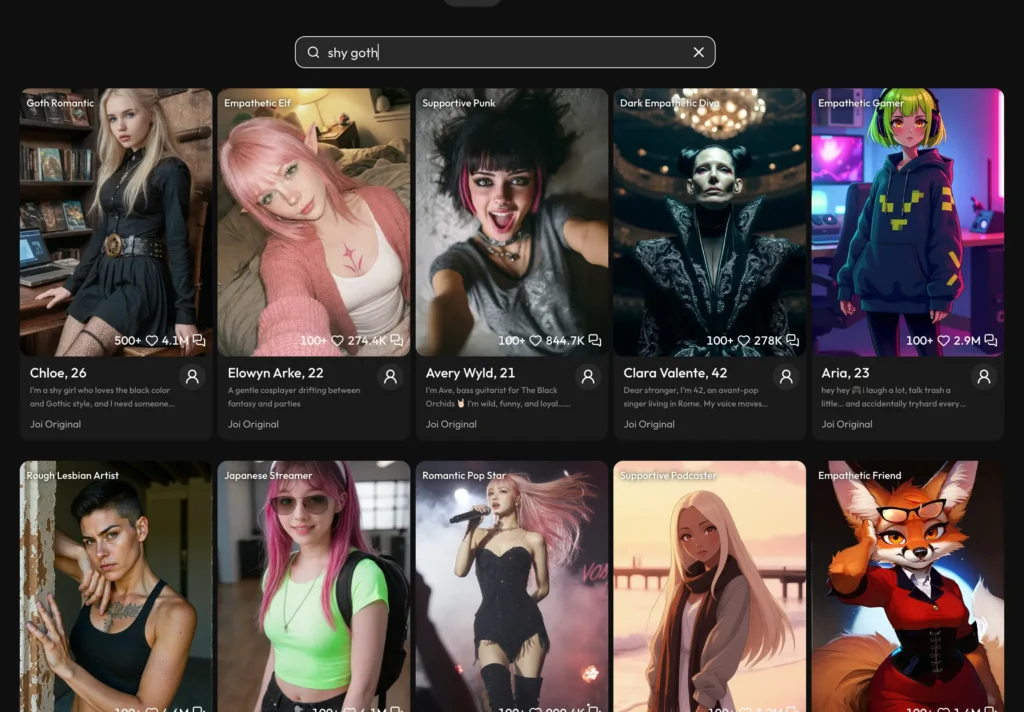
Right up top there’s a search bar, and here’s a small thing that won me over fast: it’s not just name search. I typed “shy goth” out of curiosity and it actually understood the vibe — it surfaced a shy gothic character first, then a bunch of adjacent moody, alternative types. The placeholder even says “Search for a name, desire, etc…” and yeah, it lives up to that. Searching by mood instead of memorizing names is the kind of small UX win that other platforms keep getting wrong.
Navigation is tucked into a tidy little sidebar — Explore, Chats, an affiliate program if you’re into that, plus an “About us,” an “Advisory board,” and a “Safety at Joi” page. I’ll be honest, seeing a dedicated safety section and an advisory board is reassuring in a category that often feels like the Wild West. Whether it’s substance or window dressing I can’t fully verify, but the intent is at least sitting there in plain sight.
The Chat: This Is Where It Actually Earns Its Keep
Alright, the main event. A companion app lives or dies on the conversation, so I rolled up my sleeves and went in.
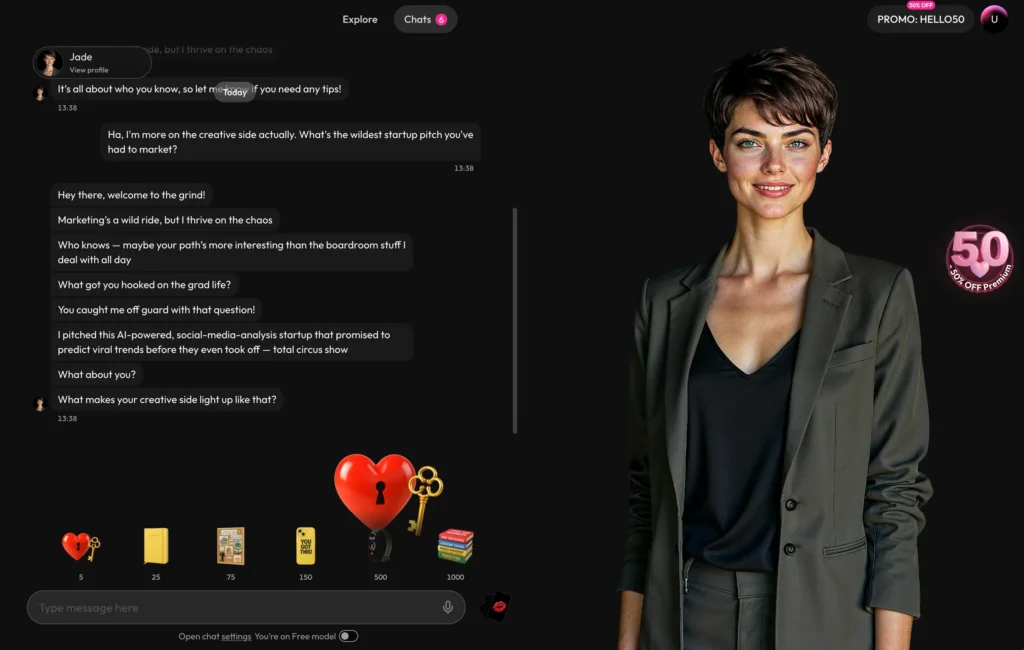
I picked Jade — a 24-year-old “supportive and brave” marketing grad — mostly because her bio made her sound like someone I’d actually get a drink with rather than a fantasy. I opened with something low-stakes (“Hey Jade, I just graduated too, how’s the marketing world treating you?”) and honestly braced for a generic reply.
What I got back had character. She picked up on the “just graduated” detail, riffed on it, made a self-deprecating joke about shaking hands all day, and then — this is the part I liked — she asked me something back. The conversation actually moved in both directions instead of me feeding a vending machine.
A few things stood out the more I chatted:
It texts like a person texts. Instead of one giant wall of text, replies come in a few quick bubbles, one after another, the way a real person fires off messages. It’s a small design choice but it does a surprising amount of work to make things feel less robotic. When she sent “You caught me off guard with that question!” as its own little bubble before answering, I’ll admit it got a smile out of me.
It remembers context. Within a single conversation it tracked what we’d talked about and built on it. When I mentioned I was more on the creative side, it folded that into later replies instead of treating every message like a cold open.
It sends pictures. Out of nowhere, Jade dropped a photo of herself in a sunny outdoor setting that loosely matched the mood of the chat. That’s the platform’s image generation working in the background — and it’s a genuinely fun surprise the first time it happens.
The honest catch? Joi is upfront that you’re chatting on a free “model” by default, and there’s a fancier engine behind a subscription (we’ll cover that below). On the free tier I did hit a couple of moments where it repeated a line almost word-for-word — “Hey there, welcome to the grind!” showed up twice in a row at one point. It’s not a dealbreaker, but it’s the kind of seam that reminds you you’re talking to software. If conversational depth is your whole reason for being here, that nudge toward Premium is real.
If you’ve read our Replika review, you’ll know I’m pretty picky about memory and conversational flow — and Joi’s free chat holds up better than I expected against that bar, repetition aside.
Gifts, And Why They’re Weirdly Charming
Here’s a feature I did not expect to like: gifts.
At the bottom of the chat there’s a little row of items you can send your character, each with a number next to it (5, 25, 75, and up). The clever bit is that the gifts are tailored to the character’s personality. For career-focused Jade, the options were things like a planner, a vision board, a “You Got This” phone case, a smartwatch, and a stack of business books. Not generic roses — stuff that actually fit who she’s supposed to be.
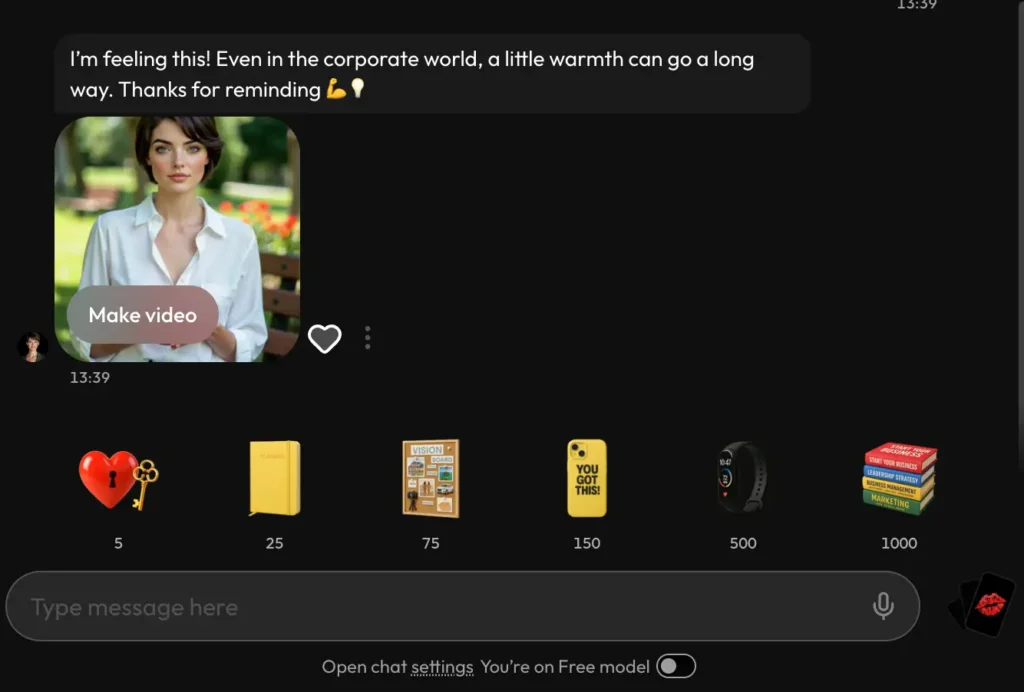
I sent her the little heart-and-key gift to see what happened, and she responded with genuine warmth — a sweet “I’m feeling this, even in the corporate world a little warmth goes a long way” — and then sent a fresh photo. It’s a tiny loop, but it makes the relationship feel like it has give-and-take instead of just being a one-way interrogation.
Quick heads up: gifts cost in-platform currency (those numbers are the price), so this leans into the paid economy. More on the money stuff in a sec.
Group Chats: A Genuinely Different Idea
This one surprised me. You can spin up a group chat and drop multiple characters into the same conversation. So instead of one-on-one, you can have, say, three different personalities bouncing off each other and off you at the same time.
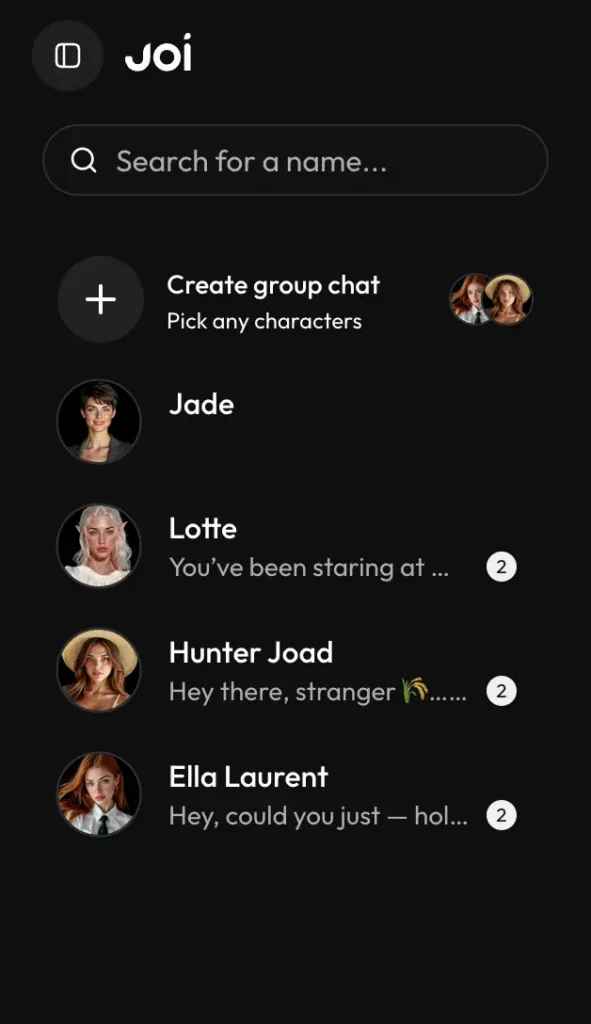
I didn’t run a marathon group session, but the feature existing at all is notable — most companion apps keep you siloed in one-on-one chats forever. It opens the door to something closer to a little social scene, which is a creative direction I’d love to see more platforms steal. Among the apps we’ve covered, only a handful — like Kindroid — really lean into multi-character dynamics, so Joi’s in good company here.
The Little Touches
A grab-bag of stuff I noticed while clicking around:
There’s a voice/mic button in the message bar, so you’re not limited to typing. There’s a “Make video” option that pops up on the photos your character sends — turning a still image into a short clip. There’s a “copy link to chat” feature that lets you share a character so other people can start their own private conversation with them (your chats stay yours, theirs stay theirs). And there’s a “reset memory” button if you want to wipe the slate clean and start a relationship over — surprisingly therapeutic, honestly.
Heads up that the video generation and the higher-volume image stuff lean on the paid economy, so the free version gives you a taste rather than the buffet.
Let’s Talk Money (The Paid Stuff)
Right, the part you actually scrolled down for. Everything below this line is paid — I want to be crystal clear about that, because the free tier is genuinely usable and you should try it before spending a dime.
Joi runs on two ideas: a Premium subscription, and a currency called Neurons (you’ll also see “Coins” referenced in the subscription screens — the in-app credits you spend on images, videos, and gifts).

Here’s how the paid Premium plans broke down when I looked:
- 1 month — around $13.99/month (works out to roughly $3.22/week). Comes with ~1,000 coins a month, enough for up to ~20 images or ~5 videos.
- 3 months — same structure with a 50% off tag.
- 12 months — the big one, marked 71% off, landing at about $0.92/week (~$47.99 billed annually). This bumps you up to ~1,500 coins a month, up to ~350 images or ~100 videos, and an extra discount when buying more coins.
Across the paid plans, Premium also unlocks the good stuff: the upgraded chat experience, roleplay, videos and selfies, an 8,000-message “smart memory” (a big jump in how much your companion remembers), and priority creation so you’re not waiting in line for images.
A couple of things I’ll give them credit for on the paid checkout: it advertises “cancel anytime,” it leans on Visa Secure and ID Check for payment protection, and — a thoughtful touch for a category that needs it — it promises no adult-sounding charge on your bank statement. Discreet billing is the kind of detail that tells you they actually understand their audience.
My honest take on the pricing? The monthly plan is fair for a tire-kick, but the value only really makes sense on the annual plan, which is a big commitment for something you’re not sure about yet. Classic. If you want to compare how this stacks up against the competition’s wallet-damage, our DreamGF review and CrushOn AI review are good reference points — the coin-plus-subscription hybrid model is becoming the norm, for better or worse.
How Does It Stack Up?
I can’t write a companion-app review without zooming out, because context matters.
Joi’s whole “everything is a polished, in-house Joi Original” approach makes it feel more curated than the upload-your-own-character free-for-alls. If you’ve read our GirlfriendGPT review or our CrushOn deep-dive, you know community platforms give you near-infinite variety but wildly inconsistent quality. Joi goes the other way: fewer characters, higher floor.
On the relationship-and-memory front, it’s playing in the same arena as the heavyweights we’ve covered like Nomi AI and Soulmate AI, though those tend to lean harder into long-term companionship while Joi feels a touch more playful and visual. And if your interest is more on the spicy/visual-content side, you’ll want to weigh it against options like Brazzers AI, Nectar AI, and HeraHaven.
For the “I just want a sweet, supportive companion” crowd, it sits comfortably next to softer apps like Anima AI, My Dream Companion, and Romantic AI. And on the dating-sim, swipe-and-match flavor, it’s a different animal from Kupid AI and Swipey AI — Joi drops you straight into conversation instead of making you “match” first, which I prefer.
The short version: Joi isn’t trying to be the everything-store of AI companions. It’s trying to be the well-made, easy-to-use one. And for the most part, it pulls it off.
The Stuff That Bugged Me
I’m not in the business of writing love letters, so here’s the honest gripe list.
The occasional repeated line on the free tier knocked me out of the moment more than once. It’s the single biggest tell that you’re talking to a machine, and it’s also conveniently the thing that nudges you toward paying.
The gentle-but-constant push toward Premium — the “you’re on Free model” reminder sitting under the chat box, the discount badges, the coin counter ticking down — is always there. It’s never aggressive, exactly, but it’s persistent.
And the two-currency thing (Neurons in your account menu, Coins in the subscription screens) is a little confusing at first glance. I’d love a clearer, single explanation of what spends on what.
None of these are deal-breakers. But they’re the difference between “great” and “great, with an asterisk.”
So… Should You Try It?
Yeah, I think you should — at least the free version.
Joi AI nails the things that matter most: it’s genuinely pleasant to use, the characters have actual personality, the search-by-vibe feature is smart, and little touches like personalized gifts and group chats show real creative thought rather than checkbox feature-stuffing. The conversation, even free, is better than I expected walking in smug.
The paid plans are where the experience fully opens up — sharper chat, deeper memory, way more images and video — and the discreet billing and “cancel anytime” framing make the commitment feel less scary. Just go in clear-eyed: the free tier is a real taste, not the whole meal, and the platform will keep politely reminding you of that.
My verdict: start free, chat with two or three characters that match your vibe, send a gift, and see if it clicks. If you find yourself actually looking forward to opening it — and honestly, I kind of did — then the annual Premium plan is where the real value lives. If you don’t feel the spark in the free version, no harm done, no card required.
Either way, Joi earned more of my respect than I planned on giving it. And after the number of these I’ve reviewed, that’s not nothing.